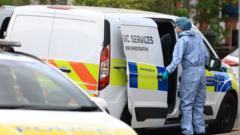
Police have launched an urgent manhunt after an attempted arson attack on a local synagogue, an incident that has sent shockwaves through the community and ignited a broader conversation about the surge in targeted religious violence. This was not a random act of vandalism. The suspect, captured on grainy surveillance footage, intentionally targeted a place of worship with an accelerant, a clear signal of premeditated hate. While the fire failed to take hold and no injuries were reported, the psychological impact is profound, marking a dangerous escalation in domestic tensions that law enforcement agencies are now struggling to contain.
Investigators are currently combing through forensic evidence and digital footprints to identify the individual responsible. The incident fits a disturbing pattern of rising antisemitic attacks that have moved from digital vitriol to physical confrontation. This is the reality of the current security climate. Small-scale attacks are often precursors to larger, more coordinated efforts if the perpetrators are not swiftly brought to justice and the underlying radicalization remains unaddressed.
The Anatomy of the Attack
The security footage reveals a chillingly methodical approach. In the early hours of the morning, a hooded figure approached the side entrance of the building. This was not a heat-of-the-moment decision. The suspect carried a pre-mixed flammable liquid, indicating a level of preparation that moves this crime from a simple misdemeanor to a serious felony involving domestic terrorism protocols.
First responders arrived within minutes, but the suspect had already vanished into the urban labyrinth. The fire department confirmed that the structural damage was minimal, largely due to the building's fire-resistant materials and a stroke of luck regarding the wind direction. However, the intent remains the focal point of the investigation. When someone tries to burn down a synagogue, they aren't just targeting bricks and mortar. They are attempting to incinerate the sense of safety and belonging of an entire demographic.
Law enforcement officials have increased patrols around religious institutions citywide. This reactive measure is necessary but underscores a systemic vulnerability. Security budgets for houses of worship are often stretched thin, relying on volunteer monitoring or outdated camera systems that provide limited help after the fact.
The Digital Pipeline of Radicalization
We cannot ignore the ecosystem that produces such actors. The path from an anonymous forum to a physical crime scene is shorter than it has ever been. Extremist ideologies are no longer confined to the fringes of the dark web; they have bled into mainstream social media platforms through coded language and aggressive recruitment tactics.
Law enforcement agencies often find themselves playing catch-up. Monitoring every potential threat is a logistical impossibility, especially when the transition from "online loudmouth" to "active threat" happens behind closed doors. The arsonist in this case likely didn't act in a vacuum. Most lone-wolf attackers are influenced by a steady diet of inflammatory content that devalues their targets and frames violence as a necessary or noble act.
This specific attack highlights a failure in preemptive intelligence. If the suspect was active in certain radical circles, there may have been "leakage"—threats or hints of action shared online before the event. Scouring these digital trails is now the priority for the multi-agency task force assigned to the case.
Hardening the Target
Many religious leaders are now forced to become security experts. It is a grim reality. Synagogues, mosques, and churches are traditionally open, welcoming spaces, but the current threat level demands a shift toward controlled access and professional surveillance.
- Reinforced Entry Points: Upgrading doors and windows to resist forced entry and incendiary devices.
- Enhanced Surveillance: Implementing high-definition cameras with night vision and off-site cloud storage.
- Community Watch Programs: Training congregants to identify and report suspicious behavior without escalating situations themselves.
While these measures are effective at deterring opportunistic criminals, a determined arsonist remains a difficult threat to neutralize entirely. The goal is to create enough friction to make the attack fail or to provide enough evidence to ensure a quick arrest.
A Failure of Social Cohesion
The manhunt is the immediate priority, but the broader issue is the fraying social fabric. When political rhetoric becomes increasingly polarized, it provides cover for those with violent tendencies to justify their actions. This is a cyclical problem. An attack occurs, the community feels marginalized, and the political discourse sharpens, which in turn fuels further resentment in extremist circles.
The silence from certain sectors of the public is also telling. In previous decades, an attempted arson on a house of worship would trigger a universal, bipartisan outcry. Today, such events are often filtered through a partisan lens, with people more interested in how the event fits their narrative than in the safety of the victims. This lack of a unified front emboldens attackers, who feel that their actions have silent supporters or that the consequences will be mitigated by political sympathy.
The Investigative Hurdles
Catching an arsonist is notoriously difficult. Fire often destroys the very evidence needed to secure a conviction. DNA, fingerprints, and even the chemical signatures of accelerants can be washed away by fire hoses or consumed by the flames. In this instance, because the fire failed to spread, the forensic team has a rare opportunity.
The police are looking for more than just a face. They are looking for a vehicle, a specific type of clothing, or a unique gait. They are also checking local hardware stores and gas stations for suspicious purchases made in the days leading up to the attack. This is the "grind" of investigative work. It is slow, tedious, and depends heavily on public cooperation.
The reward for information has been increased significantly. Money often loosens tongues in circles where loyalty is thin. The suspect might have bragged to an associate or shown signs of sudden agitation following the news coverage.
Why This Matters Beyond the Community
Some might view this as a localized incident, a "small" fire that didn't even burn. That perspective is a mistake. An attack on a synagogue is an attack on the principle of religious freedom. If one group is not safe to gather and pray, no group is truly safe.
The escalation from graffiti to arson is a critical threshold. It indicates a willingness to cause physical harm and death. Had the accelerant caught properly, this would be a murder investigation. The legal system must treat the attempt with the same severity as the completed act to provide any real deterrent.
The Strategy for Future Prevention
Waiting for an attack to happen and then launching a manhunt is a losing strategy. The shift must move toward proactive disruption. This involves better coordination between federal and local authorities to track known hate groups and intervene before they move to physical action.
It also requires a frank conversation about mental health and radicalization. Many of these perpetrators are vulnerable individuals who find a sense of purpose in extremist ideologies. Identifying these people before they are fully radicalized requires a community-based approach involving educators, mental health professionals, and local leaders.
The manhunt continues, with law enforcement scouring every lead. Every hour that passes without an arrest increases the risk that the suspect will attempt a second attack, perhaps with more effective methods. The community remains on high alert, a state of hyper-vigilance that is exhausting and unsustainable.
The focus must remain on the swift capture of the suspect to provide a sense of closure and to signal that such acts will not be tolerated. This isn't just about one man with a bottle of gasoline. It's about a society deciding where the line is and what it is willing to do to defend it.
Check your home security systems, report any suspicious vehicles parked near religious centers, and remain aware of your surroundings at all times.