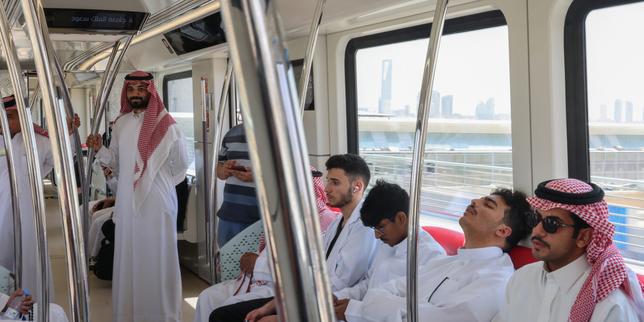
For decades, Riyadh functioned as a sprawling monument to the internal combustion engine. Urban planners treated the desert capital as a vast grid designed for the solitary driver, where walking was a risky endeavor and public transit was nonexistent. Today, that model is undergoing an aggressive correction. The newly operational Riyadh Metro, a 176-kilometer network spanning six lines and 85 stations, represents the most significant attempt in modern history to force a car-dependent megacity into the mold of a transit-oriented hub.
This is not merely a transport project. It is an engineering and social experiment on a scale that defies standard comparison.
The sheer ambition behind the project is visible in its architecture. Stations like the KAFD Metro Station, crafted by the late Zaha Hadid, function more as civic landmarks than mere transit stops. They incorporate solar energy, climate-controlled environments, and advanced signaling systems designed to support a fully driverless, automated fleet. The project aims to reduce daily car trips by a quarter-million, effectively stripping hundreds of thousands of liters of fuel from the city’s daily carbon footprint.
However, the hardware is only half the battle.
Critics of the project often focus on the $22.5 billion price tag or the logistical nightmare of burying rail lines beneath one of the world's fastest-growing cities. The real story, however, resides in the behavioral shift required to make the system viable. Riyadh residents have spent generations cultivating a culture of private vehicle ownership. Moving an entire population away from the convenience of door-to-door car travel requires more than just shiny trains and air-conditioned platforms. It demands a complete overhaul of the urban fabric.
The challenge of last-mile connectivity remains the silent threat to the project’s long-term utility. In many sectors, the distance between the metro station and the actual destination is a sprawling, sun-drenched expanse of asphalt. If a commuter can reach a station with ease but finds themselves stranded upon arrival, the entire system risks becoming an expensive, underutilized asset. Success will depend on the city's ability to integrate pedestrian pathways, micro-mobility solutions, and a feeder bus network that acts as the circulatory system for the main rail arteries.
Construction history reveals why this was so difficult to execute. Riyadh was built for the automobile; inserting a massive, high-capacity underground network into a city with no prior public transport foundation is akin to performing open-heart surgery on an athlete while they are mid-marathon. The coordination required between international consortia, local authorities, and the physical constraints of the existing road grid pushed engineering teams to adopt high-performance materials and specialized underground water management systems capable of withstanding the local heat and soil conditions.
The integration of solar power—aimed at offsetting roughly 20 percent of the network's energy demand—is a smart tactical move that aligns with wider national goals for efficiency. But the true test is whether the transit system can evolve into the city's nervous system.
There is an inherent risk in trusting a top-down infrastructure overhaul to dictate human behavior. In other global capitals, transit systems were allowed to grow organically alongside the population. Riyadh is attempting a forced pivot. It is an attempt to create a transit-oriented culture from scratch, in a climate that is fundamentally hostile to pedestrian movement for half the year.
The economic implications are equally layered. The project promised thousands of jobs and sparked a wave of secondary development around major intersections. If the ridership numbers match the aggressive projections—aiming for 1.2 million daily passengers—the city will see a reduction in congestion and an increase in real estate value around these transit hubs. Conversely, if the system fails to bridge the gap between "commuter" and "passenger," these stations will stand as isolated, if architecturally striking, monuments to a vision that the city was not quite ready to embrace.
History often forgets the early struggles of urban transit, remembering only the convenience of the finished result. The Riyadh Metro is currently in that vulnerable, early phase where the novelty has yet to transform into habit.
The transition is underway, but the infrastructure is only as effective as the final kilometer. Riyadh has spent billions to ensure that a train arrives on time. Whether the city can ensure a citizen is willing to walk to that train is the next, and far more difficult, chapter. The concrete is laid. The tracks are humming. Now, the capital must decide if it is truly ready to leave the driver’s seat behind.