History rarely looks like science fiction. When we picture the birth of rocketry, we imagine gleaming steel facilities, thousands of technicians, and countdown clocks echoing across Cape Canaveral. We don't picture a snowy potato patch in Auburn, Massachusetts, on a freezing March afternoon in 1926.
Robert Hutchings Goddard didn't care about cinematic grandeur. He cared about physics. While academic peers laughed at his ambitions of reaching the Moon, Goddard built a ten-foot-tall contraption of thin steel tubes, brass pipes, and bicycle parts in his aunt's barn. It looked ridiculous. It weighed barely ten pounds. Yet, on March 16, 1926, that clumsy metal frame changed human history forever. It was the world's first flight of a liquid-fueled rocket. Don't forget to check out our earlier coverage on this related article.
It didn't soar majestically into the stratosphere. It sputtered upward for about two and a half seconds, covered a miserable distance of 184 feet horizontally, reached a paltry altitude of 41 feet, and crashed unceremoniously into a cabbage field at roughly sixty miles per hour.
Most observers walked away unimpressed. The local newspapers ignored it. But Goddard knew what he had just witnessed. He had proven that liquid propellants—gasoline and liquid oxygen—could actually provide sustained, controllable thrust. The Wright brothers had their twelve seconds at Kitty Hawk; Goddard had his two seconds in a Massachusetts farm field. Both moments looked like failures to the casual bystander. Both moments birthed entirely new industries. To read more about the background here, CNET provides an in-depth breakdown.
The Man Who Refused to Look Up
Goddard was a quiet physics professor at Clark University. He spent his days teaching students and his nights sketching equations that his contemporaries dismissed as fantasy. Long before Sputnik or the Saturn V, he realized solid propellants were dead ends. You couldn't throttle them. You couldn't steer them effectively. Liquid fuels offered high energy density and precise control.
He faced an intellectual hostility that is hard to fathom today. In 1920, The New York Times published a scathing editorial mocking Goddard's assertion that a rocket could operate in a vacuum. The paper stated that Goddard lacked the knowledge taught daily in high schools—specifically, the idea that action needs something to push against, failing to understand Newton's third law in the vacuum of space. The editorial became a legendary blunder. Decades later, on the morning of the Apollo 11 launch, the newspaper issued a quiet retraction.
Goddard operated in near-total isolation. He funded his early work out of his own meager academic salary, supplemented by small grants from the Smithsonian Institution. He didn't have a PR team. He didn't have venture capital. He had a welding torch, an obsessive work ethic, and a stubborn refusal to accept the limits of Earth's gravity.
Inside the Barn Workshop
Building the 1926 rocket required an absurd level of mechanical ingenuity. Goddard faced a brutal engineering hurdle: how do you keep the combustion chamber from melting? Liquid oxygen and gasoline burn at thousands of degrees. Standard metals turn to liquid instantly under those conditions.
His solution was counterintuitive and brilliant. He placed the combustion chamber at the front of the rocket, near the payload, and fed the propellants down through long fuel lines to the nozzle at the bottom. This kept the hottest part of the engine away from the structural tanks and used the incoming fuel to cool the system slightly.
The machine was christened "Nell." It used gasoline as fuel and liquid oxygen as the oxidizer. Because liquid oxygen boils at an extreme negative temperature, the launch had to happen fast before the fuel lines froze solid or boiled away.
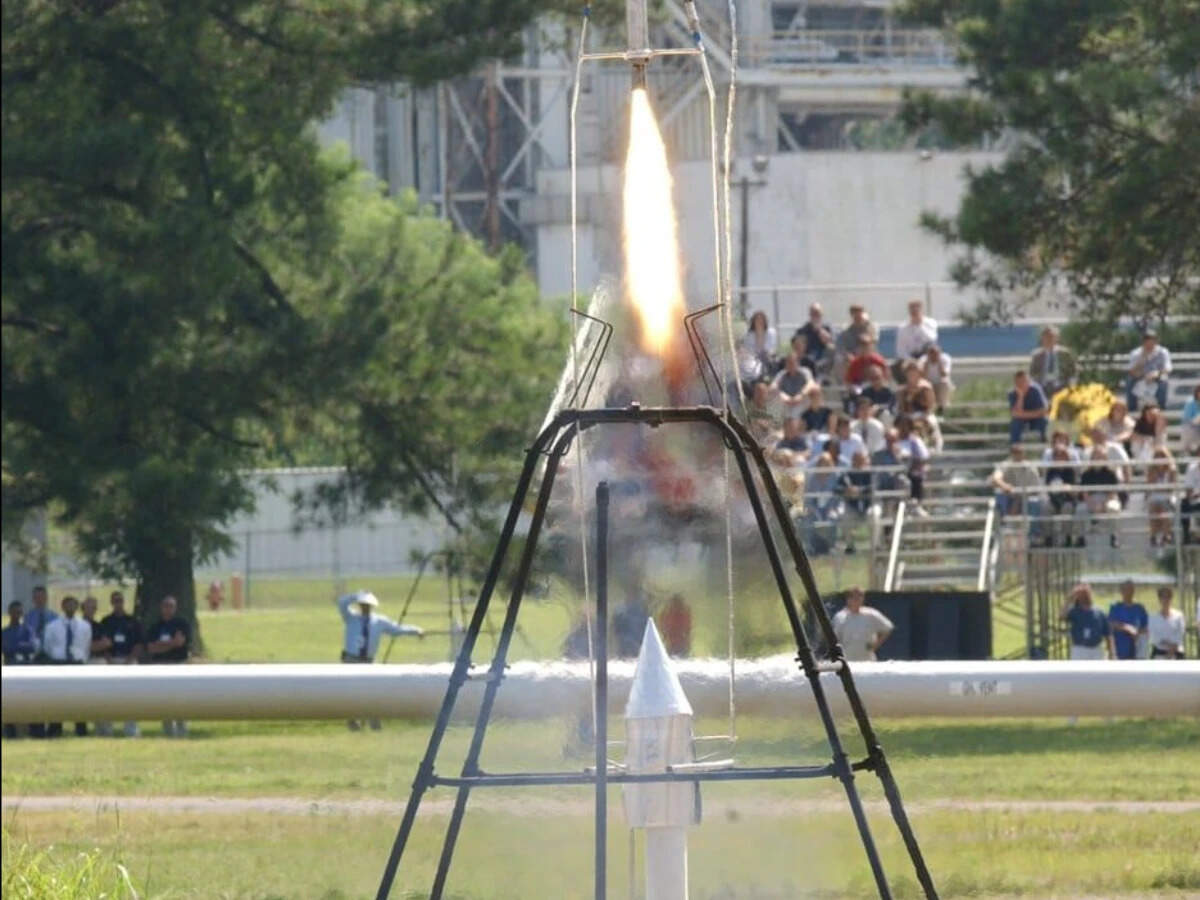
Think about the sheer danger involved. Goddard and his assistant, Esther Kisk (who would later become his wife), stood yards away from a bomb strapped to plumbing pipes. They didn't wear flame-retardant suits. They wore wool coats and flat caps. If a weld failed, the metal shrapnel would have shredded them. When Nell finally roared to life with a sound like a muffled roar, it hissed, wobbled, and lifted off a simple pipe frame that served as an improvised launch tower.
Surviving the Skeptics
After the 1926 flight, Goddard didn't rest. He kept building larger rockets. He moved his operations to a desolate ranch in Roswell, New Mexico, in 1930, escaping the cramped New England geography and local fire marshals who kept threatening to arrest him for disturbing the peace.
In New Mexico, his rockets grew. They reached heights of several thousand feet. They incorporated gyroscopic stabilization systems and steering vanes. He patented the basic designs for multistage rockets and rocket-propelled aircraft.
Yet, during World War II, American military leaders largely ignored his foundational work. They looked at his small-scale experiments and dismissed them as irrelevant compared to German developments. Wernher Braun and his team in Peenemünde studied Goddard's published papers closely. The German V-2 program drew heavily on concepts Goddard had patented years earlier. When American soldiers captured German rocket engineers after the war, the engineers reportedly asked, "Why are you interrogating us? Why didn't you just ask Dr. Goddard? He already did all of this."
History often ignores its true pioneers while celebrating the people who scale the mountain after the path has already been cut. Goddard died in 1945, decades before humanity set foot on the Moon. He never saw his theoretical foundations turn into orbital spacecraft.
Why the First Flight Still Matters
We live in an era where reusable boosters land themselves on floating barges and billionaires launch private citizens into orbit for weekend getaways. It is easy to look at a ten-foot metal pipe rising forty-one feet into the Massachusetts air and laugh.
Don't.
That tiny flight proved that humanity was no longer bound by muscle, wind, or steam. It proved that controlled chemical combustion could push an object off the surface of this planet. Every satellite circling the globe today, every deep-space probe mapping the outer solar system, and every astronaut floating in the International Space Station traces its lineage directly back to that freezing March day in Auburn.
Innovation doesn't start in boardrooms. It starts with a lonely individual willing to look foolish in front of his neighbors, welding scrap metal together in a barn because he refuses to accept that Earth is our permanent ceiling.