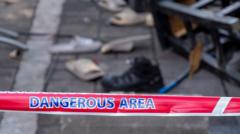
The outrage machine has a predictable playbook. Whenever a nightlife venue in Southeast Asia goes up in flames, the international media rushes in with the same tired, hand-wringing narrative. They blame corrupt local officials. They point fingers at lax building codes. They ask, with a mix of condescension and despair, "Will anything ever change?"
This lazy consensus is not just wrong; it actively stalls real progress.
The assumption that writing stricter laws or launching flashy "crackdowns" will suddenly make venues safe is a fantasy. It ignores the fundamental economic forces that dictate how cities actually develop. If you want to understand why tragedies like the Mountain B&B fire or the Santika Club blaze happen, you have to stop looking at safety as a moral failure and start looking at it as an economic calculation.
The Illusion of the Regulatory Fix
Every pundit calling for "stricter enforcement" misses a glaring reality. Thailand does not have a shortage of regulations. The Building Control Act and the Fire Prevention Technology standards on the books are already highly detailed. The issue is not the absence of rules; it is the cost of compliance in a high-inflation, low-margin industry.
To make a venue truly fire-safe under modern international standards, an operator must invest heavily in:
- Flame-retardant acoustic paneling (which costs up to ten times more than cheap, flammable polyurethane foam).
- Dual-source emergency power systems for lighted exit signs.
- Certified fire suppression sprinklers integrated into municipal water lines.
For a mid-sized venue in a nightlife district like Ekkamai or RCA, retrofitting an older building to meet these standards can easily exceed several million Baht. In an industry where the average venue lifecycle is less than three years and margins are razor-thin, those upfront capital expenditures are a death sentence for a business.
When you make compliance financially impossible for the average operator, you do not get safer bars. You get underground bars. You get operators bribing inspectors just to stay afloat because the alternative is immediate bankruptcy. Corruption in municipal inspections is not a cultural defect; it is a market-driven coping mechanism for over-regulation.
Why "Awareness" is a Useless Metric
Well-meaning NGOs love to talk about "raising awareness" and training staff. Let's dismantle this premise.
Imagine a scenario where a young, underpaid bartender is fully aware of the exit locations and the fire hazard of indoor pyrotechnics. On a crowded Friday night, when a spark hits the ceiling, that awareness does not override physics. If the emergency exit is locked from the outside to prevent patrons from slipping out without paying, or if the main door is a bottleneck designed to control crowd capacity, training is useless.
Safety is a structural and financial reality, not a state of mind.
[Typical Regulatory Cycle: Disaster -> Public Outrage -> Crackdown & Fines -> Increased Bribery -> Status Quo]
Instead of trying to educate operators into poverty, the conversation must shift to reducing the cost of compliance. If safety equipment and fire-rated materials were heavily subsidized or exempted from import tariffs, the financial incentive to cut corners would drop dramatically.
The Hard Truth of Consumer Choice
Here is the perspective nobody wants to admit: the market gets the level of safety it is willing to pay for.
Tourists and locals alike flock to crowded, dimly lit venues because they want atmosphere, cheap drinks, and high energy. The very elements that make a venue exciting—darkness, enclosed spaces, loud music, dense crowds—are the exact elements that make it a death trap during an emergency.
If consumers demanded certified fire safety ratings before entering a club, operators would display them proudly next to their hygiene ratings. But they don't. The average patron prioritizes the price of a beer over the presence of an outward-opening fire door. Expecting businesses to invest in invisible safety features that consumers refuse to premium-price is economic illiteracy.
Dismantling the "Fix the System" Myth
People frequently ask: Why can't Bangkok just adopt Western-style safety enforcement?
The premise of this question is deeply flawed. It assumes that enforcement mechanisms can be copy-pasted from wealthy Western capitals into developing megacities without accounting for local economic realities.
In high-income countries, property values are astronomical, and insurance companies act as the de facto regulators. If a club in London or New York is not up to code, insurers will refuse to cover it, or the premiums will be so high the business cannot operate. The system relies on a deep, highly capitalized insurance market.
In emerging markets, the commercial insurance sector does not have that kind of leverage. Many small-to-medium venues operate entirely without comprehensive liability insurance because the legal system does not hand out multi-million dollar civil payouts that would make such insurance mandatory. Without the pressure of insurance underwriters, municipal inspectors are the only line of defense—and they are highly susceptible to the economic realities of their local environments.
The Real Path to Safety is Unfashionable
If you want to stop deadly fires, stop demanding symbolic police raids and start looking at urban planning and tax codes.
- Deregulate the zoning to allow open-air venues. Enclosed, soundproofed "black box" clubs are inherently more dangerous. Yet, noise pollution laws and zoning restrictions often force operators into sealed, indoor concrete bunkers. Relaxing noise ordinances in designated entertainment zones would allow more semi-open-air venues, which naturally reduce smoke inhalation risks during a fire.
- Eliminate tariffs on fire-retardant materials. If importing high-quality acoustic foam and fire-rated drywall did not carry massive import duties, the cost gap between safe and lethal construction would shrink.
- Tie business registration to utility capacity. Instead of relying on human inspectors to check if a club is overcrowded, monitor real-time electricity and water usage peaks. If a venue consistently operates beyond its physical design limits, the utilities themselves can trigger automated regulatory audits.
The cycle of tragedy, outrage, and ineffective crackdowns will continue as long as we treat safety as a moral crusade rather than an engineering and economic challenge. Stop asking if the culture will change. Start asking when the financial incentives will.