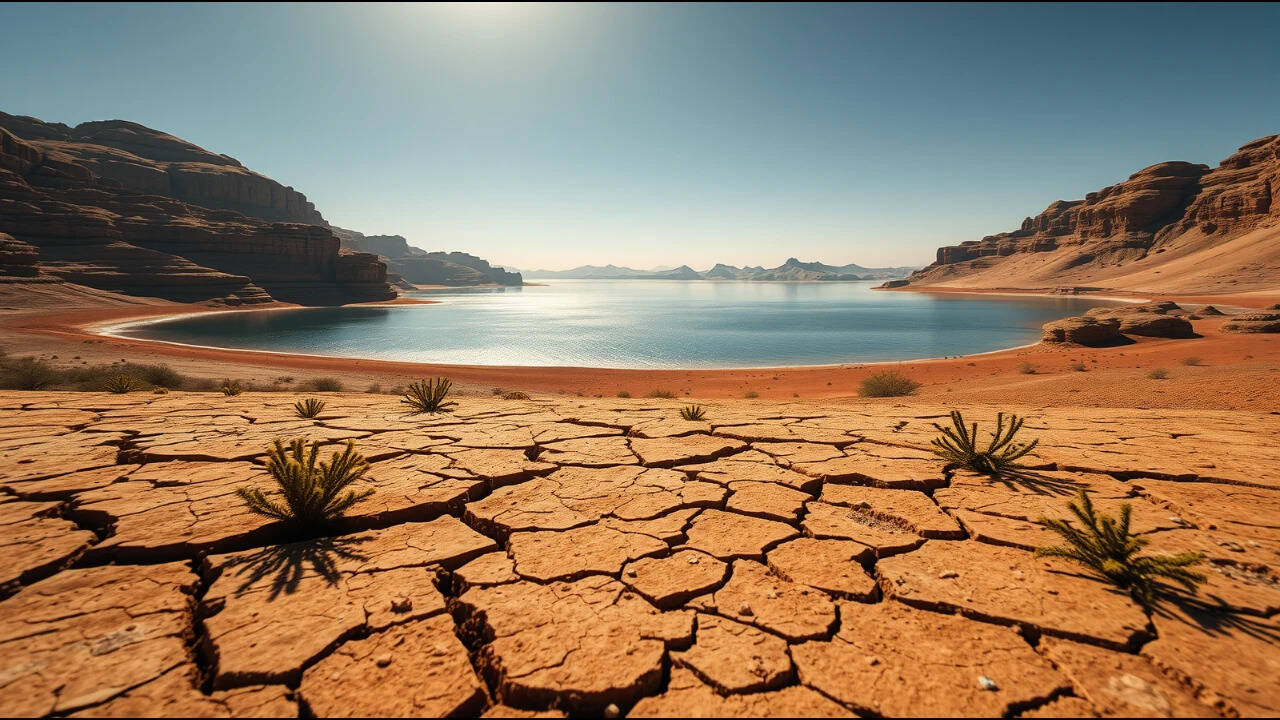
Six thousand years ago, the heart of North Africa looked nothing like the sun-scorched expanse we recognize today. Where endless dunes and dry basins now stretch toward the horizon, a massive inland sea dominated the region. Paleolake Mega-Chad, a body of water reaching upwards of 361,000 square kilometers, held significantly more surface area than all five North American Great Lakes combined. It was not merely a puddle or a transient oasis. It was an ecosystem of continental proportions, a liquid heartbeat that sustained human migration and biodiversity across what is now the most unforgiving terrain on the planet.
The existence of this ancient water body rests on geological fingerprints left behind long after the water retreated. Researchers have utilized optically stimulated luminescence to date sediment samples, tracing the timing of the African Humid Period. This era, which stretched roughly from 15,000 to 5,000 years ago, transformed the Sahara into a vibrant mosaic of rivers, wetlands, and sprawling lakes. The evidence is written in the earth. Ancient shorelines ring the Chad Basin like marks on a bathtub, documenting a time when the West African monsoon was powerful enough to pull moisture deep into the Saharan interior.
Why did this occur? The primary driver was orbital precession. Changes in the way the Earth tilted and wobbled altered the seasonal distribution of sunlight, cranking up the heat over North Africa during the summer months. This thermal engine strengthened the West African monsoon, dragging rain clouds thousands of miles north of their current limits. This was a climate feedback loop. Increased vegetation and soil moisture further amplified the monsoon, trapping the humidity and maintaining a self-sustaining cycle of rainfall that lasted for millennia.
The disappearance of this immense lake provides a sobering study in how rapidly nature can reset its terms. Roughly 5,000 years ago, the moisture faucet effectively turned off. The transition from a lush, humid corridor to an arid desert happened in a geological blink of an eye. Some scientists argue this shift was nonlinear, a sudden collapse rather than a slow decline. As the rains failed, the water evaporated, leaving behind a stark, salt-crusted basin. Today, the Bodélé Depression, a site once buried under the depths of this ancient lake, acts as the world’s most prolific source of airborne mineral dust. These particles are picked up by prevailing winds and carried across the Atlantic, serving as a critical nutrient source for the Amazon rainforest. In a strange twist of planetary debt, the ghost of a dead Saharan sea now fertilizes the lungs of the world.
We often view deserts as eternal, unchanging voids. This mindset is a failure of perspective. The Sahara is a young, volatile feature of our world. Humans lived, hunted, and migrated across a region that was once a paradise of freshwater, only to witness its drying firsthand as their livelihoods withered along with the receding shoreline. The archaeological record shows that ancient populations were forced to abandon these settlements, essentially carving out the path for the modern desert-dwelling cultures that followed.
Looking at the map today, it is difficult to fathom the scale of what was lost. Lake Chad, the modern remnant of this colossal system, is a ghost of its former self, currently struggling under the combined pressures of localized consumption, deforestation, and a changing climate. It is a shallow, fragile echo, occupying a tiny fraction of the footprint held by its ancestor. Understanding the past existence of Mega-Chad forces a confrontation with the instability of our current environment. We exist in a brief interval of relative climate status, yet the geological history of the Chad Basin serves as a reminder that the environment can fundamentally reorder itself within a few hundred years.
The obsession with these ancient waters is not just about nostalgia for a greener Sahara. It is a fundamental investigation into the sensitivity of our regional climate systems. When researchers analyze the sedimentary deposits, they are not just counting shells or mapping old beaches. They are decoding the triggers for monumental shifts in global weather patterns. If the African monsoon can collapse, it serves as a warning for how sensitive other regional climate drivers might be to small changes in orbital or atmospheric forcing.
We remain anchored to the idea that the earth under our feet is a constant. The story of Mega-Chad tells us that the ground is merely a canvas for the weather to paint on. We are currently walking through a period of extreme dryness that is, in the long view of the Quaternary period, an outlier. The water is gone, but the basin remembers. It sits waiting for the next shift in the orbital cycle, a dormant giant that once held the world’s largest freshwater reservoir, now reduced to the fine, wind-blown dust that shapes our modern global climate. The landscape does not lie. It simply waits for the next cycle to begin.