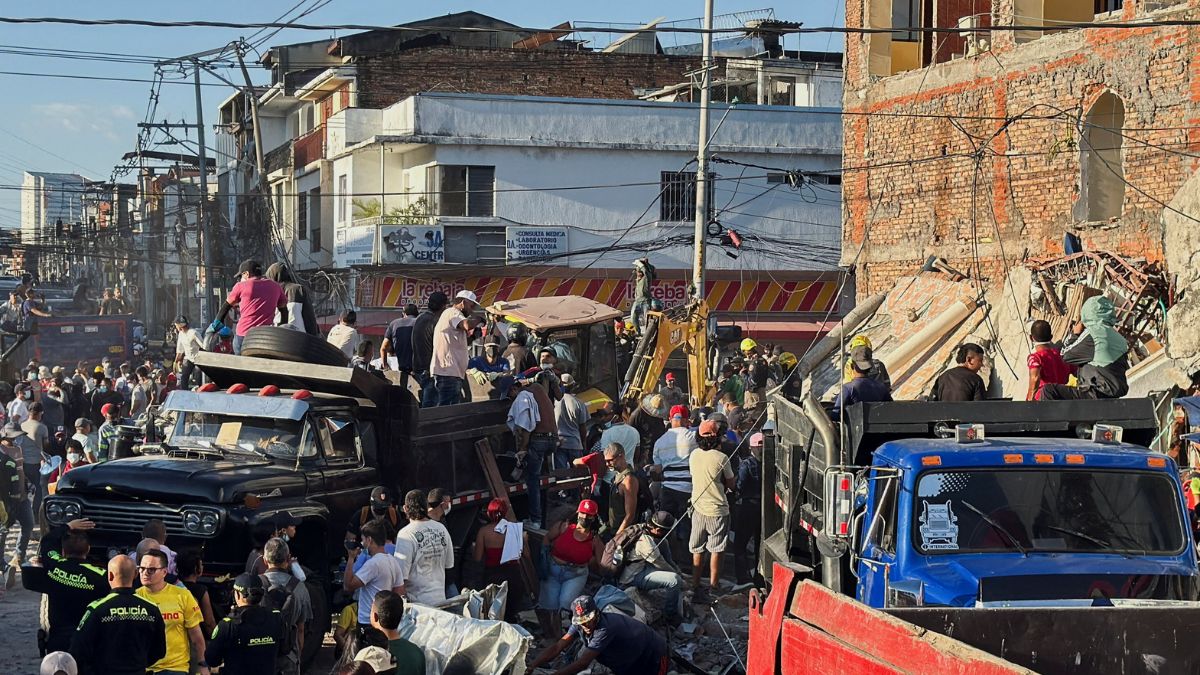
The magnitude 7.4 earthquake that struck western Colombia with an epicenter near San José del Palmar in the Chocó department violated common intuitive assumptions regarding seismic damage distribution. Surface observations confirmed that heavy structural degradation and widespread panic occurred hundreds of kilometers away in major urban centers like Cali, Pereira, and Bogotá, while the immediate surface area above the rupture experienced lower peak ground acceleration than standard shallow-focus models predict. Deconstructing this phenomenon requires analyzing the mechanical interaction between focal depth, wave attenuation physics, and the complex triple-plate tectonic architecture of the northern Andes.
The Mechanics of Intermediate Depth Wave Propagation
To understand why surface perception spans a multi-departmental radius, the operational physics of seismic energy release must be separated from surface distance metrics. The hypocenter of the Chocó event was recorded by the United States Geological Survey and the Colombian Geological Service at an intermediate-to-deep focal depth ranging between 96 and 107 kilometers.
When an earthquake originates at shallow depths under 15 kilometers, the energy release is concentrated directly below the epicentral footprint. This produces severe local peak ground acceleration, steep spatial attenuation gradients, and intense near-field destruction that drops off sharply over distance.
Conversely, an intermediate-depth rupture alters the geometric spread of body waves. Seismic energy radiates outward from a deep focus in an expanding spherical or conical wavefront. As these waves travel upward through the lithosphere toward the surface, they undergo geometric spreading over a larger volume of rock before breaking through the crust.
- Higher Residual Energy at Distance: Because the initial energy distribution vector points upward and outward through dense crustal layers at steep angles, the attenuation rate per kilometer is lower over regional distances.
- Broad-Area Synchronicity: Wavefronts arrive across a wide geographical arc almost simultaneously, causing millions of residents across multiple departments to perceive heavy shaking without a single isolated hyper-destructive epicenter point.
Tectonic Convergence and the Northern Andes Stress Regime
The regional stress environment dictates the magnitude and frequency characteristics of seismic events in western South America. Colombia sits atop a volatile tectonic intersection defined by the convergence of three distinct plates:
- The Nazca Plate: An oceanic plate subducting eastward beneath the South American continent at a high convergence rate.
- The Caribbean Plate: Interacting along the northern margin with complex strike-slip and oblique subduction vectors.
- The South American Plate: A continental mass moving westward, overriding the subducting oceanic lithosphere.
The Chocó event occurred within this active subduction zone where the downgoing slab interacts with the overriding continental crust of the Cordillera Occidental. The strain accumulation within this deep Wadati-Benioff zone builds until the shear stress exceeds the frictional resistance of the fault plane, resulting in a sudden brittle failure. Because the rupture took place deep inside the subducting slab rather than the fragile upper crust, the fault plane mechanics favored a high-magnitude energy release without immediate surface fault rupture.
Soil Amplification and Urban Vulnerability Vectors
While deep focus explains the broad geographic footprint of the shockwave, the localized pockets of severe structural failure observed in cities like Cali and Pereira are governed by local site effects. Seismic waves traveling through bedrock lose high-frequency components but retain long-period energy. When these long-period waves encounter deep sedimentary basins, alluvial valleys, or soft soil deposits, a mechanical transfer occurs.
- Impedance Contrast: Seismic waves transition from dense, high-velocity rock formations into loose, unconsolidated basin sediments.
- Velocity Reduction and Amplitude Gain: As wave velocity drops upon entering soft soil, the wave amplitude increases proportionally to conserve energy. This traps and amplifies the shaking motion.
- Resonance Frequency Matching: Multi-story urban buildings matching the natural frequency of these amplified basin waves experience resonant buildup, leading to structural failures even at distances exceeding 300 kilometers from the source.
Strategic Operational Recommendations for Regional Infrastructure Resilience
- Recalibrate Regional Building Codes Based on Deep-Focus Risk: Standard seismic zoning often penalizes proximity to active surface faults while underestimating regional vulnerability to deep slab events. Codes across the Coffee Axis and Valle del Cauca must integrate long-period basin amplification factors into structural design mandates.
- Prioritize Lifeline Infrastructure Hardening: Hospitals, emergency command posts, and transit hubs located on soft alluvial fill must undergo immediate structural retrofitting using isolation bearings to decouple building foundations from low-frequency amplification waves.
- Deploy Dense Real-Time Strong-Motion Accelerometer Networks: Expand sensor coverage across the Cordillera Occidental to capture real-time shear-wave velocity data, allowing automated early-warning systems to shut down critical industrial pipelines and transit networks milliseconds before destructive surface waves arrive.


