You remember the crackers your grandmother bought. They came in a box lined with wax paper, smelling faintly of cardboard and salt. When you bit into one, it didn't shatter with an aggressive, cinematic crunch. It yielded. It dissolved. It tasted like wheat and time.
Now open a bag of chips purchased this morning. In related updates, take a look at: Why Blaming Yankee Stadium For Legionnaires Disease Ignores How Urban Infrastructure Actually Works.
The sound it makes when you tear the foil is louder, engineered to catch your attention from across a quiet kitchen. The first bite produces a high-frequency fracture, a sharp acoustic snap that registers in your jawbone before your tongue even registers the salt. It feels fresh. It feels alive. It feels explosive.
It is also entirely intentional. Medical News Today has analyzed this important topic in extensive detail.
Meet Sarah. Sarah is sitting at her kitchen island at 9:00 PM, illuminated only by the cold blue glow of her smartphone. She is not particularly hungry. She ate a substantial dinner an hour ago. Yet, her hand wanders instinctively toward a tall, cylindrical package of potato crisps. She pulls one out. Crunch. She pulls another. Crunch.
Before she realizes it, the bottom of the container is visible, and she is left with a fine dusting of orange powder on her fingertips and a quiet, nagging bewilderment. Why did she eat the whole tube? She didn't even like the flavor that much.
The answer does not lie in a sudden spike in Sarah's willpower. Willpower has nothing to do with what is happening in her mouth. The answer lies in laboratories three thousand miles away, where food scientists have spent decades mapping the intersection of physics, psychology, and oral neurology. They have discovered something profound about the human brain: we do not just taste food. We hear it. We feel it. We calculate its freshness and quality based on millisecond vibrations sent through our skulls.
And the food industry has learned how to hijack that machinery.
For generations, food preservation was a game of defense. The primary battle was keeping things from spoiling, from going rancid, from turning soft when they should be crisp or hard when they should be tender. But as supply chains grew longer and grocery store shelves became crowded with thousands of identical options, defense was no longer enough.
Manufacturers needed an offense. They needed a way to make products scream for attention in a crowded marketplace.
Consider what happens inside a food laboratory when a new snack or processed meal is born. Scientists use specialized equipment called texture analyzers, fitted with tiny steel probes that measure the exact force required to pierce, shear, or crush a food item. They record the decibels of the fracture. They measure the gummiess, the adhesiveness, the springiness, and the cohesiveness.
Why? Because human beings are hardwired to equate certain textures with survival value.
Crunchiness has historically meant freshness. A crisp apple, a raw carrot, a dry seed—these were foods that had not yet begun to rot or ferment. Our ancestors relied on that acoustic feedback to know what was safe to eat. When a food snaps loudly, primitive circuits in our brains fire off a signal: This is vital. This is energetic. Eat more.
Conversely, gooeiness and creaminess trigger our ancient affinity for high-calorie density. Fat and sugar in nature are rare, precious windfalls. When a texture coats the mouth slowly, lingering on the palate, it signals a rich bounty.
Food engineers realized they could dial these evolutionary triggers up to eleven.
They didn't just improve the food. They supercharged the physical sensation. They introduced modified starches, hydrocolloids, and specialized extrusion techniques that create a dual sensation once thought impossible: products that are simultaneously crunchier on the outside and gooier, chewier, or more meltingly decadent on the inside.
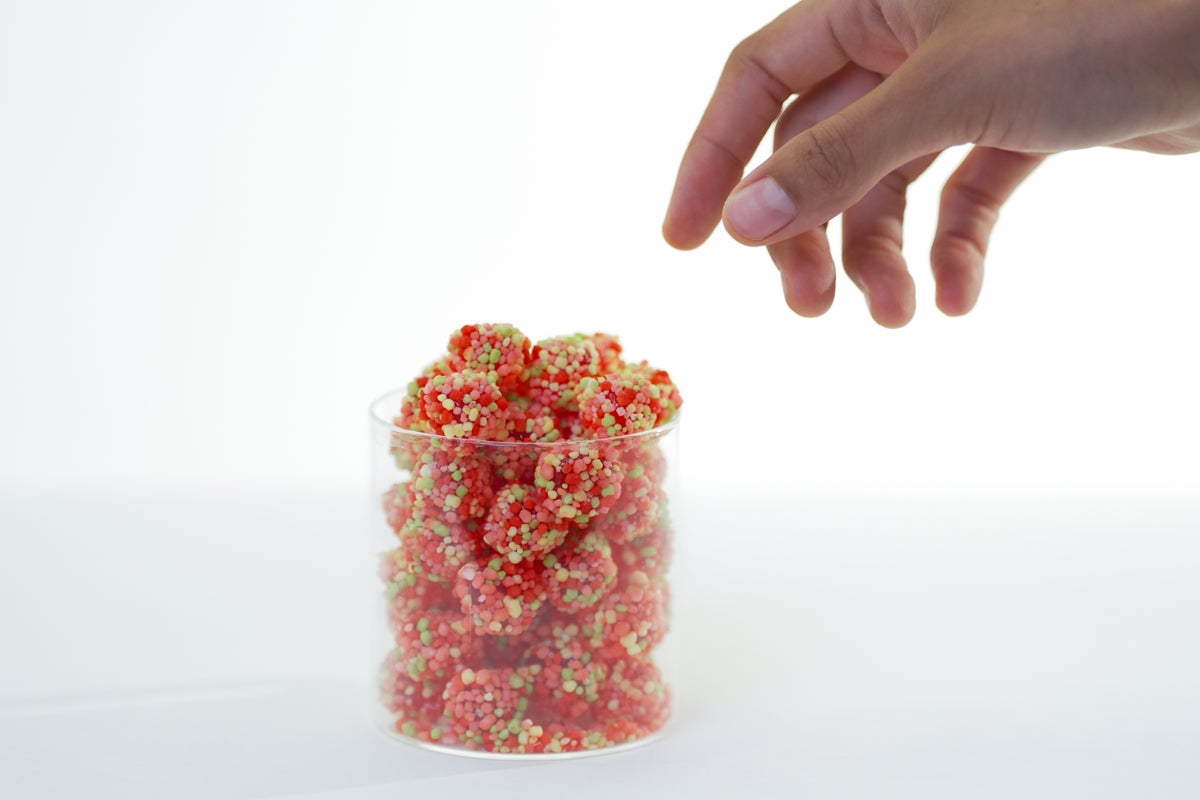
Think about the modern confectionery aisle, or the frozen food section, or the snack bar shelf. A candy bar doesn't just snap; it gives way to a stretchable, viscous caramel layer that clings to your molars. A frozen cheese snack puffs up in the microwave into a rigid, crispy shell that instantly collapses into an elastic, stringy molten core.
This contrast is known in the industry as sensory dynamic contrast. It is the holy grail of food formulation. When a food offers shifting textures—crunch followed immediately by smooth, or crisp giving way to gooey—it confuses the brain's satiety mechanisms.
The brain relies on monotony to tell us we are full. If you eat plain boiled potatoes or unseasoned rice, your mouth grows bored. That boredom is an evolutionary cue: You have consumed enough of this specific nutrient; stop eating.
But when a food constantly changes its texture in your mouth—when every single bite delivers a new cascade of acoustic pops and melting richness—your brain never gets bored. The sensory feedback loop remains wide open. The brake pedal of appetite is disconnected.
Sarah doesn't stop eating the crisps because the sensory experience is a moving target. Her brain keeps waiting for the pattern to settle, but the food is engineered to keep surprising her oral receptors.
This is not an accident. It is architecture.
Behind every exaggerated crunch and impossibly velvety center is an army of chemists manipulating the food matrix. They use texturizing agents derived from corn, seaweed, and soybeans to lock moisture into places it has no business being, keeping interiors soft while exteriors are flash-fried or baked into brittle armor. They adjust the particle size of salt grains so that flavor hits the tongue in waves rather than all at once.
The result is a sensory illusion. We mistake the intensity of the physical sensation for the quality of the nutrition.
We feel manipulated, and rightly so. But there is a deeper tragedy here than just overeating a bag of snacks. We are losing our connection to real, unaugmented food. Real food has flaws. A real apple has a soft bruise on one side. A home-baked cookie loses its crispness by the second day. Bread baked without chemical dough conditioners stales, hardens, and demands to be eaten in its moment of truth rather than sitting in a plastic bag on a shelf for three months, waiting indefinitely with a factory-sealed crunch.
When we normalize these hyper-engineered textures, our palate shifts. Real food starts to taste boring. An actual carrot feels underwhelming because it doesn't detonate with the acoustic violence of a processed extrusion.
Consider the child growing up today whose primary exposure to texture is mediated by industrial food science. Their baseline for what food should feel like is set by laboratories, not farms. They learn to expect a sensory fireworks display with every single bite.
So what do we do with this knowledge? We do not need to retreat to a utopian fantasy where we process every grain of wheat by hand. That is neither practical nor desirable.
The first step is simply awareness. The next time you open a package and hear that startlingly loud crack, pause for a single second. Listen to the sound. Notice how quickly the texture transforms in your mouth. Recognize that what you are experiencing is not just a snack, but a carefully calibrated acoustic and tactile design meant to bypass your better judgment.
When you name the mechanism, the illusion loses some of its power.
Sarah closes the empty tube of crisps and drops it into the recycling bin. She feels a familiar pang of frustration, but this time, it is mixed with clarity. She walks over to the refrigerator, reaches past the brightly colored packaging, and pulls out a crisp, unremarkable, perfectly ordinary apple.
It doesn't crack like a gunshot. It doesn't melt into a velvet pool of artificial cream. It just tastes like fruit, quiet and steady and real, waiting in the dark.