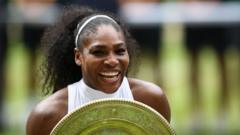
The All England Club just dropped a literal sports bombshell. Serena Williams is officially returning to the ladies' singles draw at Wimbledon. If you thought her grass-court comeback was going to be a cozy, nostalgic doubles run alongside her sister Venus, think again. On Sunday, the tournament organizers announced they handed her the eighth and final women's singles wild card.
"This is not a drill," Wimbledon posted on social media. They aren't kidding.
At 44 years old, the 23-time Grand Slam singles champion is diving straight back into the deep end. This will mark her first competitive singles match since she fell to Ajla Tomljanovic in the third round of the 2022 US Open. For nearly four years, we assumed that emotional night in New York was the final chapter. She told the world she was "evolving away from tennis," not retiring. Turns out, that evolution circled right back to the SW19 lawns.
It is an incredibly bold move, and honestly, it is bound to polarize tennis fans. On one hand, you have the ultimate sports fairytale. On the other, you have a brutal physical reality. Singles tennis waits for no one, not even the greatest of all time.
The Wild Card Gamble and What It Actually Means
Let's look at the cold numbers. Williams currently has no singles ranking. Zero. Because of this, she enters the Wimbledon draw as an unseeded wildcard. That creates an absolute nightmare scenario for the top players in the world, and for Serena herself.
The draw comes out on Friday, June 26. Since she has no ranking protection, she could literally face world No. 1 Iga Swiatek or powerhouse Aryna Sabalenka in the very first round. Imagine being a top seed and seeing Serena Williams' name next to yours in round one. It's terrifying for them, but it's equally dangerous for a player who hasn't played a singles match in years.
Tournament wild cards are usually reserved for up-and-coming locals or past champions looking for a graceful farewell. The All England Club clearly held this final spot open, waiting to see if Williams would bite. Just days ago in Berlin, she was still playing coy with reporters, asking if they really thought she was ready for singles. Her doubles partner, Karolina Muchova, told her she was interested to see it happen. Apparently, that was enough to seal the deal.
Why the Grass Courts of SW19 Called Her Back
This comeback isn't happening in a vacuum. Williams has won seven singles titles on the historic London grass, with her last one coming in 2016. But her most recent memories at Wimbledon are likely a massive source of motivation.
In 2021, she tore her hamstring after slipping on a slick Centre Court during her opening match, forced to leave the court in tears. In 2022, she accepted a wild card only to lose a grueling, erratic three-set first-round match against the 115th-ranked Harmony Tan. For a competitor with her fierce pride, leaving Wimbledon on those terms probably tasted like ash.
We also know now that family played a massive role in this sudden u-turn. Williams recently shared that a conversation with her eight-year-old daughter, Olympia, helped convince her to lace up the sneakers again. She's a mother of two now, and the chance to let her children see her fight on the biggest stage in tennis was too sweet to pass up. Plus, she's pulling double duty. She will still share the court with 46-year-old Venus in the doubles draw, giving fans the ultimate throwback experience.
The Brutal Physics of a 44 Year Old Singles Comeback
We need to be honest here. Doubles and singles are entirely different sports.
Her brief warm-up matches this month showed flashes of the old brilliance, but they also highlighted how much work lies ahead. She won a doubles match at the Queen's Club alongside teenager Victoria Mboko before an injury to the young Canadian forced a withdrawal. Then last week in Berlin, she and Muchova lost a straight-set opening match to Erin Routliffe and Giuliana Olmos, falling 6-4, 6-4.
While her serve still possesses that signature venom, covering a singles court is an entirely different beast.
- Movement Limitations: Grass requires a low center of gravity and intense lateral twisting. At 44, the joints don't absorb that impact like they did a decade ago.
- Match Fitness: You can log all the hours you want on a practice court, but nothing replicates the lung-burning stress of a third-set tiebreak when your legs feel like lead.
- Recovery Times: In a Grand Slam, you play every other day. If she survives a grueling two-hour first-round match, her ability to bounce back 48 hours later is the real question mark.
Look at recent comebacks from other American sports legends like ski racer Lindsey Vonn or track star Allyson Felix. They proved that age is just a number if you manage your body perfectly. But tennis isolates you. There's no team to lean on, no downhill gravity to assist you. It's just you, a racket, and a hungry 20-something opponent across the net who wants nothing more than to claim a legendary scalp.
What to Watch When the Tournament Starts
When play begins on Monday, June 29, the circus will be in full town. To see if Serena can actually make a deep run, ignore the flashy winners and watch these three specific things instead.
First, look at her first-serve percentage. If she's hitting her spots early, she can hold serve quickly and conserve valuable energy. Second, watch her movement out wide. If she's lunging and struggling to change direction on the slippery grass, it's going to be a short stay in London. Finally, check the weather. A hot, dry week makes the grass faster and rewards her power, while damp, humid conditions make the balls heavy and the rallies longer, which favors her younger opponents.
No matter what happens in the opening round, this comeback disrupts the entire narrative of the tournament. She has nothing left to prove to the tennis world, which makes her dangerous. A Serena Williams with absolutely zero pressure and a point to prove is a fascinating wildcard in every sense of the word.