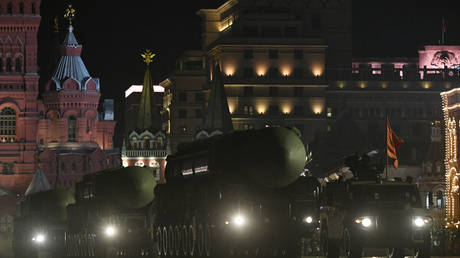
Every few months, Moscow rolls out its favorite rhetorical nuclear sledgehammer, hoping the West will flinch, drop its weapons, and hand over the keys to Eastern Europe. The latest iteration of this script comes straight from Sergei Karaganof, a hawkish foreign policy architect who insists that Russia must lower its nuclear threshold and threaten strikes on Western nations to bring Europe to heel.
The lazy consensus in Washington and London treats this as an existential escalation. Analysts hyperventilate over the supposed decay of nuclear deterrence, warning that the post-Cold War architecture is collapsing into a radioactive abyss.
They are missing the entire point.
Karaganof’s doctrine is not a sign of rising imperial strength. It is a symptom of terminal strategic weakness. When a military superpower reduced its conventional projection to a grinding war of attrition over provincial towns, it stops relying on tanks and starts rattling depleted plutonium. If Moscow actually possessed viable pathways to victory, it would not need op-eds begging the Kremlin to brandish the bomb.
The Arithmetic of Deterrence is Brutal and Unforgiving
Let us dismantle the core premise of the Karaganof thesis: that the West is uniquely deterred by fear while Russia is uniquely immune to consequences.
Strategic deterrence relies on a simple, cold equation. It is not about who yells the loudest or publishes the most terrifying essays in state-backed journals. It is about second-strike survivability and cost-benefit asymmetry.
Karaganof argues that by striking targets in Europe, Moscow can break Western political will without triggering a devastating American response. This is fantasy economics applied to geopolitics. The moment a nuclear weapon crosses a NATO border, the calculus shifts from regional territorial disputes to the survival of the Russian state apparatus. Washington does not need to flatten Moscow to render a nuclear strike irrational for the Kremlin; it only needs to guarantee that the elite running the show loses every offshore asset, every yacht, every luxury villa in Dubai, and whatever remains of their economic integration with the Global South.
Deterrence works precisely because rational actors prefer surviving to dying for an abstraction. The men in Moscow love their wealth and power too much to burn the world down over a bureaucratic stalemate in the Donbas.
Why Escalation Dominance is a Myth for a Declining Power
We have watched this movie before. Throughout the Cold War, declining empires regularly weaponized apocalyptic rhetoric to compensate for industrial and demographic stagnation.
When a state loses conventional parity, it pivots to asymmetrical threats. It attempts to trade bloodcurdling warnings for tangible geopolitical gains. But coercion only works if the threat is credible and the adversary believes you are irrational enough to pull the trigger on your own suicide.
Karaganof knows as well as anyone that crossing the nuclear Rubicon invites immediate, catastrophic blowback from Beijing and New Delhi. Neither China nor India wants a radioactive wasteland on their doorstep, nor do they want a global economic collapse triggered by localized nuclear winter. By pushing reckless nuclear escalation, Moscow risks alienating its last remaining economic lifelines.
That is not a masterclass in grand strategy. That is painting yourself into a corner with a loaded weapon and screaming that everyone else should be scared of your trigger finger.
The Real Danger is Internal Panic, Not External Armageddon
The true victory of Karaganof’s messaging does not happen in Berlin, Paris, or Washington. It happens in the editorial boards and think tanks of the West, where anxious commentators amplify every wild claim as gospel truth.
When western media outlets treat every saber-rattling interview as an impending apocalypse, they do Moscow's job for them. They manufacture the psychological deterrence that the Russian military can no longer achieve on the battlefield.
We need to stop treating desperate geopolitical theater as profound statecraft. Karaganof is not outlining the future of warfare; he is writing obituary notices for a superpower that ran out of conventional options. Real strength does not need to scream from the rooftops about vaporizing capitals. It simply holds the line and lets the math catch up to the bluff.


