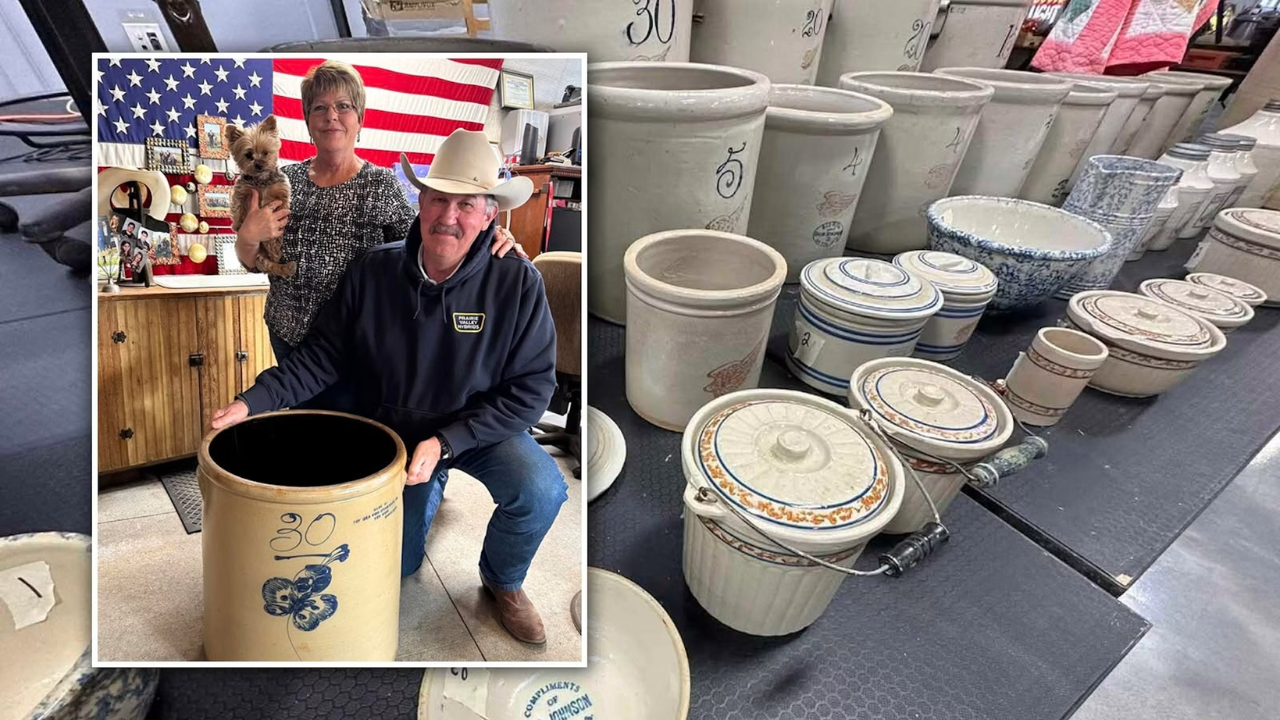
Dust smells like old paper and forgotten time. If you have ever cleared out an estate in the upper midwest, you know the scent. It clings to the wool of your sweater long after you have walked back out into the sharp South Dakota air. It smells of cedar chests, damp basements, and the quiet ghost of someone else's daily life.
On a Tuesday that felt much like any other, a collector in South Dakota stood looking at a salt-glazed stoneware crock. It sat on a wooden workbench, heavy, gray, and unassuming, bearing the unmistakable blue-painted brushwork of a nineteenth-century artisan. To an untrained eye, it was a heavy vessel once used for pickling pork or storing grain, cracked by decades of temperature shifts and heavy handling. To the owner, it was an object priced at seven hundred fifty dollars. A fair sum for a Tuesday. A reasonable exchange of paper for pottery.
Except the pottery was lying. Or rather, the market had whispered a lie, and the collector had chosen to listen.
Value is a strange, phantom thing. We pretend it lives in physical attributes, in the weight of salt-glazed clay or the precise cobalt stroke of a bird painted by a potter who could neither read nor write. We look at an antique crock and imagine it holding salted beef in a root cellar while winter howled across the prairie. We attach history to objects because history is comforting. It anchors us.
Yet, history has a twin. And twins are notoriously difficult to tell apart until the light hits them just right.
Consider what happens next in the quiet ecosystem of high-end antiques. A month prior to that South Dakota transaction, inside a brightly lit auction house thousands of miles away, another stoneware crock sat under the harsh glare of halogen spots. It was nearly identical. Same gray density. Same cobalt ornamentation. Same salt-glazed texture that felt like orange peel beneath the thumb.
When the gavel finally fell, that second crock commanded thirty-two thousand dollars.
Thirty-two thousand dollars for dirt, water, fire, and blue pigment.
Why? Because the difference between a mid-tier curio and a museum-grade artifact often hinges on a millimeter of brushwork, an obscure maker's mark stamped near the base, or the precise kiln temperature that turned a common utility into a survivor. The South Dakota collector saw a bargain. What they actually held in their calloused hands was a microscopic margin of error.
We live our lives by margins just as narrow. We make choices every single day based on what things appear to be on the surface, entirely unaware that a microscopic shift in context changes the math entirely.
Let us step back into the dusty basement for a moment. Picture the hypothetical homeowner who left that crock behind. Let us call him Arthur. In 1912, Arthur did not think of his storage crocks as investments. He thought of them as Tuesday. He filled them with brine. He dropped pickles into their dark interiors. He shoved them into the corners of root cellars because they were sturdy, cheap, and got the job done. Arthur never imagined that a hundred years later, people would argue over the exact shade of cobalt blue on the side of his pickle jar, trading thousands of dollars over the signature of an immigrant potter whose name was forgotten before the First World War.
Stoneware was the plastic of the nineteenth century. It was ubiquitous. Every general store carried rows of it. Every homesteader owned a half-dozen pieces. It was mundane. It was cheap.
That is precisely why the survival of a rare piece is so miraculous. Most of them broke. They shattered on stone floors. They cracked during harsh winters when the water inside froze and expanded. They were tossed into rubbish heaps when modern glass jars and tin cans arrived to take their place.
Scarcity is manufactured by destruction. The more common an object is originally, the more devastating its eventual disappearance, until the few survivors become ghosts worth a king's ransom.
When the $750 crock changed hands in South Dakota, the buyer was betting on a story. They were betting that the market had overlooked a hidden gem, that somewhere in the gray clay lay the signature of a master craftsman whose work routinely smashed auction records. It is a romantic gamble. It is the same gamble people make when they buy a beat-up Fender guitar at a garage sale or a dusty oil painting at a thrift store.
We all want to be the one who saw what everyone else missed.
We crave that moment of vindication. We want to stand on the mountain of our own cleverness, holding up a dusty piece of pottery, and watch the experts gasp. It is a deeply human impulse. We are pattern-seeking animals stranded in a chaotic universe, desperately hunting for meaning, for validation, for the secret code that unlocks hidden worth.
Most of the time, the crock is just a crock.
The $32,000 twin did not command its staggering price tag because it held pickles any better. It commanded that price because of provenance, condition, and the fierce, irrational hunger of collectors who refuse to lose a bidding war. In the world of high-stakes antiquing, you are not buying the object. You are buying the narrative. You are buying the bragging rights. You are buying the absolute certainty that you possess something singular, untouchable, and rare.
When you miss that mark by a fraction of an inch—when your $750 find turns out to be just a standard, mass-produced vessel with a hairline fracture—the silence in the room is deafening.
The dust settles again. The light shifts across the workshop floor.
The crock sits there, heavy and gray, holding nothing at all except the weight of what it could have been. And the collector puts it back on the shelf, wondering where the line between treasure and trash was drawn, and why they were standing on the wrong side of it.