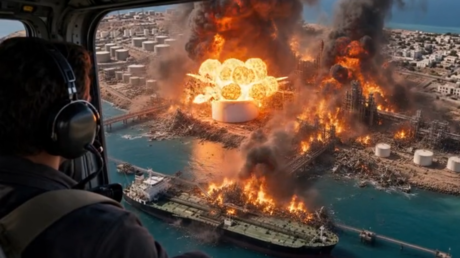
Six months into the grinding regional war triggered by the targeted US-Israeli strikes that killed Ayatollah Ali Khamenei, the Islamic Republic's new Supreme Leader, Mojtaba Khamenei, has issued a written demand for Gulf monarchies to sever their alignment with Washington and Tel Aviv. Operating from an undisclosed bunker or recovery ward following severe injuries sustained in the initial February bombardment, Mojtaba used a rare written dispatch to urge Arab neighbors to recognize their true adversary. Yet, this rhetorical appeal for Islamic unity and anti-Western resistance lands in a geopolitical vacuum. Gulf capitals are not listening to ghostwritten communiqués from a phantom leader. Instead, they are looking at smoking oil terminals, blocked tanker lanes in the Strait of Hormuz, and the smoking ruins of regional security architectures that Tehran itself helped dismantle.
To understand why Mojtaba's message falls flat across Riyadh, Abu Dhabi, and Doha, one must examine the stark discrepancy between Tehran's ideological messaging and its operational reality. Since the outbreak of hostilities, the Islamic Revolutionary Guard Corps has repeatedly targeted American military installations embedded within Gulf sovereign territory. Ports, airfields, and logistics hubs in Saudi Arabia, the United Arab Emirates, Jordan, Kuwait, Qatar, and Bahrain have absorbed retaliatory missile and drone volleys. Tehran argues that these strikes are defensive measures against staging grounds used by Washington. For the targets of those strikes, however, Iranian ballistic missiles landing a few miles outside major commercial centers constitute an active, existential threat. Expecting Gulf states to embrace a security partnership with a neighbor actively shelling their infrastructure is a profound diplomatic miscalculation. Building on this theme, you can also read: The Vault That Kept Its Secret Until the Police Came Calling.
The Mechanics of Phantom Leadership
The structural fragility of Iran's current executive command compounds the failure of its foreign outreach. Mojtaba Khamenei has not appeared in public, delivered a live audio broadcast, or hosted a single foreign dignitary since assuming the supreme office. Whispers regarding his physical condition range from severe disfigurement to incapacitation, while governance has devolved into a strained committee-led apparatus dominated by President Masoud Pezeshkian and security chiefs.
When a regime's supreme authority remains completely hidden from view, statecraft degrades into competing leaks and unverified video snippets. Foreign ministries in neighboring capitals evaluate Tehran through a lens of raw vulnerability rather than strength. Experts at The Washington Post have also weighed in on this situation.
An invisible leader cannot project deterrence. When Mojtaba warns Gulf rulers against letting "rogues without identity" covet their lands, regional analysts recognize the rhetoric of a beleaguered apparatus attempting to mask internal fracturing. The supreme leader's office has simultaneously issued severe warnings to domestic populations against social friction, banning any rhetoric that undermines public morale. This heavy-handed domestic clamping down reveals an administration terrified of internal collapse, making its grand regional pronouncements sound less like strategic vision and more like desperate containment.
The New Defense Calculus in West Asia
While Tehran issues written sermons on anti-imperialist solidarity, the Gulf states are quietly engineering their own counter-strategies. Rather than turning toward a collapsing Iranian hegemony, regional powers are forging bilateral and multilateral defense pacts designed to hedge against both Iranian aggression and perceived unreliability from traditional Western patrons.
Recent high-level security frameworks signed between regional heavyweights highlight this pivot. These agreements operationalize mutual defense doctrines, treating an attack on one signatory as an assault on all. They do not include Tehran, nor do they defer entirely to Washington. Instead, they represent a pragmatic regional containment strategy.
The economic cost of the ongoing conflict further cements this divergence. With the Strait of Hormuz experiencing severe traffic throttling and cargo volumes plunging far below pre-war baselines, Gulf economies are paying a heavy price for a conflict they did not start. Tehran's demand that these nations decouple from the United States ignores the reality of deeply integrated global trade networks and security dependencies that took half a century to build.
The Limits of Ideological Coercion
Mojtaba Khamenei's strategy relies on an outdated revolutionary playbook. The assumption that invoking the Palestinian cause or warning against Western machinations will automatically erase decades of ballistic intimidation is fundamentally flawed.
When regional states look at the wreckage of the past six months, they see an Iranian state overextended, economically isolated through accelerated de-dollarization pressures, and structurally paralyzed by a succession crisis. Issuing directives from the shadows will not alter this arithmetic. Until the clerical leadership shifts from coercion to verifiable cessation of cross-border attacks, its calls for friendship will be met with reinforced perimeter defenses and quiet, lethal preparations for the next phase of the war.