The Stage in Rome, Georgia
Sweat sticks to the back of your neck in the humid Georgia evening air. The bleachers vibrate with five thousand voices chanting, clapping, and roaring every time the bass drops through the massive speaker stacks. Bright stadium lights carve sharp edges through the muggy air, focusing every eye in the arena on a single spot.
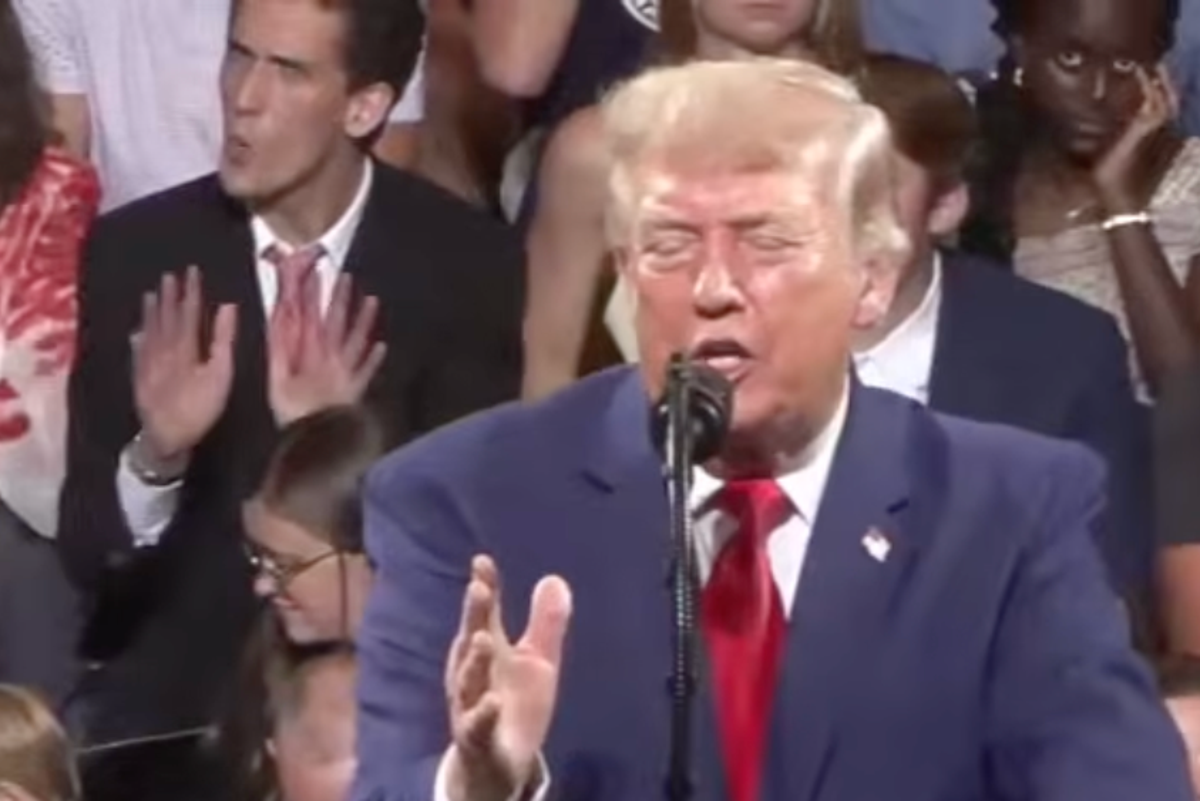
Donald Trump stands at the podium. His blue suit is sharp, his red tie hangs low, and his hands move with the rhythmic rhythm of a conductor steering a long-rehearsed symphony.
Then you see him.
Directly over Trump’s left shoulder, positioned squarely in the center of millions of television frames across the nation, sits a man in a black shirt. He is not shouting. He is not holding a poster. But as Trump’s right hand sweeps out to make a point about the economy, the man’s right hand sweeps out at the exact same angle. When Trump pinches his thumb and forefinger together to emphasize a specific figure, the man’s fingers pinch together in identical cadence.
It was a strange, hypnotic spectacle that quickly went viral across social channels. To a casual viewer scrolling through a video feed late at night, it looked like a glitch in the matrix—a living silhouette mimicking every chop, swoop, and point in real time.
Was it performance art? A subtle, quiet protest? Or simply an extreme manifestation of something deep inside human biology?
The Biology of the Mirror
We like to believe we are in complete control of our bodies. We tell ourselves that every blink, nod, and shift in weight is a deliberate choice made by our conscious mind.
Science tells a very different story.
Deep within the premotor cortex of the human brain lies a network of specialized cells known as mirror neurons. First discovered by neuroscientists studying primates in the early 1990s, these cells fire both when you perform an action and when you observe someone else performing that same action.
Mirror neurons are the invisible threads connecting one human mind to another. They are the reason you wince when you see someone hit their thumb with a hammer, and the reason you smile when a stranger beams at you across a crowded train car.
When a crowd gathers in an arena, those mirror neurons go into overdrive.
Consider what happens when a charismatic speaker takes the stage. They are not merely delivering words; they are projecting physical energy. Their posture, cadence, and hand gestures create a visual signal that the brains of the audience begin to process instantly. For most people, this internal processing stays hidden beneath the surface. You feel the energy, your heart rate picks up, and you might nod along without realizing it.
But for the man sitting behind the podium in Rome, Georgia, the barrier between internal brain activity and physical execution seemed to evaporate entirely.
When the Crowd Becomes the Speaker
Political rallies are high-pressure psychological environments. The combination of blaring music, emotional rhetoric, intense summer heat, and collective energy creates a psychological state known as emotional contagion.
It is a simple truth: emotions spread like wildfire through human crowds.
When the man behind Trump began echoing those famous hand moves—the side-to-side sweeping gesture, the sharp downward palm chop, the precise finger pinch—he wasn't just watching a speech. He was physically absorbing it.
Watch the footage closely and you notice the timing. His hands did not lag behind by two seconds, as they would if he were consciously trying to copy a move he had just seen. The movements were practically simultaneous. He was so dialed into the visual rhythm of the speaker that his own nervous system surrendered to the momentum of the stage.
It felt uncanny because it exposed something we usually try to hide: how easily influenced we really are.
We pride ourselves on our individuality. We craft custom wardrobes, curate our social media feeds, and defend our unique worldviews. Yet, put us in a room with a dominant personality and a few thousand cheering peers, and our body language begins to bend toward the center of gravity in the room.
The Micro-Stage Behind the Podium
The layout of a modern political rally is meticulously engineered.
Campaign staff spend hours organizing the seating grid directly behind the main microphone. They select supporters based on energy, attire, and placement to ensure the camera shot looks vibrant, enthusiastic, and unified. Every background seat is a micro-stage of its own.
People sitting in those seats know they are on camera. They feel the eyes of millions on them, even if they are just background characters in a national broadcast. That conscious awareness creates a unique kind of tension.
Do you sit perfectly still like a statue? Do you cheer at every sentence? Or do you get swept away in the choreography of the moment?
The man in the black shirt chose—or was driven by subconscious impulse—to match the cadence of the man at the mic. In doing so, he stole the scene without uttering a single word. He became a living mirror, reflecting the high-octane theatricality of American politics back to the audience watching from home.
What We See When We Look at the Mirror
The internet reacted to the clip with predictable speed. Memes flooded feeds within hours. Commentators debated whether the man was mocking the former president or showing ultimate devotion.
Ultimately, the intent of the man in the black shirt matters far less than what the moment revealed about us, the viewers.
We live in an era dominated by screens, clips, and fleeting visual moments. We scan our feeds looking for something authentic, something strange, or something that breaks the script of everyday life. A man mirroring a politician's iconic gestures hits every single one of those triggers. It is funny, baffling, slightly surreal, and deeply human all at once.
It reminds us that beneath all the high-stakes political drama, policy debates, and media noise, rallies are fundamentally human gatherings. They are spaces where thousands of people come together to feel connected to something bigger than themselves, even if that connection manifests as a synchronized dance of hands in the Georgia heat.
The speech eventually ended. The stadium lights dimmed. The crowd filtered out into the cool night, driving back home along dark highways. The viral video faded into the endless archive of the internet.
Yet the image remains fixed in the mind: a speaker commanding the room, and a quiet figure just behind him, moving in perfect, involuntary unison—a silent reminder of how tightly bound we are to the signals we send each other.

/https://i.s3.glbimg.com/v1/AUTH_e84042ef78cb4708aeebdf1c68c6cbd6/internal_photos/bs/2026/g/B/3vpkvHQKizRKAfzDxjXA/vini-jr-antes-e-depois.jpg)