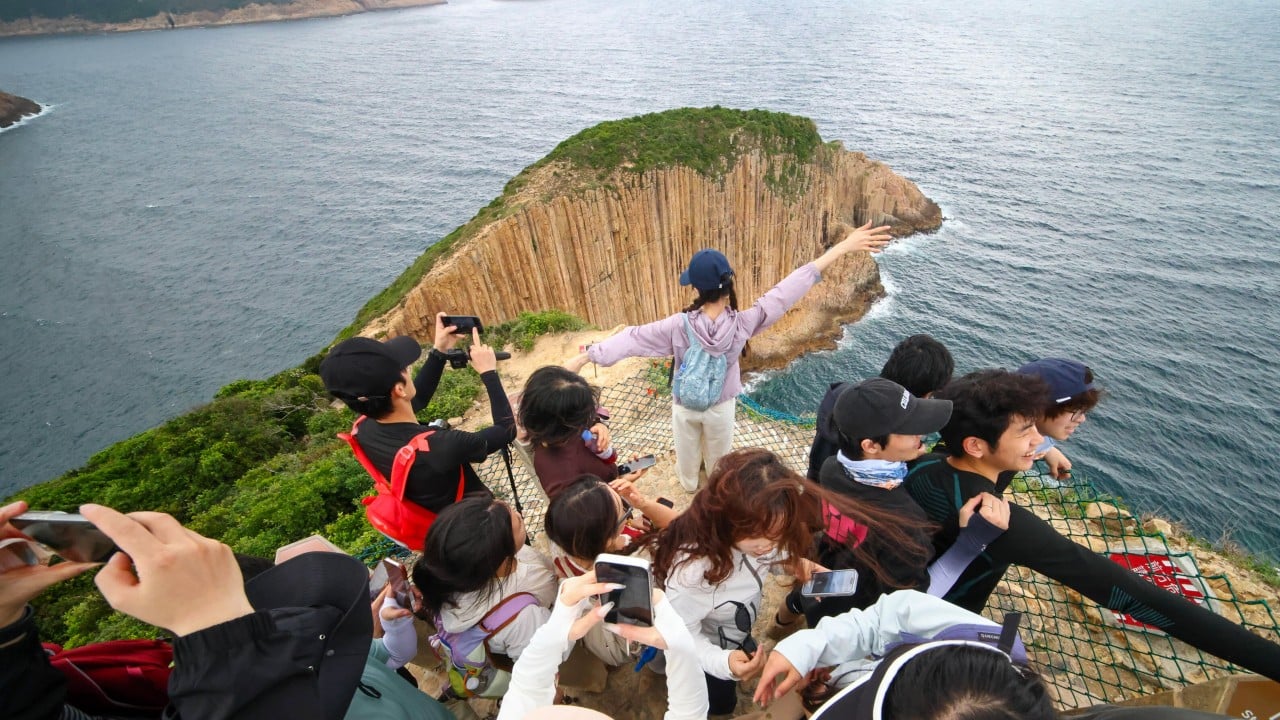
The heat in Musandam doesn’t just sit on your skin; it presses against your chest like a physical weight. Here, at the jagged northern tip of Oman, the Hajar Mountains don’t crumble into the sea. They plunge. These are the "fjords of Arabia," sun-scorched limestone cliffs that drop hundreds of feet into water so blue it looks painted.
I sat on the edge of a dhow—a traditional wooden boat—watching a pod of humpback dolphins break the surface. Behind me, the captain, a man named Ahmed whose face was a map of deep-set wrinkles and sun-faded memories, sipped bitter coffee from a small ceramic cup. He didn’t look at the dolphins. He looked north, toward the horizon where the haze of the Iranian coastline shimmered like a ghost.
Between us and that ghost lay the Strait of Hormuz.
It is a narrow throat of water. At its tightest point, it is only twenty-one miles wide. Yet, through this tiny needle’s eye, nearly one-fifth of the world’s total oil consumption flows every single day. If the world has a pulse, you can feel it beating right here.
The Weight of the Horizon
To the average traveler, Musandam is a rugged escape, a place of silent coves and telegraph islands. But for the people who live here, the view is different. They don’t see a postcard. They see a geopolitical tightrope.
Ahmed pointed a calloused finger toward a massive tanker hulking on the horizon. From this distance, it looked like a toy, but in reality, it was a steel leviathan carrying millions of barrels of crude oil. "That ship," Ahmed said, his voice gravelly, "carries the lights of a city I will never see. If it stops, the world gets dark. If it burns, my fish die."
This is the central tension of the Strait. We talk about energy security in boardroom terms—barrels per day, transit liquidity, regional stability. We treat it like a math problem. But standing on a dhow, you realize it is a human problem. The "embattled" nature of these waters isn’t just about naval skirmishes or diplomatic posturing; it’s about the terrifying fragility of a global system that relies on a twenty-one-mile gap.
The Geography of Anxiety
Geographically, the Strait of Hormuz is a quirk of nature that became a chokehold of history. On one side, you have the Islamic Republic of Iran, with its long, jagged coastline and its strategic islands of Kish and Qeshm. On the other, the Musandam Peninsula, an Omani exclave separated from the rest of the country by the United Arab Emirates.
The shipping lanes—the actual "roads" the tankers must follow—are only two miles wide in each direction, separated by a two-mile buffer zone. Imagine a highway where the world's most flammable cargo travels bumper-to-bumper, and the neighbors on either side of the road haven't spoken in decades.
Because the deepest water lies within Omani and Iranian territorial limits, every vessel passing through must, by necessity, navigate through the sovereign waters of one or both nations. Under the United Nations Convention on the Law of the Sea, ships enjoy the "right of transit passage." It is a legal grace that keeps the world’s economy breathing. But grace is a fickle thing when drones are in the air and mines are in the water.
A Day in the Life of a Chokehold
Consider a hypothetical sailor named Elias. He is a third mate on a Panamanian-flagged VLCC (Very Large Crude Carrier). For Elias, the Strait of Hormuz isn't a "strategic asset." It is forty-eight hours of high-alert adrenaline.
As his ship approaches the Strait, the atmosphere on the bridge changes. The crew isn't just looking for reefs or other ships. They are watching for the "fast boats"—small, agile crafts often used by the Iranian Revolutionary Guard to swarm or shadow commercial vessels. They are checking the radar for "spoofing," where GPS signals are manipulated to trick a ship into drifting into the wrong territorial waters.
The stakes for Elias are personal. If a conflict breaks out, his ship is the target. If a pipe leaks, he is the one who deals with the toxicity. He is a tiny human component in a machine that demands perfection.
Back on the dhow, Ahmed watched a different kind of traffic. Small, fiberglass speedboats zipped past us, heading north. These are the smugglers. They carry televisions, cigarettes, and household goods from Oman to Iran, dodging patrols in the dead of night.
"The water doesn't know about the sanctions," Ahmed remarked, watching the wake of a departing speedboat. "The water only knows the trade."
The Invisible Infrastructure of Peace
Oman occupies a unique psychological space in this region. While other neighbors have chosen sides in the long-standing friction between Tehran and the West, Muscat has traditionally played the role of the "Switzerland of the Middle East."
This neutrality isn't just a political choice; it’s a survival mechanism. Omanis know that any spark in the Strait would incinerate their backyard first. Consequently, they have invested heavily in being the quiet observers. They maintain sophisticated coastal radar stations and naval patrols that aren't meant to provoke, but to monitor.
The Omani side of the Strait is a study in watchful silence. In the town of Khasab, the capital of Musandam, life moves at a glacial pace. Old men sit in the shade of the date palms, and the call to prayer echoes off the limestone cliffs. Yet, just a few miles away, some of the most advanced military technology on earth is pointed at the horizon.
It is a bizarre juxtaposition: the ancient and the apocalyptic. You can buy a hand-woven basket in the souk, then look up and see a grey maritime patrol aircraft circling the clouds.
What Happens When the Flow Stops?
Economists often try to quantify the "Hormuz Risk." They tell us that a total closure of the Strait would send oil prices soaring past $200 a barrel. They talk about the collapse of equity markets and the sudden, violent spike in shipping insurance premiums.
But look closer at the ripple effect.
A closed Strait means a factory in South Korea runs out of power. It means a trucking company in Germany goes bankrupt because it can no longer afford diesel. It means a family in a developing nation can no longer afford the kerosene they need to cook their evening meal.
The "waterfront view" provided by Musandam isn't just a view of ships. It’s a view of our collective dependence. We have built a civilization on the assumption that these twenty-one miles will always be open. We treat the Strait of Hormuz like a natural law, as certain as gravity or the tide.
It isn't. It's a fragile human agreement, held together by a thin ribbon of international law and the quiet, exhausting work of diplomats and sailors.
The Silent Sentinels
As the sun began to dip behind the Hajar Mountains, the cliffs turned a deep, bruised purple. The water shifted from turquoise to a dark, impenetrable navy. The dolphins had long since vanished.
Ahmed turned the dhow back toward Khasab. The massive tanker we had seen earlier was now just a cluster of lights on the horizon, blinking rhythmically.
"People come here to see the mountains," Ahmed said, steering the wooden tiller with his foot. "They think the mountains are the strongest thing here. But they are wrong."
He gestured to the dark water between us and the Iranian shore.
"The water is the strongest. It carries everything. It carries the bread, the oil, and the war. We just live on the edge of it, hoping it stays quiet."
The true story of the Strait of Hormuz isn't found in the headlines about missile tests or carrier groups. It’s found in the eyes of the people who watch the horizon every day. It’s in the silence of the fjords, where the world’s loudest industry passes by like a ghost.
We live in an age of digital clouds and intangible assets, but our reality remains anchored to the physical world. Our lives are tethered to the movement of steel hulls through a narrow gap in the rocks. We are all, in a sense, standing on that dhow with Ahmed, peering through the haze, waiting to see what the next tide brings.
The light faded completely, leaving only the steady, mechanical pulse of the tankers, moving through the dark, carrying the weight of the world on their backs.