The survival of N1, Serbia’s primary independent news outlet, is no longer a mere question of media economics. It has become the frontline in a brutal war of attrition waged by the state. While Western observers often focus on the overt suppression of journalists in Russia or Belarus, the Serbian model is more surgical, utilizing state-controlled telecommunications giants and administrative strangulation to silence dissent. By squeezing N1’s distribution and weaponizing the state-owned provider Telekom Srbija, the government is effectively deleting the country’s last remaining window into reality.
This isn't about ratings. It is about the total monopolization of the narrative.
The Infrastructure of Silence
In Belgrade, censorship doesn't usually arrive with a sledgehammer. It arrives through a contract renewal or a technical "restructuring." The primary mechanism used to isolate N1 is the aggressive expansion of Telekom Srbija. This state-owned entity has spent years buying up smaller cable providers at inflated prices, often using debt-fueled capital. Once these smaller operators are under the state umbrella, independent channels like N1 and its sister station, Nova S, are frequently pushed to the margins or dropped entirely from the basic packages.
This creates a digital ghetto. If a citizen cannot see the news on their remote control, for all practical purposes, that news does not exist. The strategy is to make independent journalism a luxury or a technical hurdle that the average voter—already struggling with inflation—is unlikely to clear.
Telekom Srbija’s expansion serves a dual purpose. It provides a massive, state-aligned platform for pro-government tabloids while simultaneously draining the advertising pool for anyone else. In a market where the state is the largest employer and the largest advertiser, private companies are terrified to buy airtime on N1. To do so is to mark oneself as an enemy of the ruling Serbian Progressive Party (SNS). The result is a hollowed-out revenue model that forces independent outlets to rely on international grants or dwindling subscriptions, which the government then uses to paint them as "foreign mercenaries."
The Regulatory Capture of REM
The Regulatory Authority for Electronic Media (REM) acts as the janitor for this systemic cleanup. For years, N1 and Nova S have applied for national broadcasting licenses—the frequencies that reach every household in Serbia via a simple antenna. Each time, REM has bypassed them, granting licenses instead to stations that have historically ignored opposition voices or served as mouthpieces for the presidency.
The bias isn't even subtle. Monitoring reports from various media watchdogs consistently show that the president receives over 90% of political airtime on national frequencies, almost all of it positive. N1, meanwhile, is relegated to cable, reaching a fraction of the population. By denying these licenses, REM ensures that the "bubble" remains intact.
The legal arguments used to deny these licenses are often opaque or circular. They claim the market is saturated or that the applicants don't meet technical criteria that the current license holders—many of whom are in significant debt or violate broadcasting standards daily—somehow magically possess. It is a closed loop of bureaucratic denial.
Weaponizing the Street and the Screen
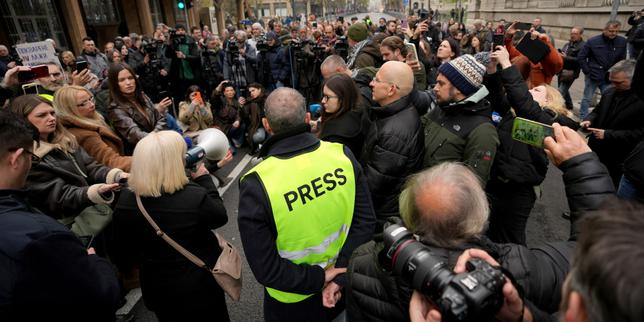
Journalists at N1 don't just face financial pressure; they face physical and psychological intimidation that is often signaled from the top. When a high-ranking official labels a journalist a "traitor" during a televised press conference, it acts as a green light for online trolls and street-level thugs.
- The Protax Strategy: Pro-government tabloids often run coordinated front-page attacks against N1 staff, publishing private details or fabricating scandals.
- The Legal Thicket: SLAPP suits (Strategic Lawsuits Against Public Participation) are increasingly common. These aren't meant to be won; they are meant to drain the legal budget of the newsroom and keep editors in courtrooms instead of behind desks.
- Physical Exclusion: N1 reporters are frequently denied access to government events or ignored during Q&A sessions, effectively preventing them from performing the basic duty of holding power to account.
This creates a chilling effect that extends beyond the newsroom. Sources become reluctant to speak. Whistleblowers fear the reach of the security services. When the state controls the cable box, the courtroom, and the street, the act of reporting a simple fact becomes a revolutionary act.
The Failure of European Pressure
For years, the European Union has issued "progress reports" expressing concern about the media environment in Serbia. These documents are usually written in the cautious, toothless language of diplomacy. They speak of "limited progress" or "the need for further alignment with EU standards."
To the journalists on the ground, this feels like an abandonment.
The Serbian government has mastered the art of "performative compliance." They will pass a new media law that looks perfect on paper—often drafted with the help of international consultants—while simultaneously finding a new way to bypass it in practice. The EU, distracted by regional stability and the geopolitical tug-of-war over Kosovo, often prioritizes its relationship with the Serbian leadership over the protection of democratic institutions. This trade-off is a disaster for pluralism. When Brussels stays quiet in exchange for stability, it validates the autocrat's playbook.
The reality is that N1 is surviving on borrowed time and the sheer stubbornness of its staff. If the international community continues to accept "stability" at the expense of truth, the Balkan media landscape will soon mirror the state-controlled monoliths of the East.
Why the Cable Box is the New Ballot Box
In a country where the state-controlled media tells a story of constant economic triumph and external threats, N1 provides the only contradictory evidence. They cover the lithium mining protests that the national broadcasters ignore. They report on the crumbling infrastructure and the corruption in public procurement.
Without N1, these stories would stay on the streets or in small social media circles. By keeping N1 off the national frequencies and squeezing it out of the cable packages, the government isn't just fighting a TV station; it is managing the public’s perception of reality. If people don't know there is a problem, they don't know they need a solution.
The siege of N1 is a test case for how a modern illiberal democracy can dismantle the free press without ever having to shut down a printing press or arrest an editor in the middle of the night. You don't need to ban the truth if you can just make it impossible to find.
Investors and diplomatic missions often look at GDP growth or infrastructure projects as signs of a healthy state. They are looking at the wrong metrics. The true health of a nation is found in the ability of a journalist to ask a difficult question without losing their livelihood or their safety. In Serbia, that ability is being strangled by a thousand small administrative cuts. The disappearance of N1 would signify the final closure of the Serbian mind to any narrative other than the one written in the president's office.