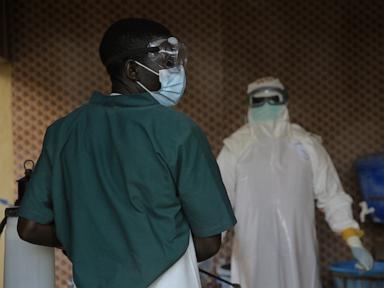
The air in the province is heavy with a strange, breathless humidity. It smells of damp earth, woodsmoke, and an unspoken dread that clings to the skin long after the sun dips below the horizon. Here, in the eastern stretches of the Democratic Republic of Congo, life moves to the rhythm of bustling market stalls, distant drumming, and the rustle of dense rainforest canopy. Yet beneath this vibrant daily pulse runs a current of absolute, paralyzing fragility.
When an invisible enemy arrives, it does not announce itself with sirens or marching boots. It whispers. It enters a home quietly, riding on the touch of a hand, the comfort of an embrace, or the simple act of caring for someone who is shivering in the dark.
By the time the numbers swell past eight thousand confirmed cases, statistics cease to be mere numbers. They transform into empty chairs at dinner tables. They become unstitched community ties, unfinished conversations, and an agonizing test of human endurance. To understand what it means when an epidemic spirals beyond immediate control, one must look past the epidemiological charts and enter the sweltering treatment tents where the battle for survival is waged breath by breath.
Imagine Dr. Kaleb, a fictional pediatrician whose boots are permanently stained with red equatorial mud. Every morning at dawn, Kaleb washes his hands in a chlorinated bucket outside a makeshift triage center. He does this not out of routine, but out of absolute reverence for the danger he faces. Every gesture must be deliberate. Every zipper on his personal protective equipment must be checked twice. A single millimeter of exposed skin is an invitation to catastrophe.
In Kaleb’s world, medicine is not practiced from behind mahogany desks or through pristine computer screens. It is practiced in an arena of raw sensory overload. The relentless hum of plastic generators competes with the muffled weeping of families waiting behind rusted chain-link fences. Inside the isolation ward, the air is stifling, trapped behind heavy visors that fog with every exhale. Sweat stings the eyes. Hands gloved in thick yellow rubber lose their sense of touch, forcing doctors to rely entirely on clinical intuition and acute observation.
The virus itself—Ebola—is an ancient predator wearing a modern face. It preys on the very instincts that make us human: compassion, community, and grief. When a loved one falls ill, our natural impulse is to draw closer, to hold their hand, to wash their forehead with cool water, and to bury our faces in their shoulders. The virus turns these sacred acts of love into vectors of transmission. Traditional burial practices, honed over generations to honor the departed and ease the transition into the next world, become high-risk events that can reignite an entire cluster of infections.
This is why managing an outbreak in regions like eastern Congo is unlike almost any other public health crisis in human history. It is not merely a biological problem requiring a biological solution. It is a deeply cultural, psychological, and logistical labyrinth.
Consider what happens next when distrust takes root in a community already battered by decades of regional conflict and political instability. For generations, many villagers have lived with a state apparatus that felt distant at best and predatory at worst. When men and women in strange white suits arrive in armored vehicles carrying chlorine sprayers and body bags, fear often eclipses logic. Rumors spread faster than the pathogen itself. People whisper that the treatment centers are where people go to die, or that the sickness is a foreign fabrication designed to destabilize local communities.
Kaleb knows this hostility intimately. He has walked into villages where the air felt like broken glass, where stone-faced youths stood blocking the path, their arms crossed, watching every move with hostile eyes. In those moments, science books and vaccine distribution schedules are entirely useless. What matters is patience. What matters is sitting down on a wooden bench, refusing to wear the intimidating mask for a moment while listening to an elder speak about lost crops, missing sons, and a deep-seated exhaustion that predates the virus by decades.
Trust is built in centimeters and lost in kilometers.
To turn the tide against an outbreak of this magnitude, health workers must become ethnographers, diplomats, and neighbors all at once. They recruit local leaders, traditional healers, and survivors who bear the invisible badge of immunity. These survivors walk through the alleys of bustling towns, lifting their sleeves to show that recovery is possible. They speak the local dialects, understand the subtle nuances of community politics, and bridge the vast chasm of suspicion between international medical agencies and the people whose lives are hanging by a thread.
Yet, even with local champions leading the charge, the sheer logistics of containment remain staggering. The terrain is punishing. Heavy seasonal rains turn dirt roads into impassable rivers of mud, cutting off remote health posts for days at a time. Cold-chain storage required to keep sensitive vaccines viable demands a fragile dance of generators, solar panels, and ice packs hauled on motorcycles across treacherous mountain passes. A single mechanical failure can ruin thousands of doses, setting back months of painstaking outreach in an instant.
Behind every logistical hurdle lies a human story of staggering resilience. There is Mama Beatrice, a market vendor who contracted the virus while nursing her youngest daughter. Both survived. Today, Beatrice spends her afternoons sitting outside the clinic gates, offering a cup of sweet ginger tea to newly arrived patients who are shaking with terror. She does not lecture them. She simply holds their trembling hands—knowing full well the safety of her own antibodies—and tells them her story.
I walked through that door, her eyes seem to say. You can too.
That quiet defiance is the true engine of survival in the Congo. It is easy for observers thousands of miles away to look at rising case counts on a glowing monitor and declare the situation hopeless. It is easy to use clinical jargon to distance oneself from the human tragedy unfolding in the tropical heat. But despair is a luxury that people on the front lines cannot afford.
When the sun sets over the valley, casting long, bruised shadows across the zinc roofs of the treatment units, the work does not stop. The generators hum their steady, hypnotic drone. Inside, nurses check intravenous drips by the amber glow of battery-powered lanterns, whispering words of encouragement to patients fighting for their next breath. Outside, guards keep watch under a vast, indifferent canopy of stars, protecting the fragile sanctuary where science and human empathy hold the line against the dark.
The numbers may climb. The obstacles may seem insurmountable. But every single recovery represents a victory won against staggering odds—a testament to the fact that even in the face of an invisible and merciless adversary, the human capacity for courage, adaptation, and care remains unbroken. The fight is messy, exhausting, and far from over, but in the quiet spaces between one breath and the next, hope stubbornly refuses to yield.