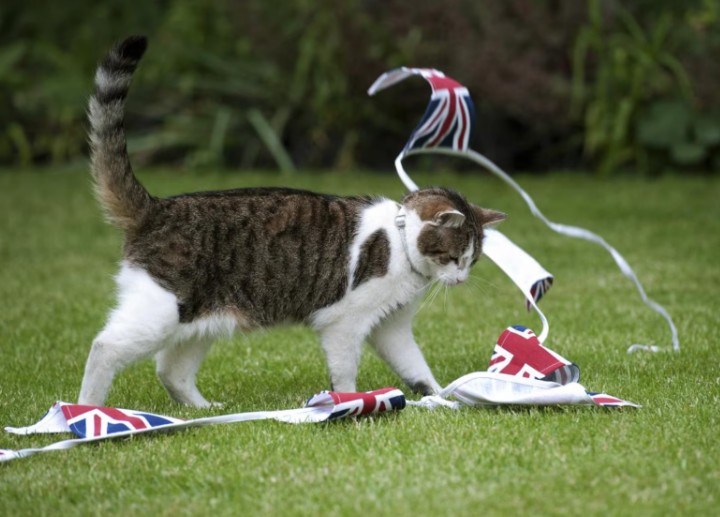
In the brutal, high-stakes arena of British politics, prime ministers are a highly perishable commodity. Over the last decade and a half, the keys to 10 Downing Street have changed hands with dizzying frequency, chewing up and spitting out some of the most ambitious figures in modern British history. Yet, through the backstabbing, the economic crises, the scandals, and the historic electoral shifts, one resident has remained completely untouched by the carnage. Larry the Cat, officially designated as the Chief Mouser to the Cabinet Office, has outlasted six prime ministers. He is not a mere mascot. Larry is a highly functional piece of geopolitical stagecraft, a masterclass in soft-power PR, and perhaps the most brilliant weapon the British civil service has ever deployed to manage the public perception of an increasingly chaotic government.
To understand how a rescue cat from Battersea Dogs & Cats Home became the most stable institution in Whitehall, you have to look past the viral social media photos and examine the mechanics of political distraction. The British public has endured years of unprecedented political volatility. Governments have collapsed over internal party civil wars, Brexit negotiations, public health mismanagement, and economic experiments that lasted fewer days than a head of lettuce. Throughout all of this, Larry has provided a vital psychological anchor for the British electorate. He offers the illusion of continuity when the state itself feels fragile.
The Permanent Secretary on Four Legs
In the strict hierarchy of British government, politicians are temporary tenants. The civil service, however, is permanent. Larry occupies a unique space that bridges these two worlds, but his true allegiance belongs to the building, not the politician holding the seals of office. He belongs to the Cabinet Office, meaning his upkeep is funded not by the taxpayer, but through the voluntary donations of the Downing Street staff. This structural independence is crucial. It means that when a prime minister falls from grace and is forced to pack their bags, Larry stays behind.
He is a living manifestation of the "permanent state." When David Cameron left office in 2016, he faced public accusations that he did not actually like Larry, forcing him to use his final Prime Minister's Questions in the House of Commons to produce a photograph proving their affection. This was a bizarre but necessary piece of political theater. To leave Downing Street disliked by the cat is to leave with a stain on your human character.
Subsequent leaders learned this lesson quickly. Theresa May, Boris Johnson, Liz Truss, Rishi Sunak, and Keir Starmer all had to navigate the Larry factor. For each of these leaders, a photo opportunity or a public interaction with the Chief Mouser was a calculated attempt to absorb some of his immense, bulletproof popularity. When a politician is sinking in the polls, standing next to an entity with a 90% public approval rating is a basic survival tactic.
The Mechanics of Political Distraction
Journalists who cover Westminster know how the game is played. When the news inside the briefing rooms is disastrous, the cameras outside focus on the doorstep. If Larry happens to be sitting on that doorstep, or if he decides to chase a pigeon across the cobblestones of Downing Street, the media narrative pivots instantly. It is a classic dead cat strategy, executed by an actual cat.
Consider how the international press corp treats a major summit or a transition of power. While serious policy analysts are trying to dissect foreign trade agreements or fiscal policy shifts, the broader public engagement is often driven by what Larry is doing. During Donald Trump's state visit to the UK, Larry famously took a nap under the US President's armored limousine, "The Beast," creating a security gridlock and a global news story that completely overshadowed the policy tensions of the day.
This is not accidental fluff. The civil service understands the value of this soft-power asset. Larry softens the hard edges of an empire in retreat. He humanizes an address that is frequently the focal point of public anger and protest. When citizens gather at the gates of Downing Street to demand the resignation of a leader, Larry can often be seen sitting calmly on the other side of the iron bars, an unbothered symbol of British stoicism.
Territorials Wars and the Illusion of Unity
The narrative around Larry is often sanitized for public consumption, but his tenure has been marked by genuine conflict that mirrors the tribalism of Westminster itself. The political village of Whitehall is a dense network of competing departments, and for years, those departments have engaged in a quiet arms race of feline diplomacy.
| Department | Feline Representative | Operational Status |
|---|---|---|
| Cabinet Office (10 Downing St) | Larry | Active / Supreme Commander |
| Foreign Office | Palmerston | Retired (2020) |
| Treasury (11 Downing St) | Gladstone | Active |
| Cabinet Office (Alternative) | Evie and Ossie | Active |
The rivalry between Larry and Palmerston, the Foreign Office cat, was notorious among the Westminster press corps. This was not a friendly administrative overlap. It was a vicious, territorial feud that resulted in multiple physical altercations, torn ears, and lost collars on the steps of Downing Street. The media covered these skirmishes with a mix of amusement and genuine fascination, but the subtext was clear. The feline battles perfectly mirrored the institutional friction between No. 10 and the Foreign Office during the chaotic early years of Brexit deployment.
When Palmerston was eventually retired to the countryside in 2020, it was framed as a choice for a quieter life. In the grim reality of bureaucratic survival, however, Larry had won the war of attrition. He outlasted his chief rival just as he outlasted the politicians who signed his pass into the building.
The Problem With the Mouse Count
If we judge Larry purely by his official job description, his record is deeply flawed. He was brought into Downing Street in 2011 because a large black rat had been spotted running across the steps during a live television broadcast, causing a minor national panic about the hygiene of the state's central hub.
Larry, a former stray with a supposed predatory instinct, was meant to solve the problem. He did not. His early months were plagued by reports of incompetence. He was caught sleeping on duty while mice ran across the carpets. On one occasion, David Cameron reportedly found a mouse in his study and had to wake Larry up, only for the cat to refuse to move.
The critics were vocal. Whispers from internal staff suggested that Larry lacked the killer instinct required for the job. Yet, his lack of productivity as a hunter only enhanced his mythos. He became an anti-hero. The British public, always fond of an underdog or a charming slacker, embraced his defiance of authority. The fact that he preferred sleeping on radiators to doing his actual job made him deeply relatable to a workforce weary of corporate metrics and government efficiency targets. He became the ultimate civil servant, doing the bare minimum required to keep his position while ensuring his pension was secure.
The Weaponization of the Feline Narrative
In the internet age, Larry's influence has been amplified through unofficial channels. The most prominent is a satirical social media account that boasts millions of followers, offering biting commentary on the political figures passing through the front door. While the account is not run by the government, the civil service has never made a serious attempt to shut it down or distance themselves from it.
Why? Because the commentary serves a vital purpose for the machinery of state. It allows for a safe, humorous venting of public frustration. When a prime minister is caught in a lie or forces a disastrous policy through parliament, "Larry" can tweet a scathing remark that defuses the tension. It transforms genuine political rage into a shared national joke. It is a highly effective safety valve for the political system.
Furthermore, this narrative creates an impossible hurdle for incoming prime ministers. A new leader cannot simply evict Larry to bring in their own pet without looking incredibly vindictive. When Rishi Sunak brought his Labrador, Nova, into Downing Street, the press immediately began looking for signs of tension. Reports soon emerged that Larry had asserted his dominance over the dog, maintaining his control over the physical space of the garden and the corridors.
When Keir Starmer entered Downing Street in 2024 bringing a rescue kitten and a family dog, the immediate media question was not just about his cabinet selections, but how the new pets would get along with the undisputed king of the castle. Starmer had to publicly acknowledge Larry's seniority. This is the reality of modern British politics. You can win a massive parliamentary majority, but you still have to negotiate territory with a fourteen-pound tabby.
The Legacy of the Ultimate Survivor
We are witnessing the twilight of an era. Larry is now an elderly cat, far past the average lifespan of a Whitehall career. Discussions about his eventual passing have already taken place within the civil service, managed with the same level of meticulous planning and secrecy dedicated to major royal funerals. Code names have been assigned. Draft press releases are sitting in secure digital folders.
When that day comes, it will mark the end of the longest-serving fixture of 2010s and 2020s British governance. Politicians will try to claim a piece of his legacy, and political commentators will write solemn columns about his service to the nation.
The truth is much colder and far more fascinating. Larry did not survive six prime ministers through luck or a cute demeanor. He survived because the British political system desperately needed him. He was the soft, furry shield that protected a succession of failing administrations from the full force of public contempt. He was the distraction when things were grim, the constant when things were broken, and the only figure in Whitehall who understood that the secret to holding power is simply to stay in the room while everyone else ruins themselves.


