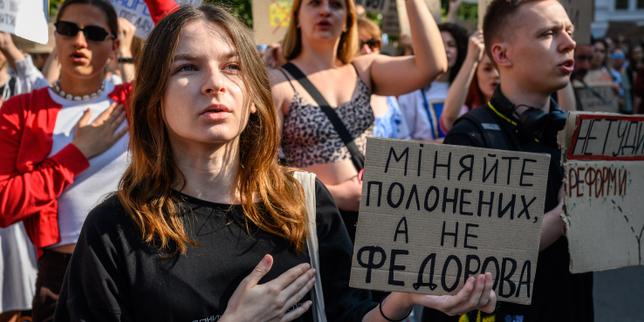
The rain in Kyiv does not wash away the smell of exhaust, damp concrete, and cheap tobacco. On a Thursday morning in Ivan Franko Square, the air felt heavy, charged with a quiet, dangerous static. Under martial law, assembling in public is not just discouraged; it is illegal. Yet, they came anyway.
They did not look like seasoned agitators. Many were young, wearing faded black t-shirts, hoodies, and sneakers caked in the gray mud of the capital. Some were combat veterans with the hollow, far-off gaze of men who have spent too many nights in waterlogged trenches listening to the whistle of incoming artillery. They held cardboard signs written in hurried marker. Some sang the anthem, their voices cracking against the stone facades.
"Bring back Fedorov," they chanted.
It was a strange rallying cry. Mykhailo Fedorov is not a grizzled war hero. He is a thirty-five-year-old tech entrepreneur who, until recently, looked more comfortable behind a dual-monitor desk than in the wood-paneled corridors of the Ministry of Defense. But for six months, Fedorov had become something more than a cabinet minister to the youth of Ukraine. He was the chief architect of their survival, the man who wanted to fight a brutal, twentieth-century industrial invasion with twenty-first-century silicon and code.
On July 16, 2026, President Volodymyr Zelenskyy cut him loose.
With that single pen stroke, a simmering cold war inside the Ukrainian state erupted into the open. It is a conflict that goes far beyond bureaucratic infighting or political jealousy. It is a fundamental, existential dispute over how a nation under siege can survive when its enemy has five times its population and ten times its artillery.
The Clash of Two Worlds
To understand why a tech executive's dismissal could drag hundreds of angry citizens into the streets during a war, you have to look at the deep, tectonic rift running through the Ukrainian military.
On one side stands General Oleksandr Syrskyi. At sixty, the commander-in-chief of the armed forces is a product of Soviet-era military education. He is a man who thinks in terms of massive troop movements, defensive lines, and heavy armor. His supporters point to his brilliant defense of Kyiv in the war's opening weeks as proof of his doctrine. His critics, however, paint a darker picture. They whisper about a commander who relies on traditional, meat-grinder tactics—sending waves of infantry to hold indefensible ruins, showing too little regard for the lives of the soldiers holding the line.
On the other side was Fedorov.
Fedorov approached the war like a systems engineer tackling an optimization problem. He saw that Ukraine could never win a war of attrition against Russia. If Kyiv tried to match Moscow soldier-for-soldier, shell-for-shell, the country would simply bleed out. The only path to survival was asymmetry.
He championed the creation of a decentralized, rapid-response drone fleet. Under his watch, the Ministry of Defense shifted critical funding away from bloated administrative salaries and traditional procurement pipelines. Instead, the money went directly into buying fiber-optic drones, reconnaissance systems, and mid-range strike capabilities that could hit Russian oil refineries deep behind the front lines.
He believed in the "fortress country" concept: an army of programmers, drone pilots, and engineers who could hold the line using software rather than human bodies.
Consider how this played out in the mud. A traditional Soviet-style brigade relies on a strict, vertical hierarchy. A platoon leader spots an enemy tank. He radios the company commander. The company commander contacts the battalion. The battalion requests artillery support from the brigade headquarters. By the time the coordinates are verified and the shells are loaded, the target has moved, or the platoon has been wiped out.
Fedorov's vision was flat. A drone operator, sitting in a basement three miles away with a modified commercial controller, spots the tank on a secure digital network. He streams the live feed directly to an automated artillery unit. The target is neutralized in ninety seconds. No paperwork. No waiting for permission from a colonel who hasn't seen the front line in ten years.
For six months, this system worked. Ukrainian drone strikes brought Russian advances to a crawling halt and choked Moscow’s domestic fuel supplies by hitting refineries hundreds of leagues away.
But the traditionalists hated it.
The Invisible Roadblocks
"We proposed reforms, and they were systematically blocked," Fedorov said during a press conference following his removal. He sat before reporters wearing his signature dark t-shirt, looking tired but defiant.
The friction had become unbearable. Fedorov wanted to transition the military toward a streamlined, corps-level command structure. This would give individual brigades permanent operational independence, letting infantry, artillery, and drone units coordinate locally without waiting for the slow, grinding wheels of the general staff to turn.
Syrskyi and his allies saw this as an existential threat to their authority. In a highly centralized, Soviet-legacy system, control is everything. To hand tactical decision-making power to twenty-four-year-old drone captains was to admit that the old way of war was obsolete.
Zelenskyy, caught between a tech visionary who was winning the technological race and a traditional general who commanded the loyalty of the old guard, chose what he saw as stability. He dismissed Fedorov, replacing him with Ievgueniï Khmara, a veteran of the SBU, Ukraine’s internal security service.
"I wanted unity," Zelenskyy explained to reporters, his face etched with the exhaustion of four years of leadership. "The sides did not find it. And that is not only their problem, but mine as well."
But to those standing in the rain in Ivan Franko Square, the decision felt like a betrayal.
"I believe his dismissal is a slap in the face of the Ukrainian people," said Vlada Roman, a thirty-year-old business owner who joined the protest in Kyiv. Like many others, she had spent years donating her own money to buy commercial drones for volunteer units. She knew how hard Fedorov had fought to clear the bureaucratic red tape that kept those drones from reaching the front.
The Cost of the Old Way
The anger is not limited to civilian volunteers. The rift has torn through the military itself, causing fractures that are impossible to hide.
Shortly after Fedorov's ouster was announced, Colonel Pavlo Yelizarov, the deputy commander of Ukraine's Air Force, did something almost unheard of in wartime: he resigned in protest.
"I believe that the removal of Mykhailo Fedorov is a great evil for the country's defense capability," Yelizarov wrote in a blistering public statement. He warned that dismantling Fedorov's tech-first approach would directly weaken air defenses, leading to more civilian deaths from Russian missile strikes.
Other key figures followed. Serhiy Sternenko, a prominent activist and advisor to the defense ministry who had been instrumental in fundraising for first-person-view (FPV) drones, severed his ties with the administration.
The tragedy of the situation is that it feeds into a deeper, cynical belief held by many Ukrainians: that no matter how hard they fight, the old, corrupt, bureaucratic habits of the state will always win in the end. For years, the country has struggled against the legacy of post-Soviet corruption. Fedorov, with his transparent, digital procurement systems and relentless focus on efficiency, was a sign that things could be different. His departure feels to many like a return to the shadows.
Russian military bloggers and state media have watched the drama unfold with open glee. They write about a "rebellion" within the Ukrainian ranks, painting the protests as a sign of imminent collapse.
They are wrong about the collapse, but they are right about the danger. Ukraine cannot afford to fight itself while fighting an enemy that occupies twenty percent of its land.
The Soldier in the Screen
To understand the stakes of this bureaucratic war, you have to leave the high-ceilinged offices of Kyiv and look at a hypothetical dugout near Pokrovsk. Let us call the soldier there Dmytro.
Dmytro is twenty-two. He has been in the mud for eighteen months. He does not care about cabinet shuffles, or political rivalries, or who sits in the prime minister's office. He cares about the sky.
When Dmytro hears the distinct, high-pitched buzz of a Russian reconnaissance drone overhead, he knows he has about three minutes before the artillery shells start falling. Under the old system, his best hope was to hunker down in his trench, pray the dirt roof held, and wait for his own side's heavy guns to reply—a reply that often never came because of ammunition shortages.
Under Fedorov's digital system, Dmytro’s unit had their own eyes in the sky. They didn't need to ask permission to defend themselves. They launched their own FPV drone, guided by a soldier sitting next to Dmytro with a modified tablet, and hunted the Russian drone down in mid-air.
If you take away the tech, if you return to a system where every drone must be requisitioned through five levels of paper approval, Dmytro’s chances of surviving the week drop dramatically.
This is the human cost of the debate. It is not about administrative efficiency. It is about whether young men and women live or die in the dirt because someone in Kyiv was too proud to let go of a paper map and a radio.
The protest in Kyiv eventually dispersed as the afternoon light faded into dusk. The police did not arrest anyone; even under martial law, the officers seemed to understand the grief and anger of the crowd.
Mykhailo Fedorov is gone from the ministry. He leaves behind a legacy of what might have been—a glimpse of a modern, agile, digital state capable of outsmarting a giant. As his successor takes office, the drones are still flying over the eastern fields, piloted by young men who learned to fight on computer screens. But the wind is colder now, and the faith that kept those pilots flying is wearing thin.
The war will go on. But the quiet belief that Ukraine could build a new world while fighting the old one has taken a deep, jagged wound.