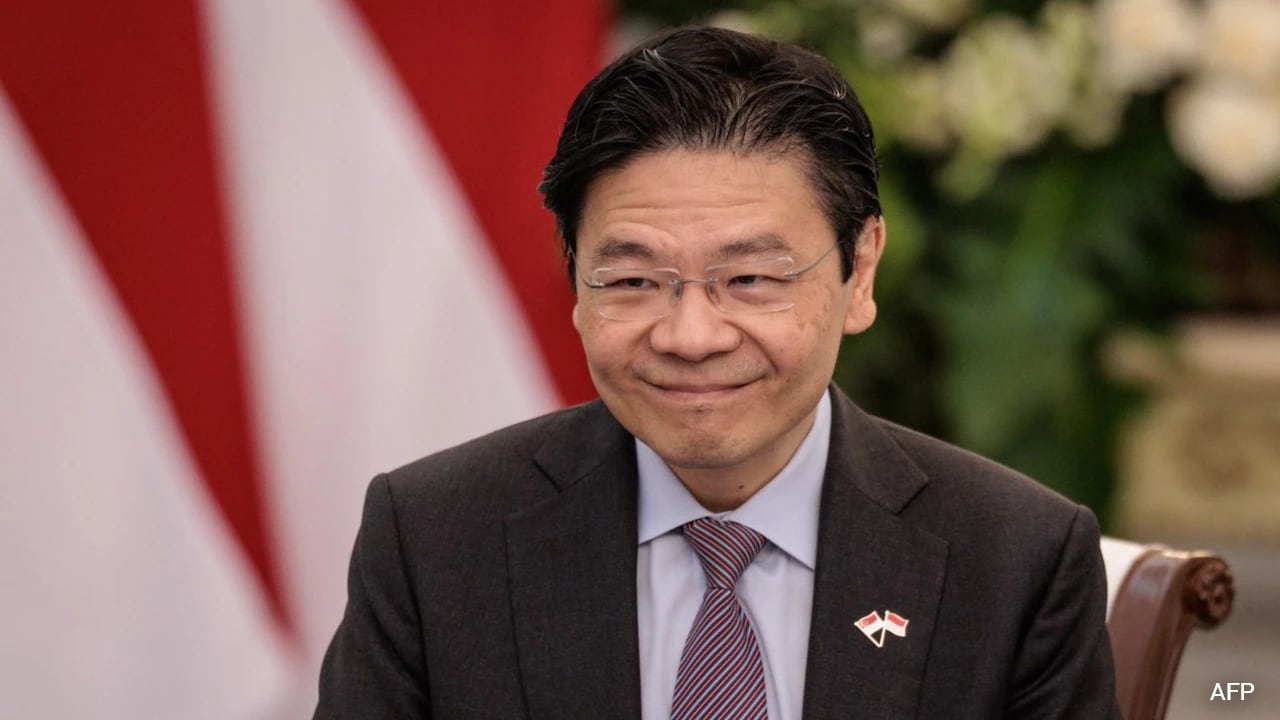
Most politicians take pay cuts or freeze their wages when public pressure mounts, but Singapore plays by an entirely different rulebook. Prime Minister Lawrence Wong's annual paycheck is about to jump by roughly one million dollars, pushing his benchmark salary to a staggering $2.8 million. He already sat comfortably at the top of the global leader pay scale. Now, he's widening the gap.
If you look at global politics, this kind of compensation is practically science fiction. US President Donald Trump draws a modest $400,000, and British leaders bring home a fraction of that. Yet Singapore defends its astronomical government salaries with brutal pragmatism. They want elite corporate talent running the country, and they are willing to pay Wall Street-level money to get them.
The Math Behind a Multi Million Dollar Politician
Let us look at the actual numbers because they defy traditional governance norms. Under the newly announced overhaul, Singapore's political salary framework is getting its first major adjustment in fifteen years. Prime Minister Lawrence Wong's benchmark package is moving from S$2.2 million to S$3.6 million, which translates to roughly $2.8 million USD.
Junior cabinet ministers aren't left behind either. Their baseline figures are climbing from S$1.1 million to S$1.8 million. Even so, officials won't instantly pocket the maximum amount on day one. A phased rollout begins with a one-time nine percent adjustment, tying future bumps tightly to individual performance and national economic metrics.
To put this in perspective, consider the local economic reality. The median monthly wage for a citizen sits around S$5,775. When a national leader earns in a single week what an average worker makes in a year, eyebrows shoot up. Prime Minister Wong himself admitted in parliament that political remuneration is a deeply emotive issue. To soften the political blow of the announcement, he publicly committed to donating his entire personal salary increase to charity for the next five years.
Why Singapore Pays Its Leaders Like Corporate CEOs
The rationale boils down to a single fear: institutional rot through underpaid incompetence. Singaporean statecraft operates on the belief that cheap politicians are expensive in the long run.
If a government pays peanuts, it attracts individuals who view public office as an avenue for personal enrichment or backroom deals. By benchmarking ministerial pay against the top 1,000 earners in the private sector—applying a deliberate forty percent discount for public service—the nation attempts to draw top-tier corporate executives, engineers, and legal minds into public office.
Singapore constantly points to its spotless corruption rankings as proof of concept. When you pay a minister millions, the financial temptation to accept a bribe drops significantly. It is an expensive insurance policy against systemic graft. Over the past fifteen years, private sector salaries and top civil service wages climbed steadily. Without this adjustment, government posts risked becoming a career downgrade for the exact kind of brilliant minds the country relies on to manage its trade hubs and financial systems.
The Public Backlash and Political Cost
Despite the cold logic, public sentiment isn't entirely thrilled. Social media feeds and public forums lit up with criticism, calling the timing tone-deaf. Recent economic data shows rising living costs and a spike in local retrenchments. Telling a populace worried about grocery bills and job security that the prime minister needs a million-dollar raise is a tough sell.
Critics also point out a glaring irony. While cabinet ministers enjoy lavish compensation packages, mandatory national service conscripts receive wages that barely clear subsistence thresholds. That juxtaposition creates a persistent underlying tension. The ruling People's Action Party has weathered this storm before. Back in 2011, public anger over soaring ministerial pay sliced their electoral mandate down to historic lows, forcing a rare thirty-six percent pay cut the following year.
What This Means for Global Governance
Singapore remains an anomaly on the world stage. Most democracies pretend that political leaders are selfless public servants who survive on idealism alone, even as many politicians exit office significantly wealthier than when they entered. Singapore strips away the hypocrisy. They treat governing a country like managing a massive multinational corporation, complete with executive bonuses and market-rate salaries.
Whether this aggressive compensation model can survive mounting populist friction remains an open question. Lawrence Wong is betting that public grumbling is a fair price to pay for maintaining a hyper-competent technocracy. As global political systems struggle with institutional decay and administrative failure, the rest of the world will be watching closely to see if buying the best talent actually delivers better countries.