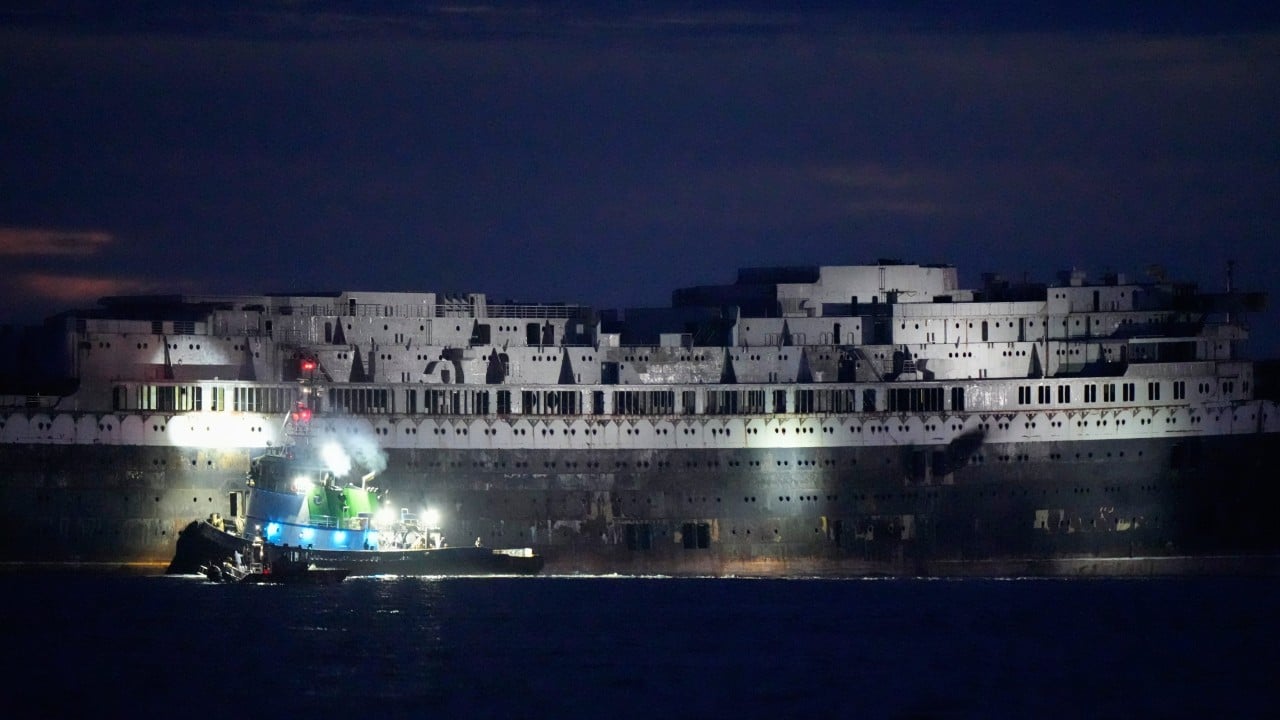
They call it conservation. The press releases gush about marine habitats, diving tourism, and giving a legendary maritime icon a noble second life beneath the waves. Everyone claps. The county commissioners cut a ribbon, the local dive shops pre-book charters for three years, and a massive steel hull slips beneath the surface to become the "world's biggest artificial reef."
It is a lie. Or, at best, a wildly expensive illusion dressed up as environmentalism.
When coastal municipalities spend tens of millions of dollars scuttling a historic ocean liner like the SS United States, they are not saving the ocean. They are executing a real estate play for scuba divers while quietly creating an ecological trap, offloading hazardous industrial waste onto the seafloor, and distracting taxpayers from the real reasons coastal ecosystems are dying.
I have spent years watching coastal authorities and maritime salvage outfits pitch these megaprojects. I have seen counties blow eight-figure budgets on towing, remediation, and hull prep, swearing up and down that a sunken cruise ship will magically resurrect dead fisheries. Meanwhile, the actual biological reefs three miles away continue to bleach and suffocate under agricultural runoff.
If you want to understand why sinking giant ships is one of the most seductive scams in modern marine management, you have to stop listening to tourism boards and start looking at the biology, the chemistry, and the balance sheets.
The Ecological Trap Nobody Talks About
The standard pitch for sinking a massive ocean liner goes like this: bare sand equals a marine desert; drop a 1,000-foot steel structure onto that sand, and suddenly you have an oasis teeming with grouper, snapper, and sponges.
Here is the problem. Fish are not stupid, and artificial reefs rarely produce new biomass. They concentrate existing biomass.
Marine biologists call this the attraction versus production debate, and for large steel wrecks, the data leans heavily toward attraction. When you drop a giant metal apartment complex onto a flat seabed, you act like a dinner bell for every predatory fish within ten miles. Reef-associated fish leave natural ledges and rubble fields—where they were spread out and harder to catch—and swarm the new wreck because its high-relief vertical structure offers immediate shelter from currents and larger predators.
Then what happens? The charter boats show up.
Because every fish in the zip code is now concentrated on a single GPS coordinate, recreational and commercial anglers hammer the population with ruthless efficiency. You haven't built a nursery. You have built a fish-aggregating device that makes overfishing vastly easier. Studies from institutions like the Florida Fish and Wildlife Conservation Commission and independent marine researchers have repeatedly warned that without strict no-take zones around major wrecks, artificial reefs accelerate localized stock depletion rather than reversing it.
Steel Is Not Coral
Even if you ban fishing on the wreck entirely, a steel hull is a terrible substitute for limestone.
Natural coral reefs are built from calcium carbonate. They have millions of micro-crevices, porous surfaces, and chemical signatures that attract coral larvae—specifically crustose coralline algae, the biological glue that tells baby corals where to settle and grow.
Painted, rolled marine steel is smooth, non-porous, and chemically foreign. Yes, barnacles, hydroids, and tunicates will coat a sunken liner within months. Divers love it because it looks dramatic through a wide-angle lens. But encrusting invertebrates are not a reef ecosystem. True reef-building stony corals struggle to colonize vertical steel plates, and when they do manage to attach, the underlying metal eventually corrodes and sloughs off, taking the coral colony down with it into the silt.
The Toxic Elephant on the Seafloor
Before an ocean liner can be sunk, regulators like the U.S. Environmental Protection Agency require contractors to strip out hydrocarbons, asbestos, loose wiring, and polychlorinated biphenyls (PCBs).
Ask anyone who has actually worked inside a mid-20th-century shipyard what happens during these remediation contracts. You cannot get it all out. It is physically and financially impossible.
A massive ocean liner built in the 1950s or 1960s is a floating museum of legacy industrial toxins. PCBs were baked into electrical cable insulation, rubber gaskets, adhesives, paint primers, and ventilation dampeners. Asbestos was sprayed into bulkheads and wrapped around miles of piping. Heavy metals—lead, mercury, cadmium, tributyltin—are bonded directly into layers of anti-fouling hull paint and structural coatings.
Remediation crews remove the obvious hazards: fuel tanks, transformers, flaking paint, and accessible insulation. Then the ship goes down. Over the next fifty to eighty years, saltwater does what saltwater always does. It eats the steel. As bulkheads collapse and paint layers delaminate under pressure and corrosion, those trapped legacy contaminants leach directly into the benthic food web. Bottom-feeding invertebrates ingest the heavy metals and PCBs, small fish eat the invertebrates, and top predators bioaccumulate the toxins.
Calling this "ocean conservation" is like burying a stripped-down, paint-covered locomotive in a national forest and calling it a wildlife sanctuary. If a private corporation dumped 50,000 tons of painted, PCB-laced structural steel onto the continental shelf, the executives would go to prison. When a county tourism board does it with a famous ship, they get a feature story in the Sunday paper.
Follow the Money
If the ecological case for sinking ocean liners is shaky at best, why do coastal governments keep writing massive checks to do it?
Because it is brilliant economic theater.
Consider the math behind a flagship reefing project. Buying the retired vessel, towing it across open ocean, stripping hazardous materials for two years, cutting diver access holes, and rigging explosive scuttling charges easily runs between $10 million and $20 million. Sometimes more.
Politicians love spending money on a single, photogenic asset. You can put a sunken ocean liner on a billboard. You can sell commemorative T-shirts. You can measure hotel bed taxes and dive charter receipts within twelve months of the sinking and declare the project an instant return on investment.
Now compare that to actual marine restoration. Real restoration looks like:
- Upgrading aging municipal sewage treatment plants so nitrogen and phosphorus stop triggering toxic algae blooms.
- Buying back coastal wetlands and restoring mangrove estuaries where juvenile fish actually spawn and grow.
- Enforcing strict agricultural fertilizer runoff limits upstream.
- Deploying small-scale, pH-neutral limestone reef modules in shallow, sunlit waters where stony corals can actually survive.
None of those things make for a viral video of a ship blowing up and sinking in slow motion. Upgrading a wastewater plant takes ten years, costs $100 million, and wins zero press conferences. Sinking a famous liner takes two years, delivers explosive B-roll for the evening news, and lets politicians claim they are "green" while ignoring the sewage pipes dumping nutrients into the bay right behind them.
Are Artificial Reefs Ever Worth It?
To be completely fair, dismissing every artificial reef on earth would be just as lazy as praising every sunken ocean liner. Context, scale, and material matter.
Small-scale artificial reefs made from marine-grade limestone or pH-balanced concrete—placed in shallow water at depths between 30 and 60 feet—can genuinely jumpstart coral recruitment. In areas where hurricanes, ship groundings, or dredging have obliterated natural hardbottom habitat, engineered limestone structures provide the exact mineral substrate that coral larvae need to anchor and calcify.
Even certain decommissioned naval vessels, when stripped down to bare metal and placed strategically in areas with strong, nutrient-rich currents, can serve as useful decompression sites for technical divers—taking human pressure off fragile, overcrowded natural reefs nearby. If 50,000 scuba divers kick their fins over a sunken ship instead of crashing into delicate staghorn coral colonies three miles away, the natural reef gets a much-needed break.
That is a valid management tool. Call it diver diversion. Call it recreational infrastructure. Just stop calling it habitat creation.
What Needs to Happen Instead
If you are a taxpayer in a coastal county, a scuba diver who actually cares about the ocean, or a policymaker looking at a proposal to sink a retired vessel, stop asking how big the wreck will be. Start asking questions that force real accountability.
- Demand a Total Lifecycle Toxicity Audit. Before a single dollar of public money goes toward acquiring a retired ship, require independent testing of core hull samples and paint layers for PCBs and heavy metals—not just visual inspections of stripped compartments. If the hull is loaded with legacy toxins, scrap it on land where steel can be recycled safely.
- Tie Reef Funding to Water Quality Metrics. Never approve public funds for an offshore artificial reef unless the municipality simultaneously meets strict targets for nearshore wastewater treatment and stormwater runoff. Dropping a wreck into polluted, warming, nutrient-choked water is pointless.
- Mandate Permanent No-Take Zones on Mega-Wrecks. If a giant ship goes down, ban all hook-and-line fishing and spearfishing within a half-mile radius. If the goal is genuinely to rebuild fish populations rather than subsidize charter captains, let the wreck function as an actual marine reserve.
- Shift Budgets to Limestone and Estuaries. Dollar for dollar, restoring oyster beds, seagrass meadows, and shallow limestone patch reefs produces orders of magnitude more marine biomass than sinking a deep-water steel monument.
The next time a press release celebrates the sinking of a legendary ocean liner as a triumph for marine life, look past the spectacle of the falling hull. Look at the water quality on the shoreline, check the fishing regulations over the wreck, and look at where the public money didn't go. The ocean doesn't need more scrap metal—it needs us to stop poisoning the reefs we already have.