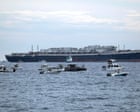
The fastest ocean liner ever built now rests on the floor of the Gulf of Mexico, intentionally sunk off the coast of Okaloosa County, Florida, to become the world’s largest artificial reef. After decades of rusting at a Philadelphia pier, passing through the hands of preservationists, cruise lines, and real estate developers, the SS United States met its final berth not in a scrapyard or a museum, but beneath roughly 180 feet of saltwater.
This decision ends a thirty-year stalemate over maritime preservation and municipal economics. By scuttling the 990-foot vessel rather than dismantling it for scrap metal, Florida officials secured an instant magnet for the global scuba diving industry while solving a chronic ecological deficit along the sandy bottom of the northern Gulf.
The Anatomy of a Maritime Compromise
Preservationists wanted a floating hotel. Scrap dealers wanted the steel. Okaloosa County wanted tourists.
For nearly three decades, the SS United States sat at Pier 82 along the Delaware River, its iconic red, white, and blue funnels flaking into the water while the SS United States Conservancy burned through millions of dollars just to pay dockage fees. Built in 1952 as a Cold War hybrid—designed to carry luxury passengers in peacetime and 14,000 troops at speeds exceeding 38 knots in wartime—the vessel was an engineering marvel. Yet, that exact military-grade construction made restoring it commercially impossible. Every interior bulkhead, deck, and fixture had been stripped out in the 1990s to remove asbestos, leaving behind a hollow, 990-foot steel shell with no engines, no wiring, and no plumbing.
To turn that shell into a modern waterfront attraction would have required upwards of half a billion dollars in capital, a figure no private investor was willing to underwrite in a volatile commercial real estate market. When a rent dispute with the pier operator triggered an eviction notice, the clock ran out.
Enter Okaloosa County. Located along the Florida Panhandle between Pensacola and Panama City, the county already operates an aggressive artificial reef program. By purchasing the ship and funding its towing, environmental remediation, and controlled sinking—a multi-million-dollar enterprise—local officials bypassed the impossible economics of maritime restoration. Instead of trying to make the ship float as a profitable business, they paid to sink it so it could generate revenue underwater.
How You Clean a Cold War Leviathan
You cannot simply tow an ocean liner offshore and open the sea cocks. Modern environmental regulations turn ship-sinking into a grueling industrial cleanup operation.
Before the SS United States could touch the Gulf floor, specialized marine contractors had to strip the hull of every conceivable pollutant under strict Environmental Protection Agency guidelines. Even though the major asbestos abatement occurred decades ago in Turkey and Ukraine, inspectors still had to hunt down residual polychlorinated biphenyls (PCBs) in old wiring insulation, heavy metals in flaking hull paint, hydraulic fluids, fuel sludge, and non-biodegradable plastics.
- Fuel and Oil Extraction: Crews pumped out lingering bunkers and steam-cleaned tanks to ensure zero hydrocarbons would leach into the water column upon submersion.
- Diver Safety Modifications: Engineers cut massive access holes through interior bulkheads and exterior hull plates, removing doors and hatches so recreational and technical divers cannot become trapped inside dark, disorienting compartments.
- Stability Engineering: Naval architects calculated exact flooding sequences, placing cutting charges and controlled valves to guarantee the massive hull landed upright on the seabed rather than rolling onto its side.
If a ship lands on its side, its profile collapses, ruining both diver navigation and the vertical relief that attracts pelagic fish. Precision matters.
The Ecology of Submerged Steel
The northern Gulf of Mexico has a structural problem. Much of its nearshore continental shelf consists of flat, featureless sand and mud, offering very little natural limestone ledge for marine organisms to anchor onto. Without hard substrate, juvenile fish have nowhere to hide from predators, and coral larvae drift aimlessly until they die.
When a massive steel structure hits that barren seabed, biological succession begins within hours.
First comes the biofilm—a microscopic layer of bacteria and algae that coats the bare metal. Within weeks, barnacles, bryozoans, and hydroids cement themselves to the hull, creating a rough texture that traps organic matter. Over the course of several years, soft corals, sponges, and stony corals take hold, transforming flat steel plates into a three-dimensional living matrix.
This vertical structure acts as an ecological oasis. Baitfish like sardines and cigar minnows swarm around the upper superstructure to feed on plankton pushed upward by deep-water currents. Those baitfish draw in larger predators: amberjack, red snapper, grouper, barracuda, and cobia. Even whale sharks and manta rays routinely cruise past deep-water wrecks in the Panhandle.
Yet marine biologists remain divided on one critical question: do artificial reefs actually produce new fish, or do they merely aggregate existing populations?
Production Versus Attraction
This is the central friction in modern reef management. If a sunken ship simply acts as a giant magnet, pulling snapper away from natural rock formations and concentrating them in one predictable GPS coordinate, it makes those fish vastly easier for commercial and recreational anglers to wipe out.
Proponents argue that the sheer surface area of a 990-foot liner—nearly 100 feet longer than the USS Oriskany, the aircraft carrier sunk off Pensacola in 2006 that previously held the title of world’s largest artificial reef—creates enough new habitat and food web support to genuinely boost regional biomass. Skeptics point out that without strict catch limits and no-take zones directly over the wreck, intense fishing pressure can strip a new artificial reef of its apex predators within two seasons.
The Economic Math of Scuttling History
Okaloosa County did not spend taxpayer and tourism-development dollars out of altruism. They did it because wreck diving is recession-proof luxury tourism.
Consider the precedent set by the USS Oriskany, located roughly 24 miles southeast of Pensacola. In the years immediately following its sinking, local charter operators reported a massive surge in bookings from international divers traveling specifically to log time on the "Great Carrier Reef." Those divers do not just pay for boat charters; they book beachfront hotels for a week, rent vehicles, eat at local seafood restaurants, and buy high-end gear from local dive shops.
The SS United States offers an even broader appeal. While the Oriskany appeals primarily to military history buffs and deep-water technical divers, the SS United States carries the glamour of mid-century transatlantic travel. It carried four U.S. presidents, Hollywood royalty, and still holds the Blue Riband for the fastest transatlantic crossing by a passenger liner—a record set on its maiden voyage in 1952 that stands unbroken today.
For the Destin-Fort Walton Beach tourism corridor, branding the ship as the centerpiece of a land-and-sea museum complex creates a year-round revenue engine. Even non-divers can visit the planned land-based museum featuring the ship’s original funnels, propellers, and radar mast, while certified divers descend into the blue to swim past the promenade deck.
What Was Lost Beneath the Waves
Still, watching an American industrial icon vanish beneath the surface leaves a bitter aftertaste for maritime historians.
The SS United States was built entirely in America by Newport News Shipbuilding, utilizing classified naval architecture designed by William Francis Gibbs. Its aluminum superstructure was the largest ever constructed at the time, engineered specifically to save weight and maximize speed. Unlike the RMS Titanic or the RMS Queen Mary, which were British, this vessel was the definitive symbol of postwar American engineering dominance.
To put the scale of this loss into perspective, imagine a hypothetical scenario where France decided the Eiffel Tower was too expensive to paint, dismantled its upper floors, and sank the iron lattice in the Mediterranean to boost local lobster yields. To maritime preservationists, scuttling the SS United States feels remarkably
The Brutal Economics Behind Sinking America’s Greatest Ocean Liner Off Florida
news, business
The SS United States, the fastest ocean liner ever built to cross the Atlantic, is destined for the bottom of the Gulf of Mexico off the coast of Okaloosa County, Florida, to become the world’s largest artificial reef. Purchased in 2024 for roughly $10 million after decades of decay at a Philadelphia pier, the 990-foot vessel will be stripped of hazardous materials and scuttled to create a massive marine habitat and dive tourism magnet. While press releases celebrate this as an ecological triumph, the sinking of the SS United States actually exposes a harsh reality about maritime preservation, municipal debt, and the high cost of environmental remediation.
For nearly thirty years, the ship sat rusting along the Delaware River, a massive steel ghost towering over a South Philadelphia IKEA parking lot. Every attempt to save her—from luxury hotel conversions to floating tech campuses—collapsed under the weight of nine-figure restoration estimates. When a landlord dispute finally forced an eviction from Pier 82, sinking the vessel became the only financially viable exit strategy left on the board.
The Illusion of Maritime Preservation
People love the idea of saving historic ships until they see the dry-dock bill. Maintaining a mid-century steel hull in saltwater is a losing battle against basic chemistry. Electrolysis and oxidation never sleep, and without constant, multimillion-dollar dry-docking cycles, a decommissioned ocean liner quietly rots from the waterline down.
The SS United States was built in 1952 as a Cold War dual-use asset. Subsidized heavily by the federal government, she was engineered to carry 15,000 troops at speeds exceeding 35 knots, featuring a top-secret hull design and an absolute ban on wood anywhere in her interior to prevent catastrophic fires at sea. Even the grand piano in the ballroom was custom-made from fireproof aluminum. That same Cold War over-engineering made her nearly impossible to repurpose for modern commercial use. Her bulkheads were compartmentalized for wartime survivability, not open-concept retail or luxury suites.
Preservationists spent decades raising millions of dollars, yet that money barely covered the rent, insurance, and minimal security required to keep squatters and scrap thieves off the decks. You cannot save a 990-foot ship with bake sales and nostalgia. When Pier 82’s operators doubled the daily dockage fees and a federal judge ordered the vessel evicted, the SS United States Conservancy ran out of runway. Selling the ship to Okaloosa County wasn't a victory for history; it was a managed surrender to maritime economics.
How You Actually Sink a 990-Foot Leviathan
Scuttling a vessel larger than the Titanic is not as simple as towing it offshore and opening the sea cocks. It is a multi-year, hyper-regulated demolition and environmental engineering project that costs millions more than the purchase price of the hull itself.
Before a single explosive charge is placed, remediation crews must strip the ship down to bare painted steel. Built in the early 1950s, the SS United States was insulated with miles of asbestos piping, wired with polychlorinated biphenyls (PCBs) in her electrical cables, and coated in layers of lead-based paint and toxic tributyltin anti-fouling coatings. Under strict Environmental Protection Agency (EPA) and U.S. Coast Guard regulations, virtually all of these materials must be removed before the hull touches the ocean floor.
The Remediation Bottleneck
The environmental preparation alone accounts for the lion's share of the project's multi-million-dollar budget. Crews have to cut massive access holes into the steel hull just to haul out old machinery, fuel residue, and hazardous insulation. Every gallon of residual oil in the bilges and double-bottom tanks must be pumped, scrubbed, and certified clean.
Once the environmental hazards are cleared, naval architects must calculate the exact physics of the sinking. If a 990-foot ship rolls onto its side during descent, it can collapse inward, creating a tangled hazard for divers and ruining the vertical relief that attracts pelagic fish. Engineers cut precise flooding ports into specific compartments and place shaped explosive charges along key structural bulkheads to ensure the vessel sinks upright, landing squarely on its keel in roughly 180 feet of water.
The Artificial Reef Economy and the Dive Tourism Gamble
Okaloosa County did not spend upwards of $10 million—factoring in acquisition, towing, remediation, and deployment—out of pure altruism for marine biology. This is a calculated municipal infrastructure investment aimed squarely at the recreational diving and sportfishing industries.
The Florida Panhandle already boasts a dense network of artificial reefs, because the natural seafloor of the northern Gulf of Mexico is predominantly flat, featureless sand and mud. Without hard structure, marine ecosystems struggle to establish complex food chains. Drop a massive steel hull onto that barren sand, and within months, barnacles, sponges, and corals colonize the metal. Baitfish follow the encrusting organisms, drawing in red snapper, grouper, amberjack, and pelagic predators like king mackerel and cobia.
Following the Money in Destin-Fort Walton Beach
Local tourism officials are betting on the precedent set by the USS Oriskany, a 888-foot Essex-class aircraft carrier sunk off nearby Pensacola in 2006. The Oriskany—dubbed the "Great Carrier Reef"—generated tens of millions of dollars in direct economic impact within its first decade, drawing international dive charters, filling hotel rooms during shoulder seasons, and boosting charter fishing revenues.
Okaloosa County wants to steal that crown. By securing a vessel over 100 feet longer than the Oriskany, the county instantly claims the global marketing title for the world's largest artificial reef. Dive operators can charge premium rates for multi-tank excursions to a famous ocean liner, while local restaurants, hotels, and tackle shops capture the ancillary spending.
Yet the financial math carries undeniable risks. Deploying the ship at a depth of around 180 feet puts the main superstructure well beyond the 60-to-100-foot range of standard recreational open-water divers. To explore the deeper decks, divers will require advanced certifications, technical training, and mixed-gas setups like nitrox or trimix. While the upper funnels and bridge wings may sit closer to the surface—accessible to standard advanced divers—the sheer depth limits the total addressable market of casual vacationers who can actually visit the wreck.
What Environmentalists Rarely Admit About Reefing Ships
The phrase "artificial reef" sounds inherently green, conjuring images of vibrant coral gardens and thriving biodiversity. Reality under the waves is far more complicated, and marine biologists remain divided on the true ecological value of sinking massive steel ships.
The core scientific debate centers on attraction versus production. Does a massive artificial reef actually increase the total biomass of fish in the Gulf of Mexico, or does it simply act as a giant underwater magnet that pulls existing fish away from natural reefs, concentrating them in one spot where charter boats can easily harvest them?
If a sunken ocean liner merely aggregates red snapper without increasing their overall reproduction and survival rates, it can inadvertently accelerate overfishing. Fishery managers have to adjust catch limits and seasonal closures accordingly, creating friction between conservationists, commercial fishermen, and recreational anglers.
Furthermore, no remediation process is 100% spotless. Even after exhaustive EPA inspections, trace amounts of heavy metals, industrial paints, and synthetic polymers remain locked inside inaccessible seams of a 70-year-old warship-grade hull. Over decades of saltwater corrosion, those trace compounds slowly leach into the surrounding benthic sediment. The hull itself will eventually collapse under the pressure of Gulf hurricanes, flattening the vertical structure that makes it attractive to pelagic species in the first place.
The Unspoken Legacy of American Maritime Decline
Beneath the dive tourism projections and environmental impact studies lies a quieter, more uncomfortable truth. Sinking the SS United States marks the literal submersion of an era when American shipyards and merchant vessels dominated global waters.
When she launched in 1952 from Newport News Shipbuilding in Virginia, the SS United States shattered the transatlantic speed record on her maiden voyage, crossing from New York to Bishop Rock in three days, ten hours, and forty minutes. She won the coveted Blue Riband—a trophy no conventional passenger liner has ever taken back. She was a floating monument to post-war American industrial might, carrying presidents, royalty, and Hollywood icons across the Atlantic in unmatched luxury and speed.
Today, the United States commercial shipbuilding industry accounts for less than one percent of global output, eclipsed entirely by shipyards in China, South Korea, and Japan. America no longer builds flagship ocean liners, and as the fate of this vessel proves, it lacks the institutional will or economic framework to preserve the ones it already built.
The land-based museum planned by Okaloosa County alongside the reefing project will display the ship’s iconic funnels, radar mast, and archival artifacts. Visitors will walk through air-conditioned galleries looking at photographs of a ship that once outran every vessel on earth, while her actual hull sits miles offshore in the dark, slowly dissolving into rust and barnacles for the benefit of charter boat captains and grouper fishermen.