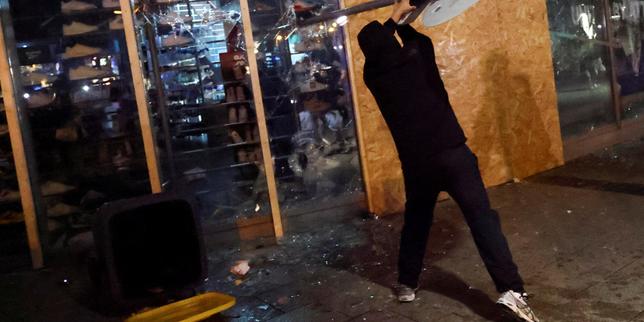
The smell of wet wool and acrid smoke clings to the back of your throat long after the riot vans have pulled away.
If you have ever stood on a rain-slicked cobblestone street in central Berlin or Frankfurt on a Sunday evening, watching municipal workers sweep shattered safety glass into neat, metallic dustpans while the last blue strobe lights reflect off closed shopfronts, you know the eerie quiet that follows a weekend of street clashes. It is a heavy, disorienting silence. Only hours earlier, thousands of ordinary citizens had marched shoulder-to-shoulder under grey skies, holding cardboard placards and chanting slogans about inflation, foreign policy, or the future of their neighborhoods. Then, as dusk fell, the mood shifted. A handful of masked figures peeled off from the edges. Fireworks flew horizontally instead of up. Bottles shattered against riot shields. If you enjoyed this piece, you should check out: this related article.
By Monday morning, the sweepers are gone, the trams are running on schedule, and the physical bruises are hidden beneath heavy coats. Yet inside the glass-and-concrete halls of the Bundestag, the real collision is just beginning.
In Germany, weekend protest violence rarely stays on the pavement. Every thrown paving stone triggers an immediate, fierce political reckoning inside the federal government—a clash not merely over policing tactics, but over the soul of a democracy haunted by its own history. For another perspective on this development, check out the recent update from USA Today.
The Anatomy of a Fractured Weekend
To understand why a few dozen agitators in black hoodies can paralyze a coalition government in Berlin, consider a hypothetical composite of what unfolds across German cities during moments of high political tension.
Imagine Lukas, a twenty-nine-year-old patrol officer from Lower Saxony, bused into the capital on a Friday night to reinforce local units. He spends twelve hours standing in heavy protective gear, his visor fogging up in the cold drizzle, trying to distinguish between a retired schoolteacher exercising her constitutional right to peaceful assembly and an organized extremist looking for a camera-ready confrontation. Two hundred meters away stands Miriam, a small-business owner who joined the march out of genuine economic anxiety, suddenly caught in a crush of people panicked by the hiss of pepper spray and the boom of flashbangs.
Neither Lukas nor Miriam asked for the escalation. Both become collateral damage in a political theater neither controls.
When the Interior Ministry releases the weekend tally on Monday morning—dozens of injured officers, hundreds of temporary detentions, shattered windows along a major shopping artery—the numbers land like grenades in the Chancellery. Because in Germany’s multi-party coalition system, governing partners rarely view the same street scene through the same lens.
One faction sees a breakdown of public order. To them, the state’s monopoly on force is the bedrock of freedom; without firm boundaries, the street belongs to whoever shouts loudest or throws hardest. They demand tougher sentencing, expanded surveillance powers, faster judicial processing, and ban zones for repeat offenders. Another wing of the very same government looks at the exact same footage and sees the danger of overreach. Raised on the post-war vigilance that birthed Germany’s Grundgesetz—the Basic Law—they worry that tightening the screws in response to fringe violence will inevitably choke the peaceful majority.
They are both right. And that is precisely why the debate turns so venomous.
A Democracy Built on Scar Tissue
Outsiders often misread German politics as a machine of predictable consensus. In reality, it is a system built deliberately on friction, designed in the ashes of 1945 to ensure that no single authority could ever again silence dissent—and that no street mob could ever again intimidate parliament into submission.
Think of Germany’s constitutional protections for assembly as a heavy, reinforced fire door. During the Weimar Republic, extremist militias turned city streets into battlegrounds, eroding public faith in democratic institutions until the state collapsed from within. When the authors of the Basic Law drafted Article 8—guaranteeing all Germans the right to assemble peacefully and without arms—they were building a sanctuary for civic voice. At the same time, they handed the state a strict mandate to protect the peace.
Walking that line in real time is like trying to perform surgery while riding a bicycle over cobblestones.
When protest violence erupts over a weekend, the political fallout inside the coalition exposes deep philosophical fault lines that routine legislative weeks manage to hide. Conservative and law-and-order voices within the government argue that hesitation invites chaos. If police are forced to retreat, or if prosecutions drag on for eighteen months only to end in suspended fines, the deterrence evaporates. Meanwhile, liberal and left-leaning partners point out a stubborn empirical reality: heavy-handed policing tactics—such as prolonged Kessel encirclements, where crowds are penned in for hours regardless of individual guilt—often radicalize bystanders who came simply to march.
I remember speaking years ago with a veteran constitutional lawyer in Karlsruhe who described the German state’s dilemma with a metaphor I have never forgotten. Democracy, he said, is like a glass greenhouse heated in winter. If you smash the panes to let out the smoke, everyone inside freezes; if you seal every crack so tightly that no air moves, the pressure builds until the glass explodes on its own.
The Invisible Stakes Behind the Headlines
Strip away the partisan point-scoring in Berlin’s press conferences, and the stakes become intensely personal. When weekend demonstrations turn violent, three quiet casualties rarely make the evening news.
First is the silent withdrawal of the moderate middle. Most people who attend rallies are not activists by trade. They are nurses, apprentices, parents pushing strollers, and pensioners who feel their voices are missing from policy papers. The first time they find themselves choking on tear gas because thirty agitators hijacked the tail end of a permitted route, they do not become radicals. They simply stay home next time. Slowly, demonstrably, the public square empties of ordinary life, leaving the megaphone to the fringes.
Second is the quiet exhaustion of the people paid to stand in the middle. Germany’s police forces—both federal Bundespolizei and state units—have logged millions of overtime hours over the past several years managing overlapping crises, from energy protests and geopolitical marches to polarizing domestic rallies. Behind every helmet is a human being who goes home to a family, scrolling past social media clips that reduce a twelve-hour shift of de-escalation to a six-second video edited for maximum outrage. Morale does not collapse in a single dramatic walkout; it erodes quietly in transfer requests, sick days, and hardened attitudes on both sides of the barricade.
Third is the weaponization of perception. We live in an era where a single burning trash bin in a single district can be looped endlessly online until millions of people believe an entire metropolis is burning. Opposition parties seize the footage to paint the government as weak and out of touch. Foreign disinformation networks amplify the chaos to portray Western democracies as ungovernable. Inside the governing coalition, ministers suddenly feel forced to legislate at the speed of a viral clip rather than the pace of sober evidence.
Why Easy Answers Always Fail
Whenever these weekend clashes dominate the Monday news cycle, the loudest voices reach immediately for sweeping new laws. Ban certain symbols. Lower the threshold for preventive detention. Mandate body cameras, or restrict them. Expand the list of prohibited gatherings.
Yet anyone who has spent time studying European public-order policing knows a frustrating truth: Germany already possesses some of the most detailed, rigorous assembly laws in the democratic world. Local authorities have broad power to impose strict conditions on routes, banners, and sound levels, and courts routinely review those decisions within hours on weekend emergency dockets.
The problem is rarely a missing paragraph in the criminal code. The bottleneck lies in execution, intelligence, and speed.
When police intelligence successfully identifies violent splinter groups before they merge into a peaceful crowd, officers can isolate them without disrupting thousands of law-abiding demonstrators. When specialized prosecutors process clear-cut assault and property-damage cases within weeks rather than years, consequences feel real and immediate without trampling civil liberties. Conversely, when understaffed municipal offices issue blanket bans that judges strike down on Saturday morning, the state looks simultaneously authoritarian and incompetent—the worst possible combination for public trust.
Even harder to admit is that politics itself sets the temperature on the street. When senior politicians speak in apocalyptic terms, framing policy disagreements as existential battles between good and evil, they unintentionally hand a moral license to those on the fringes who believe rules no longer apply. Words spoken in a televised talk show on Thursday night have a habit of echoing off brick walls on Saturday afternoon.
The Long Walk Home
It is easy to look at the fierce arguments erupting inside the German government after a violent weekend and see dysfunction. Ministers contradicting one another in morning interviews, coalition partners trading veiled barbs over police budgets and civil rights, parliamentary committees summoning officials for tense closed-door briefings—it looks messy, inefficient, and exhausting.
And yet, there is something vital happening inside that noise.
In authoritarian systems, weekend unrest is followed by eerie unanimity—a single official statement, swift mass arrests, and silence in the press. In Berlin, the aftermath is loud, contentious, and unresolved precisely because no one inside the government gets to decide alone where freedom ends and disorder begins. Every argument over riot gear, protest routes, and criminal liability is a live stress-test of a promise made nearly eighty years ago: that the state would protect its citizens without turning into the monster it replaced.
By Tuesday evening, the glass on the cobblestones is gone. The shopkeepers have replaced their cracked windows. On a commuter train heading out of central Berlin, an off-duty police officer in civilian clothes sits three rows behind a university student still wearing a faded wristband from Saturday’s march. Neither speaks to the other. Both stare out the rain-streaked window as the city lights blur past, sharing the same carriage, the same fragile peace, and the unspoken question of what next weekend will bring.