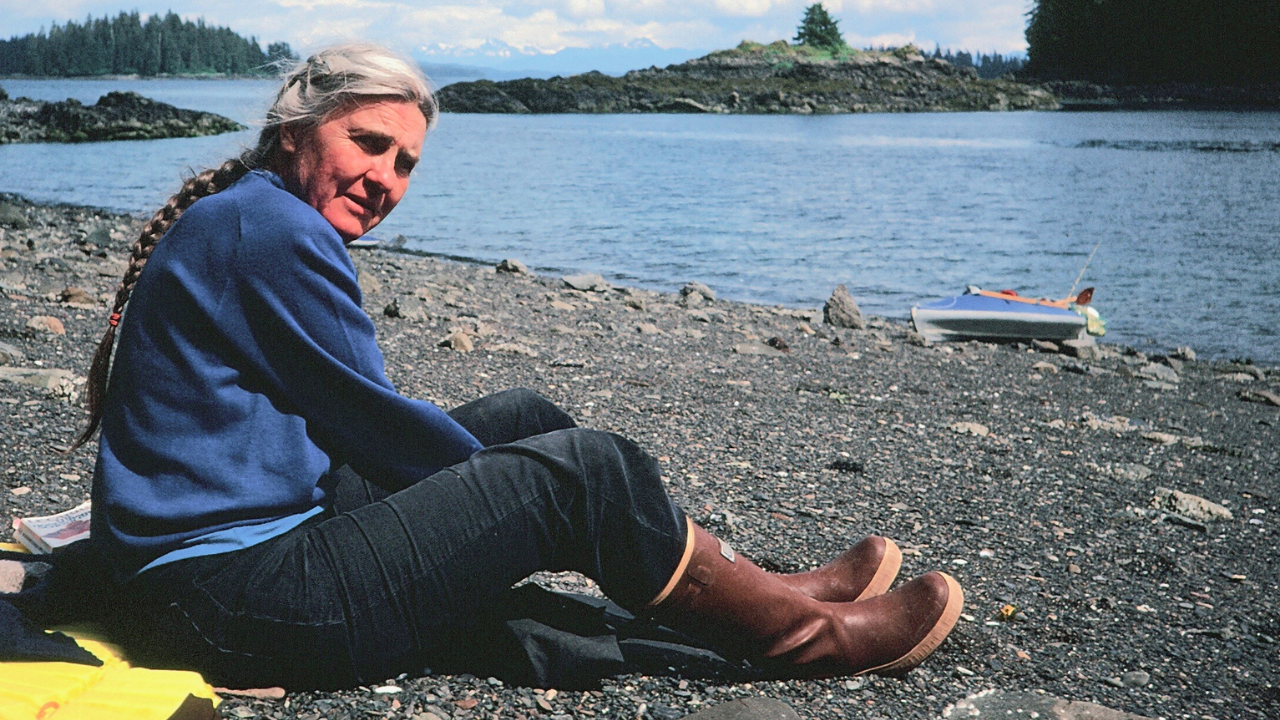
History loves a romantic photograph. Show someone a vintage black-and-white print of a small fabric-covered monoplane banking over an endless sea of jagged spruce, and the human brain instantly supplies an epic soundtrack. We imagine the absolute freedom of the open cockpit, the wind tearing at a pilot's leather helmet, the clean break from a suffocating post-World War II society that expected women to quietly return to suburban kitchens and factory assembly lines.
Celia Hunter did fly that plane. She and her lifelong partner Ginny Hill Wood did indeed pilot a war-surplus Taylorcraft all the way from Washington state up the perilous spine of the British Columbia wilderness and into the raw interior of the Alaska Territory in 1947.
That flight is usually where the romantic versions of the story stop.
The people telling the tale prefer to leave Hunter and Wood suspended in mid-air, forever frozen as daring aviation pioneers who traded convention for clouds. But the airplane was just the delivery mechanism. The real work began the moment the wheels hit the rough, gravel-strewn dirt of a territory that did not care about anyone's romantic ideals, a place where a romantic notion of the wilderness will freeze a person solid within twenty-four hours if they do not know how to bank a cabin's woodstove against a minus-fifty-degree gale.
To understand Celia Hunter is to understand that the aviation feat was the easiest part of her life. The true weight of her legacy rests not in what she flew over, but in what she stood in front of and refused to let move.
She arrived in Alaska at a precise hinge point in the region's history. The territory was trembling on the edge of massive transformation. The military buildup of the Second World War had permanently altered the isolation of the north, introducing heavy infrastructure, permanent airfields, and a sudden influx of outsiders who saw the land not as a living biome, but as a vast ledger waiting to be balanced.
Hunter did not build a cabin near Mount McKinley, now Denali, just to play at being a rugged individualist. She went there because she wanted to live inside a world that still functioned on its own terms.
Her first winter tested every assumption she carried. She and Wood constructed a primitive camp near the park entrance, hauling supplies by hand, learning the vicious rhythm of sub-arctic survival from Athabascan neighbors and old-timers who viewed eager newcomers with well-earned skepticism. There was no romantic solitude when the snow piled six feet deep against the cabin door and the water bucket froze solid by the woodstove overnight. There was only physical labor, endless chopping of dry spruce, meticulous maintenance of kerosene lamps, and the quiet, constant vigilance required to keep frostbite at bay.
Yet the physical hardship of homesteading was merely the baseline. The real battleground was political.
By the early 1950s, Hunter and Wood established Camp Denali, one of the first wilderness-oriented tourist camps in the region. They did not want to cater to the hunters and luxury-seekers who viewed the park as a game farm or a scenic backdrop for trophy shots. They designed Camp Denali as an educational outpost. They wanted visitors to walk the tundra, to count the caribou, to watch the nesting behavior of birds, and to understand that the ecological integrity of the north was a fragile, interconnected web.
This perspective put Hunter on a direct collision course with the entrenched political powers of the territory and the federal government.
At the time, the Alaska Road Commission and various commercial interests viewed Denali National Park primarily as an obstacle to economic extraction. Roads were proposed to slice through pristine migration corridors. Mining claims were staked with impunity. The dominant mindset was that Alaska was a giant resource chest, and anyone trying to preserve its wild character was dismissed as an eccentric obstructionist who did not understand the realities of progress.
Hunter did not flinch. She had spent the war years flying transport planes for the Women Airforce Service Pilots, an elite group of aviators who handled high-stress military aircraft under dangerous conditions while enduring systemic sexism and institutional disrespect. She was not intimidated by gruff territorial politicians, timber lobbyists, or federal bureaucrats in tailored suits who flew into Anchorage for three days and fancied themselves experts on northern land management.
She became a master strategist of conservation long before modern environmental advocacy was professionalized.
The Anatomy of Wilderness Defense
When the federal government began pushing an aggressive dam project on the Yukon River tributaries—a scheme known as the Rampart Dam proposal that would have flooded an area the size of New Jersey, destroying critical waterfowl nesting grounds and disrupting indigenous subsistence patterns—Hunter did not just write letters of protest. She mobilized data. She coordinated coalitions. She understood that bureaucratic machinery is only moved when it is confronted with undeniable, granular facts that make bad policy politically toxic.
She helped found the Alaska Conservation Society in 1960. It was the first homegrown environmental organization in the territory, deliberately created because Hunter and her peers knew that decisions affecting northern lands could not be safely outsourced to distant chapters of national groups in New York or Washington. They needed boots on the ground, voices that understood the specific nuance of permafrost ecology, and leaders who could articulate the value of untamed land without sounding like romantic poets disconnected from economic reality.
Her approach was relentlessly practical. She argued that protecting the land was not merely an aesthetic luxury, but an economic imperative for the long-term viability of the region. Tourism, sustainable fishing, and ecological integrity represented a permanent, renewable economy. Extract-and-abandon policies represented a boom-and-bust cycle that left behind toxic tailings, ruined watersheds, and ghost towns.
History proved her correct, though the victory required decades of trench warfare.
The culmination of her life's work arrived with the passage of the Alaska National Interest Lands Conservation Act in 1980. That monumental legislation protected over one hundred million acres of public land, creating new national parks, wildlife refuges, and wilderness areas. Hunter was not just a spectator to that legislative battle; she was one of its primary architects, working behind the scenes, testifying before Congress, and holding together a fractured coalition of conservationists, native leaders, and scientists.
Beyond the Log Cabin Myth
It is easy to categorize Celia Hunter as a classic hermit, a solitary soul who fled civilization to commune with the mountains. That is a comforting myth that strips women of her era of their political agency, reducing them to colorful local characters rather than rigorous political actors.
Hunter was deeply social, intensely connected to international conservation networks, and fiercely engaged with the world she had supposedly left behind. Her cabin was a salon for visiting biologists, writers, politicians, and activists. She read widely, corresponded globally, and understood the macro-economic forces threatening the globe.
She did not retreat into the wilderness to escape society. She went there to find a vantage point high enough and clear enough to see what society was doing wrong, and then she used every tool at her disposal to fight back.
When visiting the modern entrance of Denali National Park today, tourists ride comfortable buses along paved or gravel corridors, looking for grizzly bears and Dall sheep against the snowy bulk of the mountain. Most of them will never hear her name. The visitor centers feature displays on the geology, the flora, and the indigenous history, but the administrative framework that ensures those animals still have a migration corridor to cross is largely invisible to the casual eye.
That invisibility was often intentional. Hunter did not care about personal fame. She cared about the caribou. She cared about the unfragmented tundra. She cared about keeping the heavy machinery of modern industrial expansion from turning the last great American wilderness into another managed parkland full of souvenir shops and paved parking lots.
The airplane in 1947 was a grand gesture. But the true measure of Celia Hunter's life is found in the administrative records, the committee meetings, the decades of persistent, unglamorous advocacy, and the stubborn refusal to let a magnificent landscape be traded away for short-term gain. She proved that one person with a clear vision, deep local knowledge, and absolute refusal to be intimidated can alter the geography of a continent.
-copy.jpeg?width=1200&auto=webp&trim=17%2C192%2C547%2C1)


