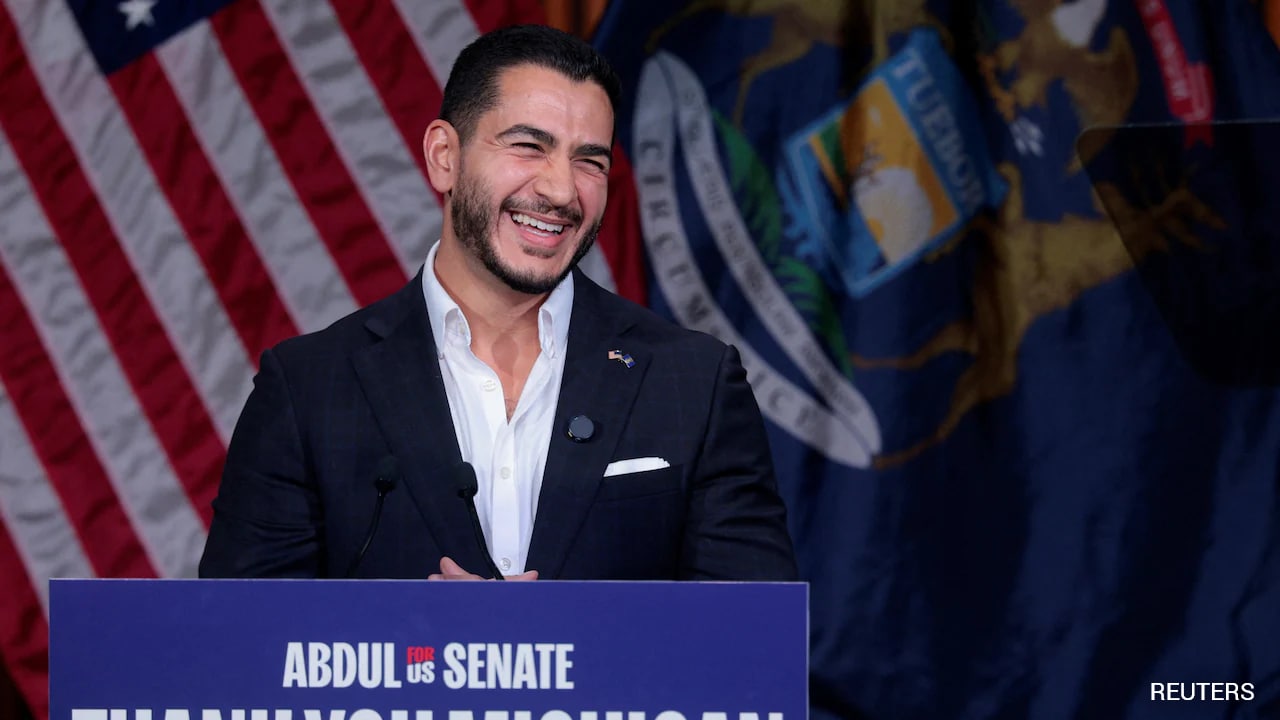
Abdul El-Sayed, the Egyptian-American physician, epidemiologist, and former Detroit health director who rose to national prominence as a progressive Democratic candidate in Michigan—including his high-profile campaigns for governor in 2018 and the U.S. Senate in the 2026 election cycle—has repeatedly faced baseless accusations of extremism and terrorism from Donald Trump and right-wing media surrogates. Labeling a Rhodes Scholar and public health official a "terrorist" is not an isolated slip of the tongue. It is a calculated political tactic designed to weaponize identity, neutralize populist economic messaging, and fracture working-class coalitions in critical swing states like Michigan.
The mechanics of this smear are brutally simple. When a candidate campaigns on Medicare for All, corporate accountability, and rebuilding public infrastructure, traditional political attacks often fall flat with disillusioned voters. Calling a doctor a socialist loses its sting in communities hollowed out by medical debt and deindustrialization. Calling him a threat to national security changes the subject entirely. In related news, take a look at: What That 73% Drop in a Bhutan Glacial Lake Really Tells Us.
How the Terrorist Smear Actually Works in Modern Campaigns
Political operatives have used guilt-by-association tactics for decades, yet the playbook deployed against Muslim American candidates operates on a distinct frequency. It relies on an immediate visual and cultural shortcut. Critics do not need to prove a policy failure or uncover a financial scandal when they can simply point to a candidate's heritage, faith, or community advocacy and let ingrained post-9/11 anxieties do the rest of the work.
During his 2018 gubernatorial run in Michigan, El-Sayed was subjected to persistent conspiracy theories alleging ties to the Muslim Brotherhood—claims thoroughly debunked by independent fact-checkers, Michigan journalists, and bipartisan state leaders. Those same talking points were resurrected and amplified by Donald Trump and aligned political action committees whenever El-Sayed entered the statewide spotlight, including during Michigan's fiercely contested U.S. Senate race following Gary Peters' retirement announcement. BBC News has analyzed this important topic in extensive detail.
The strategy follows a predictable three-step cycle:
- The Fringe Seed: An obscure blog or partisan operative publishes an insinuation linking the candidate's charitable work, student activism, or mosque attendance to extremist networks.
- The Amplification Loop: Cable commentators and social media influencers repeat the claim under the guise of "asking questions," forcing mainstream outlets to report on the controversy itself.
- The Executive Stamp: A top figure like Trump drops the slur at a rally or on social media, instantly legitimizing the smear for millions of voters who never read the underlying debunking.
It works because refutation takes paragraphs, while an insult takes two seconds. By the time a campaign explains that the Muslim Students' Association at the University of Michigan—where El-Sayed served as vice president—is a standard campus religious organization, the rally crowd has already moved on to the next chant.
Why Michigan Is the Ground Zero for Identity Weaponization
To understand why these attacks target El-Sayed with such ferocity, you have to look at the electoral math of the Rust Belt. Michigan is home to one of the largest Arab American and Muslim populations in the United States, centered in cities like Dearborn, Hamtramck, and Detroit. For decades, these communities were treated as reliable Democratic voting blocs, taken for granted by party leadership while rarely seeing representation at the top of the ticket.
That dynamic shattered over the past several years. Foreign policy grievances, economic stagnation, and frustration with establishment Democrats created a volatile electorate in Wayne, Oakland, and Macomb counties. Right-wing strategists recognized an opening: drive a wedge between working-class white voters in the suburbs and Arab and Muslim voters in the urban core.
The Populist Threat to Both Establishments
El-Sayed presents a unique problem for both conservative populists and corporate Democrats. As the executive director of the Detroit Health Department, he rebuilt an agency gutted during the city's bankruptcy, leading efforts to test Detroit public schools for lead and launching programs that distributed free eyeglasses to thousands of schoolchildren. His resume screams pragmatic competence, not ideological fringe.
More dangerously for his opponents, his rhetoric bridges cultural divides. When El-Sayed speaks about insurance executives denying care or chemical companies polluting the Rouge River, he frames those issues around class rather than identity. He argues that a laid-off autoworker in Macomb County and an immigrant small-business owner in Dearborn are being squeezed by the exact same economic machinery.
Trump's brand of populism depends on keeping those two voters suspicious of one another. If they realize their economic interests align, the entire culture-war coalition collapses. Slapping the "terrorist" label onto a candidate like El-Sayed is an emergency brake pulled to stop cross-racial, working-class solidarity before it gains momentum.
The Anatomy of Media Complicity and False Equivalence
Veterans of political journalism know that coverage of Islamophobia in campaign cycles almost always suffers from a structural flaw. Reporters trained in traditional objectivity treat an unsubstantiated slur from a former president as a "heated political exchange" rather than a documented falsehood. Headlines frequently frame the story around the conflict itself—Trump Attacks Opponent Over Faith—which inadvertently validates the premise that there is a legitimate debate to be had.
Consider the double standard applied to public figures:
- Religious Expression: When a Christian candidate cites scripture to justify healthcare or anti-poverty policies, it is covered as moral conviction. When a Muslim candidate draws on Islamic principles of social justice, opponents frame it as creeping theocracy.
- Community Associations: Routine appearances at civic fundraisers or civil rights banquets become "controversial ties" if the hosting organization has an Arabic name.
- National Security Credentials: Despite El-Sayed's career working alongside federal and local agencies on public health emergency preparedness, he is routinely forced to recite loyalty oaths that non-Muslim candidates never face.
This asymmetry exhausts campaigns. Every hour spent addressing manufactured outrage over a candidate's faith is an hour stolen from discussing prescription drug prices, infrastructure funding, or public education. That exhaustion is the entire point.
What History Tells Us About Firsts in the Senate
The U.S. Senate has always been an exclusive club, slow to reflect the country it governs. From the fierce nativist backlash against Catholic candidates in the early twentieth century to the racist smears leveled against Hiram Revels, the first Black senator seated in 1870, every breakthrough in representation has triggered an acute reactionary fever.
Critics who dismiss Trump's rhetoric as mere campaign hyperbole ignore how quickly political language hardens into institutional hostility. When a major political figure normalizes calling a Muslim American public servant a terrorist, it sends an unmistakable signal to local officials, employers, and ordinary citizens across the country. It tells millions of Muslim Americans that no matter how many degrees they earn, how many public agencies they fix, or how many votes they win, their citizenship remains conditional.
Yet the political durability of this tactic is showing signs of wear. Voters in Michigan and across the industrial Midwest have grown cynical about manufactured cultural panics, particularly when those panics are deployed to distract from rising healthcare costs and stagnant wages. During his appearances across the state, El-Sayed has increasingly refused to play defense, pivoting directly from personal attacks back to the material failures of the politicians launching them.
The Real Cost of Normalized Smears
There is a gray area in modern political strategy that consultants rarely admit out loud: ugly tactics persist because, in the short term, they often move polling numbers by two or three points in tightly contested districts. In a state decided by tens of thousands of votes, a smear does not need to convince a majority of the electorate to succeed. It only needs to depress turnout among hesitant voters or sow just enough doubt among undecided moderates to tip the margin.
That cold arithmetic explains why Trump and his allies keep returning to the same well. They are not trying to win an argument about public policy or national security. They are testing whether fear still outperforms hope at the ballot box.
For voters watching the fallout, the takeaway has nothing to do with defending a single politician's resume and everything to do with recognizing a deliberate distraction. Every time a billionaire politician calls a public health doctor a terrorist, look immediately at what legislation, tax cut, or corporate deregulation is being pushed quietly behind the curtain.