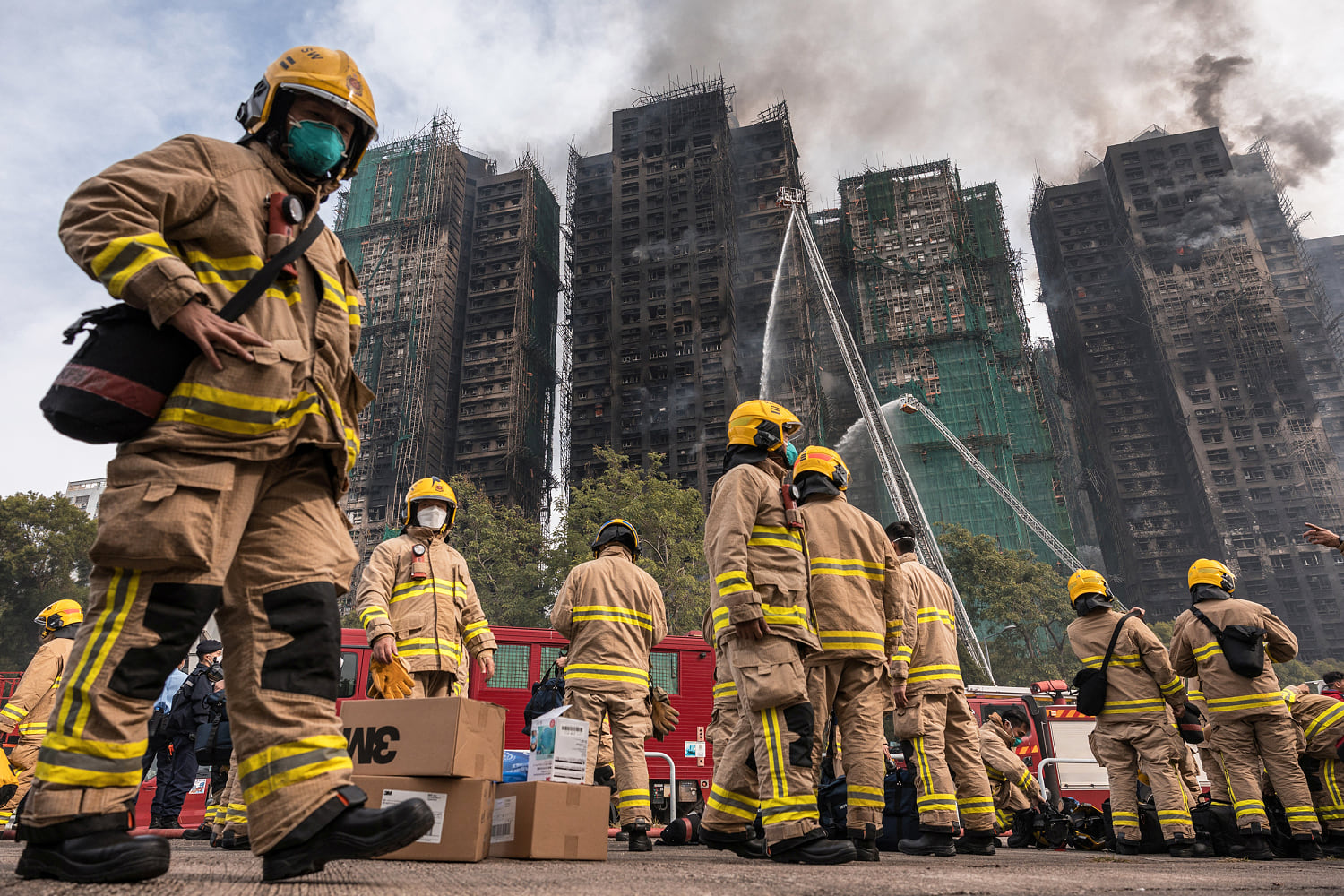
When Hong Kong’s Chief Executive issued a formal public apology following a fatal residential blaze, the gesture was designed to project empathy and administrative control. Instead, it exposed the deep structural vulnerabilities of a governance system engineered to eliminate political dissent rather than fix municipal failures. For decades, tragedies in this dense vertical metropolis triggered fierce legislative inquiries, aggressive street-level advocacy, and immediate regulatory overhauls. Today, the machinery of public accountability operates under strict political guardrails, transforming a localized housing and fire-safety crisis into a high-stakes referendum on Beijing’s tightened grip over the city.
A fire in Hong Kong is never just a fire.
In a territory where millions of residents live stacked inside aging concrete towers, subdivided flats, and tightly packed industrial conversions, building safety is the ultimate test of state competence. When flames tear through an older structure—often compounded by blocked stairwells, unpermitted renovations, or outdated fire-suppression infrastructure—the aftermath immediately shifts from emergency response to political survival. The Chief Executive’s apology acknowledged systemic lapses in enforcement and inspection, yet the carefully stage-managed contrition underscored a fundamental paradox of modern Hong Kong governance. Leaders now wield unprecedented executive power unencumbered by an opposition bloc, yet they appear remarkably slow to dismantle the bureaucratic inertia that leaves vulnerable residents exposed to preventable hazards.
The Anatomy of a Predictable Disaster
To understand why a deadly blaze carries such explosive political weight in Hong Kong, you have to look at the city’s physical and regulatory architecture. Much of Hong Kong’s private housing stock dates back to the mid-twentieth century. These aging buildings, frequently managed by fractured owners' corporations or lacking formal property management altogether, sit at the intersection of extreme population density and soaring real estate costs.
When statutory fire safety improvement directions are issued by the Buildings Department or the Fire Services Department, compliance often stalls for years. Homeowners face astronomical repair bills for installing modern sprinkler systems, fire-rated doors, and pressurized staircases. Meanwhile, landlords operating lucrative subdivided units—tiny, windowless cubicles carved out of standard apartments to house low-income workers and elderly residents—routinely bypass building codes to maximize rental yields.
The enforcement apparatus knows where the danger zones are. Internal government audits and coroner’s inquests over the past fifteen years have repeatedly mapped the exact same vulnerabilities. Yet regulatory follow-through remains trapped in a cycle of reactive crackdowns. Inspectors issue thousands of compliance orders annually, while actual prosecutions and government-led default works lag far behind. When a fatal fire inevitably erupts, the public is not witnessing an unforeseeable tragedy. They are watching the predictable outcome of deferred enforcement.
How Silencing Dissent Broke the Early Warning System
Historically, Hong Kong’s chaotic, confrontational politics served a vital civic function. Before the sweeping national security overhauls and electoral restructuring reshaped the city’s institutions, district councilors, independent labor unions, and investigative reporters acted as an aggressive early warning network.
Consider how municipal failures used to be surfaced. Local opposition lawmakers would drag housing and fire officials into televised legislative committee hearings, grilling bureaucrats line by line over inspection backlogs. Grassroots advocacy groups representing tenants in subdivided housing held noisy press conferences outside government headquarters, naming negligent landlords and shaming sluggish agencies into action. Investigative journalists combed through property registries and fire safety filings, exposing structural hazards long before a spark ever caught fire.
That ecosystem has been systematically dismantled.
Under the new political order, the Legislative Council operates almost exclusively as a consensus-driven body aligned with the executive branch. District councils, once elected directly by neighborhood voters who demanded immediate fixes to local hazards, are now largely appointed or vetted through strict loyalty filters. Independent civil society organizations have disbanded, and the local media environment has grown markedly more cautious when scrutinizing state competence.
Without those institutional friction points, bureaucratic complacency flourishes. Officials no longer face the immediate political terror of public humiliation by an opposition lawmaker or a relentless investigative press corps. The result is an administrative culture that prioritizes top-down political alignment over bottom-up problem solving. When a deadly fire breaks out under this streamlined model, the government has nobody left to blame.
The Optics of Contrition in a Controlled City
In an era where street protests are virtually nonexistent and public criticism carries severe legal risks, anger does not vanish. It goes underground, pooling on encrypted messaging apps, neighborhood forums, and subtle social media commentary.
Beijing’s overarching mandate for Hong Kong’s leadership is unambiguous. Maintain absolute stability, integrate economically with the mainland, and ensure that local grievances never metastasize into broader political unrest. Within that rigid framework, a fatal fire represents a dangerous wild card. Grief over lost lives—especially among working-class families and elderly tenants—is politically untouchable. Authorities cannot dismiss mourning relatives as foreign-backed agitators.
This explains why the Chief Executive’s public apology was deployed so rapidly and visibly. In mainland Chinese governance, sudden industrial or urban disasters often trigger swift, dramatic displays of official accountability—local cadres are publicly reprimanded, party secretaries bow before cameras, and emergency task forces are announced within hours to contain public outrage before it reaches the central leadership. Hong Kong’s political playbook increasingly mirrors this model.
By stepping forward to apologize, the Chief Executive sought to absorb the public’s shock and project personal responsiveness. Yet an apology without independent oversight is merely political theater. Critics and seasoned observers immediately pointed out the glaring omission in the government’s response. While officials promised expedited inspections and financial subsidies for building repairs, there was no commitment to an independent, judge-led commission of inquiry with full subpoena powers—the gold-standard mechanism Hong Kong historically used to uncover institutional rot after major disasters.
Why Bureaucratic Reform Keeps Stalling
Even when Hong Kong’s leadership genuinely wants to fix a systemic problem like fire safety in aging buildings, the machinery of the civil service resists rapid transformation. Hong Kong’s bureaucracy was built during the colonial era to administer a laissez-faire economy with minimal state intervention in private property rights.
That institutional DNA persists today. Government departments operate in rigid silos, bogged down by legalistic caution and an obsession with procedural insulation. Consider the multi-agency tangle required to remediate a single hazardous building:
- The Buildings Department oversees structural integrity, unauthorized building works, and means of escape.
- The Fire Services Department enforces fire-fighting installations, alarm systems, and hazardous materials storage.
- The Home Affairs Department attempts to coordinate fragmented owners' corporations that often lack the legal quorum or financial liquidity to approve major works.
- The Rating and Valuation Department and Housing Bureau monitor tenancy conditions and subdivided flat regulations, frequently overlapping with social welfare agencies tasked with rehousing displaced tenants.
When an agency attempts to intervene directly—by hiring government contractors to perform urgent fire safety upgrades and later recovering the costs from stubborn owners—the legal and administrative hurdles are immense. Officials worry about judicial reviews, property rights disputes, and debt recovery failures. Consequently, bureaucrats default to issuing warning letters and extending compliance deadlines. On paper, the department has fulfilled its statutory duty by issuing an order. On the ground, the stairwell remains choked with combustible clutter and the sprinkler pipes remain dry.
The Economic Trap of Subdivided Housing
No fire safety campaign can succeed while ignoring the brutal economics of Hong Kong’s housing market. Even after property market corrections, Hong Kong remains one of the least affordable residential markets on earth. Tens of thousands of low-income families, single elderly pensioners, and service-sector workers have nowhere else to turn except subdivided flats inside dilapidated walk-ups.
The government’s ongoing push to regulate and gradually phase out substandard subdivided units creates a dangerous transitional phase. When authorities tighten enforcement on illegal partitions without simultaneously delivering massive supplies of immediate, centrally located public housing, landlords simply pass compliance costs onto desperate tenants or push unsafe accommodations further into the shadows.
Subdivided flats are inherently hazardous from a fire engineering standpoint. Carving a single 600-square-foot apartment into four or five independent living spaces destroys the original floor plan’s ventilation and escape routes. Tenants cook on electric hotplates inches away from synthetic bedding and stacked cardboard boxes. Electrical wiring, spliced illegally to feed multiple air conditioners and appliances, overloads aging circuits.
Inspectors know that shutting down every non-compliant flat overnight would trigger an immediate homelessness crisis. So they tread lightly. That quiet compromise—trading strict safety enforcement for housing stability—holds until an electrical fault sparks at three in the morning.
Beijing’s Quiet Pressure on Local Competence
For policymakers in Beijing, the aftermath of a deadly Hong Kong fire is watched with cold pragmatism. Having expended immense diplomatic and political capital to pacify Hong Kong’s streets and reshape its political institutions, the central government expects results. The core justification for overhauling Hong Kong’s political system was that endless partisan gridlock had paralyzed the government, preventing it from solving deep-seated livelihood issues like housing, healthcare, and urban decay.
That argument now cuts both ways. With the opposition gone and executive authority consolidated, Hong Kong’s leaders can no longer blame legislative filibusters for their inability to fix aging infrastructure or enforce building codes. Every municipal failure now lands squarely at the feet of the establishment.
If Hong Kong’s administration cannot guarantee basic physical safety inside its own residential towers, the narrative of superior, efficient governance collapses. A public apology buys a few days of news cycle relief, but it does not rewire an overloaded circuit board, clear a blocked fire escape, or reform a risk-averse civil service. Until enforcement carries real teeth—backed by mandatory, state-funded remediation and transparent public tracking of every unfulfilled fire safety order—the city’s most vulnerable residents will remain trapped inside concrete tinderboxes waiting for the next spark.