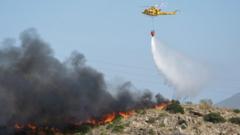
The media coverage surrounding Spain's recent tragic wildfire follows a tired, predictable script. The narrative focuses entirely on body counts, climate change, and demands for more water bombers. It is a comforting story of good versus evil. On one side is helpless nature and victimized citizens; on the other is a monstrous, unpredictable climate.
But this narrative is dead wrong.
The tragic loss of life in Spain is not an unavoidable natural disaster. It is the direct, mathematical consequence of a century of broken land management and a pathological obsession with total fire suppression. By treating fire as an enemy to be eliminated rather than a biological necessity to be managed, we have turned the Iberian peninsula into a ticking tinderbox.
Spain does not have a wildfire problem. Spain has a fuel problem. Until we stop fighting every single fire, the blazes will only get deadlier.
The Suppression Paradox: How We Built the Perfect Inferno
For decades, European fire policy has been dictated by a single, flawed metric: percentage of fires contained. When a fire breaks out, the state throws everything at it. Helicopters, specialized military units, and millions of euros are deployed to choke the flames out immediately.
Statistically, this looks like a triumph. In normal years, fire services successfully extinguish over 90% of ignitions before they exceed a few hectares.
But this success is an illusion. Ecologists call this the "suppression paradox."
Fire is a natural part of the Mediterranean ecosystem. It clears out underbrush, recycles nutrients, and thins out dense forest canopies. When you eliminate small, low-intensity fires, the dead wood, dry grass, and leaf litter do not disappear. They accumulate. Year after year, decade after decade, the fuel load builds up.
Imagine a warehouse where workers never throw away the cardboard boxes, but instead stack them to the ceiling. That is the current state of Spain’s rural interior. By suppressing every minor blaze, we are merely deferring the debt. And when a fire finally breaks out under extreme conditions—high winds, low humidity, and soaring temperatures—the accumulated fuel ensures it bypasses human capability entirely.
These are no longer wildfires. They are mega-fires. They burn so hot that they create their own weather systems, collapsing column dynamics and rendering water bombers utterly useless. No amount of tax dollars or extra firefighters can stop a fire burning at 1,000°C with a fuel load three times higher than historical norms.
The Great Rural Exodus: Nature Isn't Healing, It's Overgrowing
To truly understand why Spain is burning, you have to look away from the flames and look at the demography. The media loves to blame global warming alone because it absolves local governments of policy failures. The deeper, uglier truth lies in la España vaciada—the emptied Spain.
Over the past sixty years, millions of Spaniards abandoned traditional rural life for the coast and major cities. This was not just a cultural shift; it completely altered the physical landscape.
The Broken Mosaic
Historically, the Spanish countryside was a mosaic. It was a patchwork of cultivated fields, heavily grazed pastures, olive groves, and managed woodlots. If a fire started, it quickly hit an obstacle. A flock of goats had eaten the underbrush here; a plowed wheat field stopped the flames there. The landscape had built-in speed bumps.
When the people left, the mosaic collapsed.
- Biomass Explosion: Millions of hectares of agricultural land were abandoned. Without human intervention, these areas underwent secondary ecological succession. Pioneer species and highly flammable scrubland took over.
- The Loss of the "Four-Legged Firefighters": Spain's livestock population shifted from extensive pastoralism (animals roaming the hills) to intensive industrial farming (animals locked in barns). The millions of sheep and goats that once acted as natural, daily lawnmowers clearing the forest floor vanished.
- Monoculture Forestry: In the mid-to-late 20th century, misguided state forestry programs planted massive expanses of fast-growing, highly flammable species like Eucalyptus globulus and Pinus pinaster to feed the paper and timber industries. These are fire-adapted species that actively promote intense burns to eliminate competition.
The result? Continuous, uninterrupted carpets of volatile fuel stretching for hundreds of kilometers. The speed bumps are gone. Now, when an ignition happens, there is nothing to stop a fire from running across entire provinces.
Dismantling the Consensus
The public frequently asks the wrong questions after a disaster. Let's dismantle the most common, flawed premises driving the current debate.
"Why don't we just buy more firefighting planes?"
Because airplanes do not put out mega-fires. This is a hard truth that politicians hate to admit. Water bombers are highly effective during the initial attack phase on small fires. Once a fire transitions into a plume-dominated mega-fire, the water evaporated by the sheer heat radiation before it even hits the fuel.
Relying on bigger fleets of aircraft is a reactive, photogenic strategy designed to make politicians look decisive on the evening news. It pours money into a bottomless pit while leaving the root cause untouched.
"Can't we just clear the forests manually?"
The scale makes this impossible. Mechanical thinning is incredibly expensive, labor-intensive, and fossil-fuel heavy. You cannot manually clear millions of hectares of rugged, mountainous Spanish terrain with chainsaws and tractors. The numbers do not add up.
The only entity capable of clearing fuel at the required scale is fire itself.
The Unpopular, Unconventional Solution: Fighting Fire with Fire
If we want to stop burying citizens and firefighters, we must adopt a strategy that sounds entirely counter-intuitive to the untrained ear: we need to burn more of Spain on purpose.
+------------------------------------+------------------------------------+
| Traditional Suppressive Model       | Proactive Pyro-Management Model    |
+------------------------------------+------------------------------------+
| Target: 0% burned area             | Target: High acreage managed burns |
| Strategy: Emergency reactivity     | Strategy: Preventative lighting    |
| Fuel: Allowed to accumulate        | Fuel: Strategically reduced        |
| Outcome: Catastrophic mega-fires  | Outcome: Low-intensity, safe burns |
+------------------------------------+------------------------------------+
We must shift from an ideology of total suppression to one of managed pyro-ecosystems. This requires two drastic, politically difficult changes.
1. Massive Expansion of Prescribed Burning
We need to deliberately ignite fires during the cool, damp winter and spring months. These prescribed burns must be executed under strict meteorological windows to consume the accumulated dead biomass safely.
This is not a new theory. Indigenous cultures used this for millennia, and regions like Western Australia have successfully utilized large-scale prescribed burning to protect communities for decades.
The downside? It requires a cultural tolerance for smoke. It means seeing hillsides blacken in February so they do not explode in July. It requires accepting the minor risk that a prescribed burn could occasionally breach a containment line, which is a tough sell for a risk-averse bureaucracy.
2. "Let it Burn" Policies for Wild Wilderness
When a lightning strike ignites a fire in a remote, uninhabited mountain range during moderate weather, the instinct must change from instant suppression to strategic monitoring. If the fire is performing useful ecological work by clearing decades of fuel build-up, it must be allowed to burn out naturally against predetermined barriers.
The Hard Choice
I have watched regional governments waste millions on high-tech command vehicles and thermal drones while cutting budgets for foresters and rural shepherds. It is a fatal mistake born of urban ignorance. The urban population wants an untouched, romanticized forest that does not exist in reality. Nature is dynamic, and in the Mediterranean, dynamism involves smoke and ash.
We can choose how Spain burns. We can have controlled, low-intensity fires in the winter that clear the brush, stimulate biodiversity, and keep the landscape safe. Or we can continue our arrogant quest for total suppression and watch helplessly every summer as the landscape chooses for us, burning with a ferocity that no human technology can contain.
Stop fighting the fire. Start managing the fuel.



