The decibel meter on my phone flickered, danced, and then turned a violent shade of crimson. 140. That is the exact threshold where sound stops being an auditory experience and becomes physical pain. It is the roar of an F1 V6 turbo-hybrid engine tearing down the straightaway, a mechanical scream that vibrates through the concrete beneath your sneakers and rattles the bones in your chest.
For most of the 140,000 fans packed into the grandstands, this noise is pure adrenaline. It is the siren song of speed.
But for my twelve-year-old son, Leo, it felt like an execution.
Leo is autistic. To understand Leo’s world, you have to understand that his brain lacks the sensory filters most people take for granted. Imagine sitting in a room where the television is blaring at full volume, three people are shouting different stories in your ears, a strobe light is flashing directly into your eyes, and someone is brushing a rough piece of sandpaper against your bare arm. Now imagine you cannot turn any of it off. That is a standard Tuesday for Leo when a supermarket gets too bright.
Bringing him to a Grand Prix weekend was either an act of profound love or spectacular parental negligence. I still wasn't sure which one it would turn out to be.
The Gravity of the Grid
We had spent months preparing. In our living room, we watched race replays with the volume turned up just a fraction higher each week. We practiced wearing his industrial-grade ear defenders while eating dinner. We drew maps of the circuit, highlighting the medical tents, the quiet zones, and the escape routes.
Hypothetically, if everything went perfectly, he would see his hero, Lewis Hamilton, navigate the turns he had memorized on his iPad simulator. But reality rarely respects a hypothetical plan.
The shift happens the moment you leave the sanctuary of your car. The parking lot at a major race is a sprawling sea of mud, exhaust fumes, and thousands of moving bodies. The human crowd has its own gravity. It pulls you in, compresses you, dictates your pace. For a child who requires clear physical boundaries to feel safe, the pressure of strangers bumping into his shoulders was the first crack in the armor.
I felt Leo's hand tighten inside mine. His fingers were cold, locking around my wrist with a desperate, vice-like grip.
"Too many faces," he whispered. His eyes were darting, tracking every neon jersey and flying flag, unable to prioritize which visual information mattered and which could be ignored.
This is the hidden tax of autism. The sheer cognitive energy required to navigate a crowded corridor can exhaust a child before they even reach their seat. We stopped by a concrete barrier, away from the main pedestrian artery. I knelt down so we were eye-to-eye.
"We can go back to the car right now," I told him. I meant it. No ticket price is worth a psychological fracture.
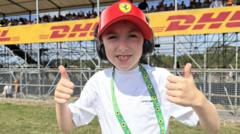
Leo closed his eyes. He took a long, shaky breath, counting to four the way his therapist taught him. He opened them, looked toward the distant sound of the track, and shook his head. "No. I want to hear the cars."
The Architecture of Chaos
We made it to our seats just as the support races began. The support series cars are loud, but they are nothing compared to the main event.
Consider what happens next when twenty Formula 1 cars line up on the starting grid. The air changes. The atmosphere grows heavy with the scent of burning rubber, high-octane fuel, and the palpable tension of a stadium holding its breath.
When the five red lights went out, the collective roar of the engines and the crowd hit us like a physical wall.
Even with top-tier noise-canceling headphones layered underneath heavy-duty ear defenders, Leo flinched. He curled his knees up to his chin, rocking back and forth on the plastic stadium seat. The vibrations were traveling up through the metal framework of the grandstand, bypassed his ears entirely, and shaking his stomach.
Panic is a fast-moving current. Once it takes hold, logic drowns.
I watched his breathing shallow. He started humming—a low, monotonous drone. It was his way of trying to create a predictable sound to drown out the unpredictable chaos of the track. To an outsider, he might have looked like a child throwing a tantrum or reacting poorly to a sporting event. But this wasn't a tantrum. It was neurological survival.
I wrapped my arms around him, pulling him into my lap, creating a physical fortress against the sensory onslaught. I didn’t tell him it was okay, because it wasn't. The world was screaming at him. Instead, I whispered the names of the drivers in order of their starting positions. Over and over. A litany of facts. A baseline of certainty in a sea of noise.
"Hamilton. Verstappen. Leclerc. Norris."
Slowly, the rocking slowed.
The Turning of the Tide
Something extraordinary happened around lap fifteen. The field had spaced out. The continuous, overwhelming wall of sound broke down into predictable intervals. Every ninety seconds, a pack of cars would scream past, followed by a pocket of relative silence.
Leo lowered his hands from his ears slightly. His eyes tracked a streak of papaya orange as Lando Norris shot through the corner below us.
"Soft tires," Leo murmured through his microphone link to my headset.
He had noticed the yellow sidewall marking on the tires. In that moment, his hyper-fixation—his intense, brilliant ability to focus on statistics and technical details—shielded him from the environment. He wasn't a victim of the chaos anymore. He was an analyst.
He spent the next hour predicting pit stop windows based on tire degradation data he had memorized from practice sessions. He was completely dialed in, using his analytical brain to categorize the madness into spreadsheets of his own making. The very thing that made the environment hostile to his senses became the playground for his intellect.
We didn't stay for the podium celebrations. We didn't wait to see the champagne spray or fight the thousands of fans rushing the gates at the end of the race. We left five laps before the checkered flag, slipping away into the quiet outer perimeters while the rest of the world was distracted by the final sprint.
Walking back to the car under a darkening sky, the distant hum of the engines finally fading into the background, Leo let go of my hand. He walked a few paces ahead, jumping over puddles, imitating the high-pitched whine of an downshift.
He was exhausted. His face was pale, and he would likely spend the next two days in a darkened bedroom to recover his sensory equilibrium. The cost of admission for him wasn't measured in dollars; it was paid in neurological currency.
But as we reached the car, he turned back to look at the glowing stadium lights in the distance.
"We conquered that," he said.
He didn't say the race was fun. He didn't say he loved the noise. He used the word conquered. For a kid who spends every day adapting to a world built for people who aren't like him, standing in the middle of the loudest spectacle on earth and finding his own way to breathe wasn't just a day out at the sports. It was a victory grander than any trophy awarded on that podium.