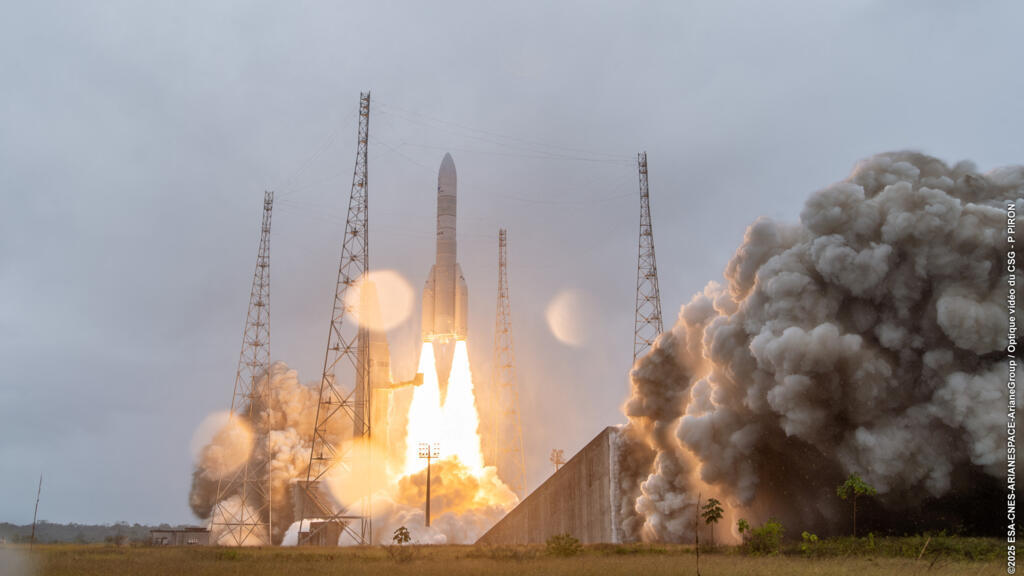
Sovereignty in low Earth orbit is not an exercise in national prestige; it is a balance sheet calculation of dependency. For decades, the European Space Agency operated on a convenient administrative fiction: that advanced scientific payloads and human spaceflight could be outsourced to foreign transport providers while European aerospace engineering focused strictly on uncrewed infrastructure. That structural compromise has reached its economic and strategic horizon. With a proposed ten-year, ten-billion-euro expenditure framework heading toward ministerial evaluation, Europe is confronting the true cost of orbital rent versus orbital ownership.
The debate is frequently framed around launch manifests and capsule hardware. This misses the underlying mechanics. The choice facing European capitals is defined by two competing cost functions: the ongoing operational drain of purchasing foreign launch services versus the front-loaded capital expenditure required to secure domestic human-rating capabilities. Learn more on a connected issue: this related article.
The Anatomy of External Dependency
To understand why European space leadership is pushing for indigenous crew transport, one must analyze the total cost of ownership associated with outsourcing. Buying seats on foreign vehicles or relying on external heavy-lift architectures introduces three hidden liabilities:
- Schedule Slippage Risk: When a primary crew transportation system faces operational pauses or priority shifts abroad, secondary mission partners absorb the schedule drag without recourse.
- Opportunity Cost of Industrial Stagnation: Funding foreign providers transfers intellectual capital and engineering iteration cycles away from domestic entities. Without human-spaceflight prime contracts, domestic supply chains atrophy.
- Monopsony Pricing Vulnerability: Relying on external commercial providers for strategic access removes competitive tension from the procurement process, exposing institutional buyers to unilateral pricing changes.
Estimates indicate that maintaining foreign service procurement through the next decade would siphon approximately five billion euros out of the European industrial ecosystem. Crucially, that capital vanishes across institutional borders rather than compounding within domestic aerospace supply chains, where every euro spent typically yields secondary technological spillover into materials science, telemetry, and life-support manufacturing. More reporting by MarketWatch explores comparable views on this issue.
The Capital Expenditure Threshold
Transitioning from an uncrewed cargo paradigm to a fully human-rated orbital architecture requires navigating a severe capital expenditure hump. The proposed ten-billion-euro envelope is designed to distribute risk across three interdependent pillars:
- Heavy-Lift and Launch-Abort Certification: Upgrading existing launch infrastructure—such as adapting heavy configurations to meet human-rating redundancy standards—requires extensive qualification testing and structural margins.
- Pressurized Capsule Development: Commercial partnerships with emerging European capsule developers (such as current cargo-return initiatives transitioning toward crewed configurations) require sustained milestone funding to achieve environmental control and life-support system (ECLSS) maturity.
- Ground Segment Modernization: Training facilities, mission control redundancy, and ocean or land recovery logistics must be established from the ground up to support independent reentry operations.
The economic justification for this capital deployment relies on amortization over decades of institutional use. While the initial outlay is front-loaded, a sovereign capability neutralizes long-term foreign currency exposure and retains high-value engineering jobs within member states.
The Institutional Friction Problem
The primary bottleneck facing European space ambitions is not technological capability; it is procurement fragmentation. Unlike centralized space programs that operate under a unified national budget, the European Space Agency functions as a coalition of member states whose industrial return rules (georeturn) dictate that contract allocation must closely mirror financial contributions.
This structural constraint historically diffused capital across too many subcontractors, lengthening development timelines and multiplying administrative overhead. To execute a ten-billion-euro crewed program efficiently, procurement models must pivot toward fixed-price milestone contracts with commercial prime contractors, moving away from pure cost-plus geographical distribution. Recent public-private awards for uncrewed cargo capsules signal a pragmatic shift in this direction, proving that competitive commercial selection can take root within the traditional framework.
Strategic Execution
Europe cannot afford to remain a subscale partner in human spaceflight while global orbital commerce accelerates. The upcoming ministerial decisions in Rome represent a definitive crossroads. If member states treat sovereign crew transport as an optional discretionary expense, European astronauts will remain permanent tenants on foreign infrastructure, subject to the shifting geopolitical priorities of external partners.
The immediate imperative is clear: commit the structural framework for end-to-end crew certification, streamline commercial procurement baselines, and treat indigenous orbital access as critical defensive infrastructure rather than an industrial subsidy program.