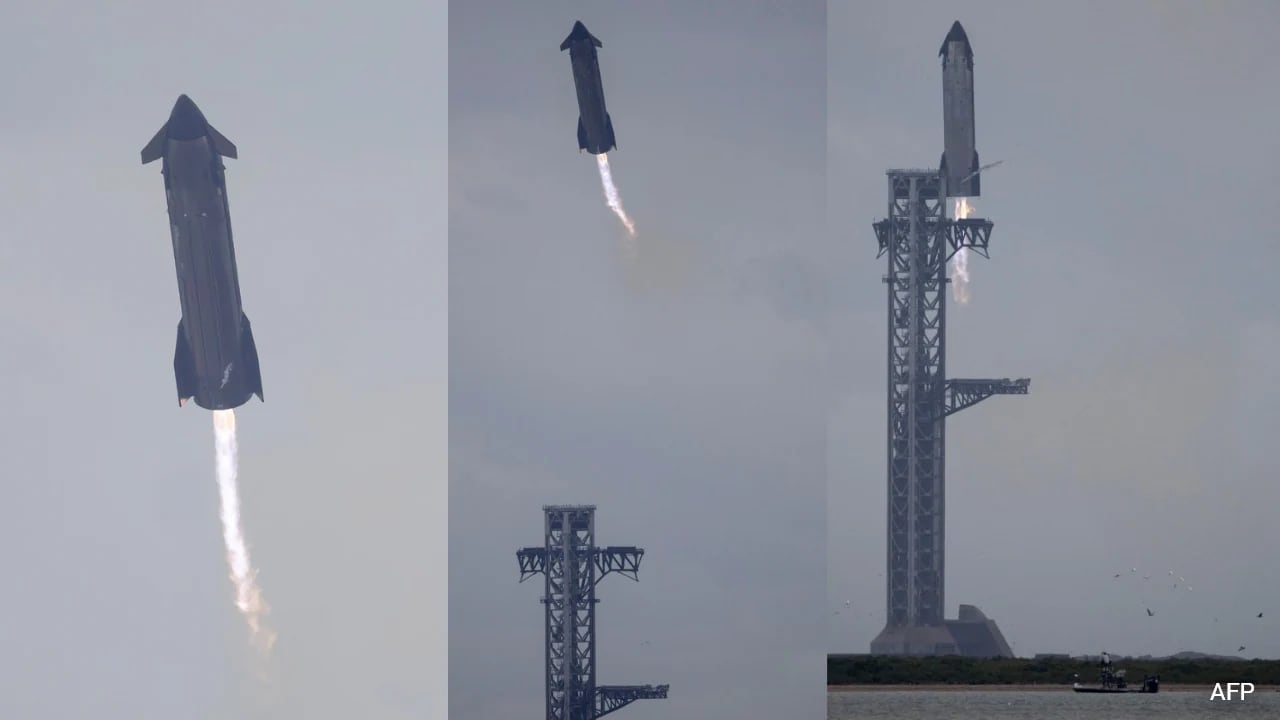
On October 13, 2024, SpaceX did something that defied decades of aerospace orthodoxy. Seven minutes after lifting off from Boca Chica, Texas, the 232-foot Super Heavy booster returned from the edge of space, relit its engines, hovered next to its launch tower, and settled directly into the mechanical arms of the "Mechazilla" structure.
Most coverage treated this as a mere visual spectacle. They missed the real story. Catching a rocket mid-air is not a stunt designed to generate viral video clips; it is a ruthless financial calculation aimed at eliminating the single biggest bottleneck in orbital economics. By removing landing legs from the booster and placing the capture hardware on the ground, SpaceX shaved tons of dead weight off the vehicle and compressed turnaround times from months to potential hours.
To understand why this maneuver matters, you have to look at what happens to a rocket the moment it leaves the pad. Every kilogram of structural mass dedicated to landing—hydraulic legs, actuators, reinforced mounting brackets—is a kilogram of payload that never reaches orbit. In the rocket equation, mass is a tyrant.
The Tyranny of the Rocket Equation
Traditional reusable rockets, including SpaceX’s own Falcon 9, carry their landing gear with them into space. Those four carbon-fiber and aluminum legs weigh roughly two metric tons. On a medium-lift vehicle, two tons is a manageable penalty. On a super-heavy-lift architecture designed to haul 100 to 150 metric tons to low Earth orbit, scaling up landing legs becomes an engineering nightmare.
Larger boosters require heavier legs to absorb the shock of touchdown, which in turn requires more propellant to lift those heavier legs, which requires larger tanks, creating a vicious cycle of diminishing returns. Furthermore, landing on a concrete pad or an autonomous drone ship introduces unpredictable surface variables. Blast backwash, uneven terrain, and residual horizontal velocity can tip a tall, narrow cylinder upon impact.
SpaceX solved this by inverting the problem. Instead of building a landing system onto the rocket, they built the landing system onto the launch tower.
Engineering the Mid-Air Capture
The capture mechanism, officially known as the Orbital Launch Integration Tower, stands 480 feet tall. Mounted to it are two massive structural steel arms equipped with shock-absorbing carriage assemblies and a sophisticated rail system.
During the descent of Flight 5, Super Heavy re-entered the atmosphere at hypersonic speeds, using four grid fins to steer itself toward the Texas coastline. The physics of this approach require millimeter-level precision. Unlike a Falcon 9, which uses a "hoverslam" maneuver—timing its engine burn so its vertical velocity hits zero at the exact moment its legs touch the ground—Super Heavy must actually hover.
Three of the booster’s 33 Raptor engines gimbaled furiously to stabilize the 250-ton empty steel cylinder, canceling out coastal crosswinds and aerodynamic buffeting. Two small structural pins, known as load points, protruded from just below the booster's forward grid fins. As the booster translated laterally between the open arms, the tower closed the pincers, allowing the load points to slide onto cushioned skids along the arms' top rails.
The margin for error was virtually nonexistent. Had the booster drifted a few feet off-center, or had a single Raptor engine suffered a combustion instability during the final three seconds, the resulting explosion would have leveled the entire Stage Zero ground infrastructure.
The Economics of Stage Zero
In aerospace parlance, the rocket itself is Stage One and Stage Two. Everything on the ground—the launch mount, the propellant tank farm, the deluge system, and the tower—is Stage Zero.
For sixty years, spaceflight treated Stage Zero as passive infrastructure. It held the rocket upright, fueled it, and got out of the way. SpaceX turned Stage Zero into an active participant in the flight profile. This shift completely alters the unit economics of space access.
Consider the lifecycle of a conventional expendable rocket. You spend $100 million to $2 billion building a precision machine, fly it once for ten minutes, and dump it in the ocean. Now consider the first-generation reusable model, the Space Shuttle. It flew back to a runway, yet required months of painstaking refurbishment, tile inspections, and engine rebuilds between flights, ultimately costing roughly $1.5 billion per launch when accounting for program overhead.
Falcon 9 broke that paradigm by proving vertical propulsive landing could work reliably. Yet even Falcon 9 hits a logistical wall. After landing on a drone ship hundreds of miles downrange, the booster must be secured by a crew, towed back to port over several days, lifted by a crane onto a transporter, driven back to a hangar, stripped of its legs, inspected, and mated to a new second stage. The fastest Falcon 9 turnaround sits at roughly three weeks.
Mechazilla eliminates the entire marine recovery pipeline.
When the chopsticks catch Super Heavy, the booster is already suspended directly over the orbital launch mount. In theory, the tower arms can swing the booster back onto the launch ring, stack a fresh upper stage on top, pump cryogenic liquid methane and liquid oxygen into the tanks, and launch again the same day.
What Competitors Are Actually Facing
The legacy aerospace sector is watching this unfold with quiet panic. For decades, defense contractors and national space agencies operated on cost-plus contracts where inefficiency was subsidized and low flight rates were the norm.
United Launch Alliance (ULA) is transitioning to its Vulcan Centaur rocket, which plans to eventually recover only its main engines via mid-air helicopter capture or splashdown—a partial reuse model that still discards the massive propellant tanks on every flight. Europe’s Ariane 6, which debuted in 2024, is completely expendable. Blue Origin’s New Glenn features a reusable first stage, yet it relies on traditional deployable landing legs and an ocean-going recovery vessel, locking it into the exact logistical bottlenecks SpaceX is currently outgrowing.
If SpaceX achieves rapid, same-day booster turnaround, the cost per kilogram to orbit will plummet below $100. At that price point, traditional satellite manufacturing changes overnight. Engineers no longer need to spend millions miniaturizing components or folding delicate solar arrays to fit inside cramped payload fairings. You can build heavy, cheap, rugged hardware out of off-the-shelf industrial steel and launch it in bulk.
The Hidden Risks Nobody Mentions
Despite the triumph of Flight 5, assuming SpaceX has solved orbital logistics is a mistake. Watching a flawless catch on a high-definition livestream obscures the razor-thin survival margins that defined the mission.
Days after the flight, audio leaked from SpaceX engineering briefings revealed that the booster was one second away from aborting the catch and crashing into the ground. A misconfigured spin-start gas parameter on one of the Raptor engines nearly triggered an automated health check failure right as the vehicle committed to the tower approach. Had the flight computer detected the anomaly a fraction of a second earlier, the booster would have diverted away from the pad, smashing into the nearby wetlands or the Gulf of Mexico.
Furthermore, capturing a booster is only half the equation. To achieve true, airline-style reusability, SpaceX must also catch the Ship—the 165-foot upper stage that actually reaches orbital velocity.
Why Catching the Ship is Exponentially Harder
Returning a booster from suborbital space is a thermal walk in the park compared to bringing an upper stage back from orbit. The booster reaches speeds around Mach 5 or Mach 6 before turning around. The Ship re-enters the atmosphere at Mach 25.
At 17,500 miles per hour, the air in front of the vehicle turns into incandescent plasma exceeding 2,600 degrees Fahrenheit. During Flight 4 and Flight 5, while the Ship survived re-entry and executed soft splashdowns in the Indian Ocean, post-flight telemetry and external cameras showed severe thermal degradation. Burn-through occurred around the forward flap hinges, melting away chunks of the stainless steel structure and stripping tiles from the thermal protection system.
You cannot catch an upper stage with giant mechanical arms if its structural load points are warped by re-entry heat or if its aerodynamic control surfaces are half-melted.
Inspecting, replacing, and bonding thousands of fragile ceramic heat shield tiles between flights was the exact issue that crippled the Space Shuttle's turnaround schedule. SpaceX is experimenting with ablative backup layers, metallic tiles, and active transpiration cooling, yet a rapidly reusable heat shield remains an unsolved materials science problem. Until the Ship can survive orbital re-entry without requiring weeks of thermal tile maintenance, the booster's rapid turnaround capability sits bottlenecked at the pad.
Regulatory Friction and Infrastructure Fragility
Beyond physics and thermal dynamics lies an equally formidable obstacle: putting all your eggs in one colossal steel basket.
Consolidating launch and recovery onto a single piece of ground hardware creates a catastrophic single point of failure. If a guidance sensor glitches during a catch and a 250-ton booster slams into the tower at 30 miles per hour, SpaceX does not just lose a rocket. They lose their ability to launch from that site for six to twelve months while they rebuild the tower, re-lay cryogenic plumbing, and recertify structural steel.
SpaceX is mitigating this by constructing a second launch tower at Starbase in Texas and modifying Launch Complex 39A at Kennedy Space Center in Florida to support Starship operations. Even with redundancy, the sheer acoustic and kinetic violence of a 33-engine liftoff—generating nearly 17 million pounds of thrust, more than double the Saturn V—places immense stress on surrounding infrastructure. During Flight 1 in April 2023, the Raptor engines pulverized the reinforced concrete pad beneath the mount, hurling boulders miles into the air and raining pulverized sand over nearby towns. While a massive water-cooled steel flame deflector solved the pad erosion issue, long-term metal fatigue on the tower itself from repeated launches and catches remains completely uncharted territory.
Then there is the regulatory apparatus. The Federal Aviation Administration (FAA) evaluates launch licenses based on public safety, environmental impact, and airspace integration. Catching a rocket over populated coastline infrastructure introduces a completely new risk profile. Every anomaly requires a mishap investigation. Every change to the flight profile, propellant load, or trajectory triggers fresh environmental assessments from the U.S. Fish and Wildlife Service. Engineering hardware at Silicon Valley speed collides directly with federal bureaucracy operating at statutory speed.
The Real Stakes of the Catch
Look past the sci-fi nickname and the cheering crowds in Boca Chica. The Flight 5 catch represents the maturation of a manufacturing philosophy that treats rockets not as bespoke, artisanal spacecraft, but as industrial commodities.
SpaceX builds Raptors on an assembly line at a rate of roughly one engine per day. They weld stainless steel rings in massive high-bays using automated friction-stir welding rather than expensive, slow-to-cure carbon composites. And now, they have proven that a 23-story booster can fly to the edge of space and parallel-park itself back onto its own launch mount.
Whether the goal is deploying next-generation Starlink satellites that beam high-speed internet directly to unmodified smartphones, fulfilling NASA's Artemis contract to land astronauts on the lunar surface, or lofting heavy orbital data centers, the underlying constraint has always been mass to orbit per dollar spent.
By turning the launch tower into a catching glove, SpaceX just rewrote the baseline math for every aerospace company on Earth. Either competitors figure out how to catch their own boosters, or they resign themselves to building expensive museum pieces that fall into the sea.