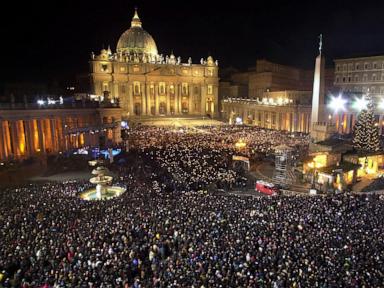
Every travel brochure, architectural digest, and mainstream news outlet will feed you the exact same lazy consensus this year. They will tell you that St. Peter's Basilica, celebrating the 400th anniversary of its consecration by Pope Urban VIII on November 18, 1626, is the eternal, beating heart of Roman Catholicism. They will gush over Michelangelo's dome, Bernini's colonnade, and the sheer, breathtaking triumph of faith rendered in travertine and gold.
They are peddling a sanitized fairy tale.
If you actually look at the historical ledger, the architectural compromises, and the geopolitical fallout of this building, St. Peter's isn't a monument to unified Christian faith. It is the most expensive, structurally chaotic, schism-inducing real estate project in human history. Celebrating its 400th birthday without acknowledging that it literally broke Western Christianity in half is journalistic malpractice.
Let's dismantle the brochure copy and look at what actually happened on Vatican Hill.
The Architecture of a Schism
Mainstream coverage loves to frame the Basilica as a seamless fusion of Renaissance genius and Baroque grandeur. I've spent two decades analyzing historic preservation budgets and large-scale religious infrastructure, and I can tell you what happens when you change lead architects a dozen times over 120 years. You don't get divine inspiration. You get scope creep on a continental scale.
Pope Julius II laid the first stone in 1506, hiring Donato Bramante to tear down the ancient, perfectly functional Constantinian basilica—a 4th-century building that had stood for over a thousand years. Bramante envisioned a symmetrical Greek cross plan. Then Bramante died. Raphael took over and wanted a Latin cross. He died. Antonio da Sangallo the Younger added towers and raised the floor. He died. Michelangelo stepped in at age 71, scrapped Sangallo's work, and reverted to Bramante's Greek cross, designing the massive ribbed dome that defines the skyline.
Then Michelangelo died, and Carlo Maderno was brought in to tack a massive, elongated nave onto the front, completely ruining Michelangelo's sightlines. If you stand in St. Peter's Square today, you can't even see the base of the dome properly because Maderno's facade blocks it. That isn't intentional symbolism. That is what happens when a client keeps changing the brief after the foundation is already poured.
The Real Cost of Travertine
How do you pay for the largest church on earth when your treasury is bleeding out from Italian wars? You monetize salvation.
To fund the demolition and reconstruction of St. Peter's, Pope Leo X ramped up the sale of plenary indulgences—essentially selling get-out-of-purgatory cards to peasants across Europe. In 1517, a German monk named Martin Luther looked at the fundraising campaign led by Johann Tetzel in Saxony, realized German money was being siphoned off to build a gilded palace in Rome, and nailed his Ninety-Five Theses to a church door in Wittenberg.
The mainstream narrative treats the Protestant Reformation and the building of St. Peter's as two separate historical tracks. They are the exact same story. The Basilica didn't unify Christendom; it shattered it. Every square foot of marble in that nave was paid for by fracturing the very institution it was meant to glorify.
Even the raw materials were stolen. Urban VIII, the same pope who consecrated the building in 1626, famously stripped the ancient bronze girders from the portico of the Pantheon to cast Bernini's massive Baldacchino over the high altar. That act of architectural cannibalism birthed the famous Roman pasquinade: Quod non fecerunt barbari, fecerunt Barberini—What the barbarians didn't do, the Barberinis did.
Why It Is No Longer the Heart of Catholicism
When commentators call St. Peter's the "heart" of the Catholic Church, they are suffering from acute Eurocentrism. They are looking at a 17th-century museum piece and confusing real estate with living faith.
Look at the demographic reality of the Roman Catholic Church in 2026. According to the Vatican's own Annuarium Statisticum Ecclesiae, Europe accounts for less than 20% of the world's 1.4 billion Catholics, and active church attendance in Western Europe is in terminal freefall. Meanwhile, Catholicism is exploding in sub-Saharan Africa and parts of Asia. The Democratic Republic of the Congo alone has more weekly Mass-going Catholics than Italy, France, and Spain combined.
To call a massive, state-subsidized tourist trap in Rome the "heart" of a faith whose pulse is actually beating in Kinshasa, Lagos, and Manila is absurd.
The Museumification Trap
Walk through St. Peter's today. You aren't walking into a parish church. You are walking into an airport terminal crossed with a high-security art gallery.
Here is what the modern pilgrim experience actually consists of:
- The Security Bottleneck: Standing for two hours in the scorching Roman sun behind metal barricades to pass through X-ray machines.
- The Selfie Gauntlet: Navigating a sea of ten thousand tourists holding smartphones aloft in front of Michelangelo's Pietà, completely oblivious to the sacramental nature of the space.
- The Velvet Rope Theology: Being herded away from the main altar by Swiss Guards and security personnel unless you have a VIP pass or a clerical collar.
A building cannot be the spiritual center of a living religion when 95% of the people inside its walls are holding audio guides instead of rosaries. The Vatican has allowed its premier sacred space to be completely commodified by mass tourism. Yes, the liturgical ceremonies held there are broadcast globally, and yes, the Chair of Peter resides there. Jurisdictional headquarters? Absolutely. Spiritual heart? Not even close. The spiritual heart of Catholicism is found in cinderblock parishes in the Global South where people walk five miles to receive the Eucharist, not under a 448-foot dome where tour groups argue over Wi-Fi signals.
Dismantling the Tourist Myths
If you are planning to visit Rome to mark this quadricentennial, you are likely asking the wrong questions. Most travelers type the exact same queries into search engines, looking for ways to optimize a fundamentally broken tourist experience. Let's look at the actual truth behind the most common misconceptions.
Is St. Peter's Basilica actually the Pope's cathedral?
No. Not even close. Despite what almost every news anchor will tell you this year, St. Peter's is not a cathedral. A cathedral is the seat (cathedra) of a bishop. The Pope is the Bishop of Rome, and his official cathedral is the Archbasilica of St. John Lateran, located across town. St. Peter's is technically a papal basilica built over the traditional burial site of the Apostle Peter. Calling it the Pope's cathedral is like calling the Pentagon the White House.
Is the Basilica really built directly over St. Peter's bones?
Probably, though the archaeology is far messier than the Vatican gift shop admits. Excavations conducted beneath the high altar in the 1940s under Pope Pius XII uncovered a 2nd-century shrine (the Trophy of Gaius) and a graffiti-covered wall reading Petros eni ("Peter is here"). In 1968, Pope Paul VI announced that bone fragments found in a marble-lined niche nearby belonged to St. Peter. However, renowned archaeologists like Margherita Guarducci and Jocelyn Toynbee spent decades debating the provenance of those bones, as they were initially mixed with animal bones and moved during the excavations. The architectural alignment is undeniable—Constantine literally cut into the side of a hill and destroyed a pagan necropolis just to put the altar directly over that specific spot. The absolute forensic certainty of the skeletal remains is a matter of faith, not settled science.
Do you need to pay to enter St. Peter's Basilica?
Entry to the main floor is technically free, which is the worst thing that ever happened to its preservation and atmosphere. Because there is no admission fee, the Basilica acts as a pressure valve for Rome's over-tourism, absorbing up to 50,000 visitors a day. Free entry sounds egalitarian, but in practice, it turns a consecrated church into a chaotic public thoroughfare. You pay with your time in the security line, and the building pays with micro-erosion from the humidity and carbon dioxide exhaled by millions of unvetted visitors.
What the Vatican Won't Admit About Structural Decay
When you build a structure this massive on unstable ground, physics eventually sends a bill.
Vatican Hill was historically a marshy area outside the ancient city walls, known for poor drainage and clay-heavy soil. Bramante and Michelangelo had to sink colossal piers into the earth to support the weight of the dome—which weighs roughly 14,000 tons.
By the 1740s, the dome was already cracking so severely that Pope Benedict XIV had to hire mathematician Giovanni Poleni to figure out how to keep it from collapsing. Poleni's solution was essentially a massive, 18th-century version of duct tape: he wrapped five massive iron chains around the drum of the dome to contain the outward thrust.
Today, the Basilica is under constant, microscopic surveillance. Traffic vibrations from nearby Roman streets, shifts in the water table, and thermal expansion from extreme European heatwaves continuously stress the 400-year-old travertine. The Fabbrica di San Pietro—the office responsible for the building's upkeep—spends millions annually just keeping the facade from shedding stone onto tourists' heads. The building isn't an eternal rock; it is a high-maintenance patient on permanent life support.
How to Actually Experience Vatican Hill Without Falling for the Trap
To be fair, dismissing St. Peter's entirely as an architectural blunder misses the sheer audacity of what Renaissance engineers pulled off without modern hydraulics or steel. Standing beneath the oculus of that dome remains one of the most spatially overwhelming experiences a human being can have. Even as a cynical observer of institutional excess, I cannot deny the terrifying beauty of Bernini's colonnade embracing the piazza like stone arms.
The flaw isn't the building itself; the flaw is how modern travelers and commentators interact with it. If you want to bypass the Disneyland atmosphere and actually understand what this 400-year-old behemoth represents, stop acting like a standard tourist.
- Skip the midday floor tour completely. Show up at 7:00 AM sharp when the doors open. For the first forty-five minutes, the tour buses haven't arrived yet. You can actually hear the footsteps of priests walking to the side chapels to say private Masses. That is the only time of day the building functions as a church rather than a theme park.
- Go underground, not up. Everyone pays to take the elevator up to the dome for an Instagram shot of Rome. Instead, book a tour of the Scavi (the Vatican Necropolis) months in advance. Walking through the damp, claustrophobic 1st-century Roman tombs beneath the basilica floor shows you the gritty, subterranean reality of early Christianity before it acquired imperial wealth and marble facades.
- Visit St. John Lateran instead. If you want to see the actual historical seat of the papacy without getting elbowed in the ribs by someone holding a selfie stick, take a taxi to St. John Lateran. It is older, historically more significant to the governance of the Church, and carries a fraction of the crowd.
The Heavy Cost of Triumphalism
Four hundred years ago, Urban VIII consecrated St. Peter's Basilica at the height of the Counter-Reformation. The building was designed as a visual sledgehammer. Every gilded cherub, every towering Corinthian column, every square inch of polychrome marble was engineered to overwhelm the senses and project absolute, unassailable papal supremacy to a fractured Europe.
It worked for a while. It terrified Protestant visitors and dazzled Catholic monarchs.
Today, that same triumphalism feels deeply out of step with a Church whose current leadership preaches poverty, synodality, and reaching out to the margins. St. Peter's Basilica is a stunning relic of an era when the papacy acted like an absolute Renaissance monarchy, flexing its financial and artistic muscle regardless of the spiritual cost.
Celebrate the artistry. Marvel at the engineering. Respect the sheer human labor required to haul millions of tons of stone out of the quarries of Tivoli. Just stop pretending that a monument funded by spiritual extortion and overrun by commercial tourism is the beating heart of a living faith.
Take the audio guide off, step outside the colonnade, and look at the building for what it truly is: the greatest, most expensive architectural distraction ever built.