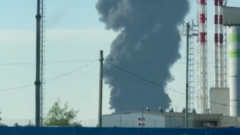
The mainstream media is treating the recent Ukrainian drone strikes on St Petersburg as a historic inflection point. They call it "unprecedented." They track the 1,250-kilometer flight paths on glossy maps, breathlessly proclaiming that the Kremlin's deep rear is now defenceless. They look at a plume of smoke near the Gulf of Finland and conclude that the geometric realities of the war have fundamentally shifted.
They are wrong. They are falling for cheap kinetic theater.
As someone who has spent years analyzing Soviet-heritage air defense networks and the brutal math of attrition warfare, watching the commentary surrounding these long-range strikes is agonizing. The collective analysis has succumbed to a lazy consensus: the idea that hitting a high-profile target equates to shifting the strategic balance of power. It does not.
The St Petersburg strikes are not a military breakthrough. They are a loud, resource-intensive signaling mechanism designed for Western headlines and domestic morale, masking a harsh structural reality that Kiev is desperately trying to bypass.
The Illusion of the Flawless Air Defense Grid
The core flaw in the current analysis stems from a fundamental misunderstanding of what air defense is actually designed to do. When the Russian Ministry of Defense calls a strike "unprecedented," Western pundits take the bait, interpreting the word as an admission of systemic failure.
Let us be precise about the architecture of airspace denial. No military on earth—not Russia with its layered S-400 and Pantsir systems, nor the United States with Patriot and NASAMS—can establish an impenetrable dome over a landmass spanning eleven time zones.
Air defense is an exercise in asset prioritization. It is a mathematical trade-off.
When a low-altitude, low-radar-cross-section citizen drone, cobbled together with off-the-shelf carbon fiber and a lawnmower engine, hugs the tree lines at 90 knots, it exploits the inevitable gaps in radar coverage. This is not a failure of the Russian state; it is a basic limitation of physics and terrain masking.
To protect every oil depot, port facility, and oligarch’s dacha between Crimea and the Arctic Circle, Russia would need to manufacture and deploy tens of thousands of short-range point-defense systems. They cannot do that. No one can. By celebrating a single drone hitting an energy terminal in St Petersburg, commentators are missing the broader structural reality: Russia’s core military production hubs and logistical nodes feeding the Donbas line remain heavily defended and largely unbothered by these long-range stunts.
The Brutal Math of Attrition Politics
Let’s look at the financial and operational ledger. This is where the mainstream narrative completely collapses.
To pull off a strike deep inside Russian territory, Ukrainian forces must invest significant planning, intelligence assets, and multiple long-range loitering munitions to overwhelm local electronic warfare packages.
- The Cost of the Attack: Tens of thousands of dollars per airframe, plus the invaluable expenditure of Western-supplied satellite reconnaissance and telemetry data.
- The Damage Inflicted: A temporary disruption at a processing plant, a charred storage tank, or a broken window at a refinery.
- The Recovery Time: Usually measured in days, occasionally weeks.
I have seen corporate analysts look at these infrastructure hits and project a systemic collapse of Russian oil exports. It is wishful thinking. Russia has spent decades engineering its heavy infrastructure to survive brutal conditions and industrial accidents. A 50-kilogram warhead on a hobbyist drone does not cripple an industrial economy. It creates an insurance headache.
Meanwhile, the tactical cost to Ukraine is hidden. Every long-range drone built for a symbolic strike on St Petersburg is a drone not built to strike Russian glide-bomb kits, artillery groupings, or command posts ten miles behind the actual frontline in Avdiivka or Kupiansk.
Ukraine is fighting a desperate war of material survival on its own soil, yet it is diverting precious engineering talent and manufacturing capacity toward high-risk, low-yield public relations operations in the far north. It is the military equivalent of a cash-strapped startup spending its remaining runway on a Super Bowl ad instead of fixing its broken product.
Dismantling the Panic Narrative
Go to any mainstream news site and look at the "People Also Ask" sections or the expert roundtables. The questions being asked are fundamentally broken because they assume a reality that does not exist.
Does this mean St Petersburg is now a frontline city?
No. To call St Petersburg a frontline city is to misunderstand the difference between harassment and invasion. A frontline city experiences sustained, multi-axis kinetic degradation designed to facilitate tactical maneuvers. St Petersburg experienced a sporadic security breach. Treating it as a new theater of war rewards the political theater of the strike without evaluating its zero-sum military utility.
Can Russia stop these long-range drone attacks?
Completely? Never. But they do not need to. The goal of Russian defense planners isn't to achieve 100% interception rates; it is to keep the damage within an acceptable margin of tolerance while maintaining their own offensive momentum in the Donbas. If Russia has to sacrifice a minor fuel depot in the north to keep its main air defense assets concentrated around its black sea fleet and domestic missile factories, its planners will make that trade every single day.
The Dangerous Logic of Symbolic Warfare
There is an ugly downside to pointing this out. When you challenge the efficacy of these strikes, you are accused of defeatism or, worse, carrying water for Moscow. But the real danger to Ukraine isn't clear-eyed criticism; it is the comforting lie of symbolic victory.
We saw this exact same dynamic play out with the early attacks on the Kerch Bridge and the drone strikes on the Kremlin roof. Each time, the internet erupted with declarations that the Russian regime was fracturing, that its red lines were a joke, and that the war was turning.
What followed those strikes? Not a Russian retreat, but a systematic, brutal hardening of Russian electronic warfare capabilities.
Every time Ukraine sends a new drone variant deep into Russia, Russian electronic warfare units map its frequencies, analyze its navigation systems, and update the software on their Krasukha and Pole-21 jamming complexes. By launching these sporadic, low-impact attacks on non-military targets like St Petersburg, Kiev is effectively providing the Russian military with free, live-fire testing data to improve their defenses.
By the time Ukraine deploys these systems in numbers that could matter, the tactical element of surprise is completely gone.
Stop Applauding the Smoke Clouds
The hard truth nobody wants to admit is that long-range drone warfare is showing diminishing returns. It creates fantastic video clips for social media channels. It satisfies the human desire to see an aggressor bleed on their own territory. But it does not move the trenches. It does not stop a 1,500-kilogram FAB glide bomb from leveling a Ukrainian defensive position.
If the goal of Western backing and Ukrainian ingenuity is to win a war of attrition against a larger industrial power, the metrics of success must change. Stop measuring progress by how far north a drone can fly before getting shot down over an oil terminal. Start measuring it by the systemic degradation of Russia's ability to wage war on the frontline.
Until the strategy shifts from chasing headlines to securing the kinetic foundations of the battlefield, these "unprecedented" attacks are nothing more than a loud distraction from a slow, grinding tragedy.
Stop looking at the smoke over St Petersburg. Look at the map of the Donbas. That is where the war is being decided, and no amount of symbolic fireworks in the north will change the math on the ground.