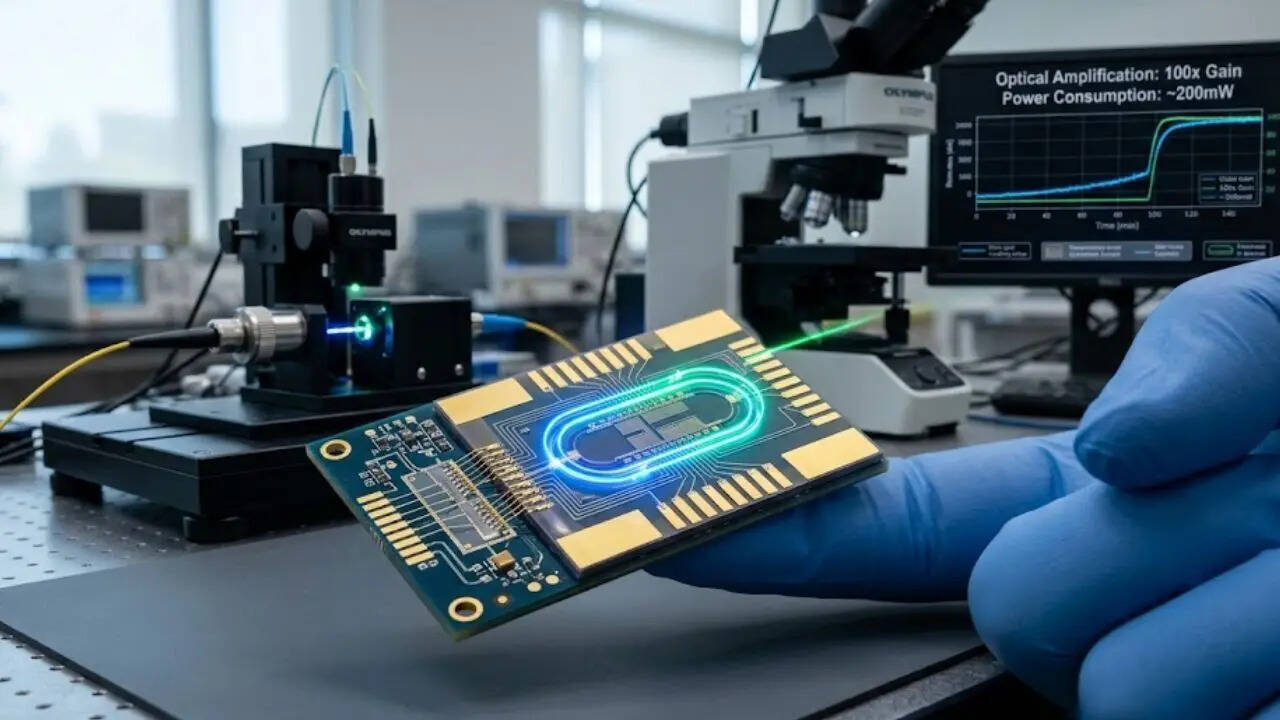
The internet we use every day relies on a massive, invisible web of glass fibers. These cables carry light pulses across oceans and under streets. It’s a miracle of engineering, but it’s hitting a physical wall. Your home connection feels fast until you realize how much energy is wasted converting those light signals into electrical data. Every time you stream a 4K movie or send a massive file, a series of bulky, power-hungry components has to translate light into bits. Stanford engineers just changed that. They’ve built a tiny chip that could make your internet 100x faster while slashing the power bill for the world's data centers.
This isn't just about a slightly better router. We're talking about a fundamental shift in how hardware handles light. Most current systems use a process called "detection" that’s honestly pretty clunky. It requires a lot of space and creates a ton of heat. The Stanford team, led by Jelena Vučković and her lab, developed a silicon-based device that manages light signals with surgical precision. It’s small. It’s efficient. It works.
Why your current internet speed is actually a bottleneck
Most people think "bandwidth" is the only thing that matters. They pay for a gigabit connection and wonder why things still lag during peak hours. The truth is that our infrastructure is struggling with the "opto-electronic" gap. Light is great for moving data long distances, but silicon chips—the brains of your computer—prefer electricity.
The translation between the two is where the speed dies. Current modulators and detectors are big. They take up valuable real estate on a circuit board. Because they’re large, they require more voltage to operate. This creates a feedback loop of inefficiency. More voltage means more heat. More heat means you need more cooling. More cooling means data centers consume about 2% of the world’s entire electricity supply. That’s a staggering amount of power just to keep the lights on—literally.
The Stanford chip, often referred to as a "nanophotonic" device, attacks this problem at the scale of atoms. By shrinking the components that manipulate light, the researchers have reduced the energy required to move a single bit of data by orders of magnitude. Imagine replacing a gas-guzzling freight train with a fleet of electric drones. You get the same cargo delivered faster with a fraction of the carbon footprint.
The genius of the thin-film lithium niobate approach
For decades, the industry stuck with standard silicon because it was cheap and easy to manufacture. But silicon is actually pretty bad at modulating light. It’s like trying to play a violin with mittens on. To get around this, the Stanford team utilized a material called lithium niobate.
This isn't a new material. It’s been used in telecommunications since the 1980s. However, old-school lithium niobate components were huge—sometimes several inches long. You couldn't fit them on a modern processor. The breakthrough here is "thin-film" lithium niobate. The researchers figured out how to layer a microscopic film of this material onto a standard silicon wafer.
How the chip handles data differently
- Precision Etching: Using advanced fabrication techniques, they carved tiny "waveguides" into the film. These paths guide light like a slot car track.
- Low Voltage Modulation: Because the structures are so small, the electrical field required to change the light's properties is tiny. We're talking about sub-volt levels.
- Massive Parallelism: Since the chips are so small, you can pack hundreds of them onto a single square centimeter. This allows for massive "lanes" of data moving simultaneously.
This isn't just a lab experiment. The team used standard industrial tools to make these. That’s a huge deal. It means we don't need a total overhaul of the world’s chip factories to start producing these. It’s a drop-in improvement for the existing supply chain.
What this means for AI and the 2026 data crisis
By 2026, the demand for data is expected to skyrocket even further, driven almost entirely by Artificial Intelligence. Training a model like Gemini or GPT requires moving petabytes of data between thousands of GPUs. Right now, those GPUs are connected by copper wires or traditional optical transceivers that get incredibly hot.
If we don't switch to more efficient light-based communication, AI progress will literally melt the power grid. The Stanford chip provides a path toward "optical computing" where light does the heavy lifting even inside the computer. By integrating these tiny chips directly into GPU clusters, we can move data between processors at 100 times the current speed. This reduces the latency that kills AI performance.
You might not see this chip inside your iPhone next year. But you'll feel it. You'll feel it when cloud gaming becomes indistinguishable from playing on a local console. You'll feel it when your AI assistant responds instantly without that "thinking" delay. And eventually, as the tech scales down, this nanophotonic tech will make its way into consumer hardware.
The massive power savings nobody is talking about
Everyone talks about speed, but the energy angle is the real story. We're currently in a bit of a climate crisis regarding our digital habits. Every video call, every Netflix binge, and every AI prompt has a carbon cost.
Standard optical modulators consume about 10 to 100 "picojoules" per bit. That sounds small, but multiply it by the trillions of bits moving through a data center every second. It adds up to megawatts. The Stanford device aims to bring that down to "femtojoules." For those who aren't math nerds, a femtojoule is one-thousandth of a picojoule.
Think about that. We're looking at a 1,000x reduction in energy consumption for data transmission. That's not an incremental gain. That’s a total disruption of how we think about the cost of the internet. It turns a massive environmental liability into a sustainable system.
Dealing with the skepticism around lithium niobate
Is it perfect? Of course not. Nothing in hardware ever is. Critics often point out that lithium niobate is harder to work with than pure silicon. It’s brittle. It can be sensitive to temperature changes.
But the Stanford researchers addressed this by using a hybrid approach. They aren't trying to replace silicon entirely; they’re using it as a base. By bonding the lithium niobate to silicon, they get the best of both worlds—the ease of silicon manufacturing and the high-speed performance of the exotic film.
There's also the question of cost. Early-stage tech is always expensive. But because they used "lithography" (the same process used to make your phone's processor), the price will drop as soon as volume increases. This isn't a boutique "lab-only" material anymore. It's ready for the big leagues.
How to prepare for the photonic revolution
The shift to light-based computing is happening whether the industry is ready or not. If you're an IT professional, a gamer, or just a tech enthusiast, you need to stop looking at "megabits" and start looking at "latency" and "energy per bit." Those are the metrics that will define the next decade.
Keep an eye on companies that are partnering with university labs like Stanford's. The first place you'll see this tech is in high-end networking gear for data centers—think brands like Cisco, Nvidia, or Marvell. From there, it filters down to enterprise hardware, and finally, your home.
If you want to stay ahead of the curve, focus on these steps:
- Monitor the Silicon Photonics Market: Look for "thin-film lithium niobate" (TFLN) in technical spec sheets. It's the keyword for this specific breakthrough.
- Audit Your Data Usage: Understand that in the very near future, the bottleneck won't be your ISP's "pipe," but the hardware inside your devices.
- Support Energy-Efficient Tech: The push for greener data centers isn't just corporate PR; it’s a physical necessity for the internet to keep growing.
The internet isn't just getting faster. It's getting smarter. By shrinking the way we handle light, Stanford has opened the door to a version of the web that’s actually sustainable. We're moving away from the era of "brute force" computing and into an era of elegant, light-speed efficiency. It’s about time.