Cold.
That is the first thing you notice in Ulaanbaatar when winter settles into the basin, trapping the coal smoke from the ger districts against the surrounding mountains like a heavy, gray wool blanket. You taste the sulfur on the back of your tongue before you even step off the train, and you feel the grit of unburned carbon stinging your eyes.
For a moment, standing on the cracked concrete of Sükhbaatar Square in the dead of January, it feels as though the entire country is holding its breath.
Consider a hypothetical herder—let’s call him Batbayar—waking up three hundred miles west of that smoky capital in the Khangai Mountains. Batbayar doesn't read political wire reports, nor does he care about the phrasing of parliamentary resolutions. What he knows is the price of diesel for his battered Russian van, the sudden disappearance of state subsidies for winter hay, and the sinking feeling in his gut when his daughter calls from the city to say the hospital ran out of basic antibiotics again. Beneath the frozen soil of Batbayar’s pasture lies billions of dollars in copper, coal, and gold—wealth enough to pave every dirt track in the nation and heat every home without choking the sky. Yet his stove burns raw coal, and his pockets are empty.
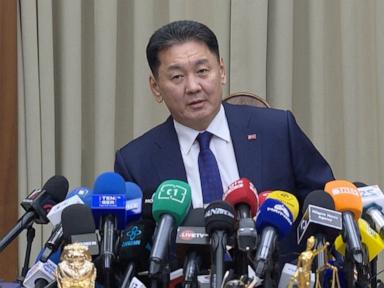
When news broke that Mongolia’s president announced he would step down amid mounting accusations of corruption, the international press treated it like another routine tremor in a distant, landlocked democracy. A headline. A brief wire summary. A dry recitation of political fallout.
They missed the real story entirely.
A head of state relinquishing power under the shadow of graft is never just an administrative shuffle; it is the sound of a dam cracking under decades of invisible pressure. It is the collision between the glittering promise of resource wealth and the quiet, grinding betrayal felt by ordinary citizens watching their future get sold off in backrooms.
The Architecture of a Broken Promise
To understand why a presidential resignation in Mongolia carries such volcanic emotional weight, you have to understand the specific agony of the "resource curse."
Picture a family that suddenly wins a massive lottery, only to discover that the eldest brother has locked the vault, handed out IOUs to his friends, and left the rest of the household arguing over scraps of bread. That metaphor isn't an exaggeration—it is the lived economic reality for millions of people living in mineral-rich nations caught between superpower neighbors.
For more than three decades since Mongolia threw off Soviet-era single-party rule in 1990, the country has been hailed as an "oasis of democracy" wedged between Russia and China. That geographic reality alone makes every political tremor in Ulaanbaatar feel like walking a tightrope in a crosswind. When democracy arrived on the steppe, it brought fierce pride, a vibrant press, and a fierce determination among nomads and city dwellers alike that no khan or commissar would ever dictate their fate again.
Yet political freedom arrived alongside a subterranean jackpot. Massive deposits like Oyu Tolgoi—one of the largest known copper and gold deposits on Earth—and the sprawling Tavan Tolgoi coal fields promised a miraculous leap into modern prosperity. Economists drew charts showing soaring gross domestic product. Foreign investors flew into Chinggis Khaan International Airport in tailored coats, speaking of boom times and rapid modernization.
Then came the rot.
Over successive administrations, public trust eroded as mega-projects stalled, sovereign wealth vanished into opaque offshore accounts, and state-owned enterprises became personal piggy banks for the politically connected. When citizens hear words like "embezzlement," "kickbacks," or "bribery" attached to the highest office in the land, they don't hear legal jargon. They hear the explanation for why their children are breathing toxic air while luxury SUVs idle outside high-end boutiques in downtown Ulaanbaatar.
The Anatomy of Public Fury
Accusations of corruption do not topple a presidency overnight. They accumulate like snow on a roof—light at first, almost imperceptible, until a single wet storm brings the entire structure crashing down.
In Mongolia, the breaking point has repeatedly centered on the intersection of state power, mining revenues, and public funds meant for ordinary citizens. Whether through scandals involving the Small and Medium Enterprise Development Fund—where low-interest loans meant for struggling local bakers, mechanics, and seamstresses were quietly funneled to lawmakers and their relatives—or massive coal-theft allegations involving billions of dollars in unaccounted exports, the pattern became impossible to ignore.
Let’s pause and admit something uncomfortable: tracking political corruption in a young democracy is confusing, messy, and often deliberately obscured. Accusations fly from rival factions like arrows in a dust storm. Sometimes anti-corruption drives are genuine reckonings demanded by the street; other times, they are weapons wielded by one oligarchic clan to purge another. It is entirely reasonable for an outside observer—or a weary voter in Ulaanbaatar—to look at the chaos and wonder where justice ends and political theater begins.
And yet, the street knows the difference between smoke and fire.
When thousands of young Mongolians march into Sükhbaatar Square in minus-thirty-degree weather, wrapping scarves over their faces against the frostbite and standing shoulder-to-shoulder beneath the bronze gaze of Chinggis Khaan, they aren't marching for rival political parties. They are marching because the social contract has been shredded.
Think about what it takes to protest in a Mongolian winter. Your eyelashes freeze together within minutes. Your phone battery dies in your pocket from the cold. Every breath burns your lungs. Nobody endures that kind of physical misery for an abstract ideological debate. You stand in that freezing square only when staying home feels even colder than the wind.
The Decision to Step Down
So what actually happens in the quiet hours before a president announces he will step aside?
The public sees only the televised statement—the stiff posture, the carefully measured cadence, the insistence on protecting national stability or defending personal honor while bowing to political reality. Behind those closed doors, however, a brutal calculus plays out.
A president facing credible, escalating corruption allegations loses the one currency that keeps any leader afloat: moral authority. Once that vanishes, every decree is met with suspicion. Parliament fractures. Allies begin quietly distancing themselves to save their own political skins before the next election cycle. Street protests threaten to spill over from peaceful demonstrations into sustained civil unrest, paralyzing the capital and scaring away the very international lenders and trading partners the economy depends on to survive.
Stepping down becomes less an act of noble self-sacrifice and more an acknowledgment of gravity. You cannot govern a nation that refuses to believe a single word you say.
Still, a resignation does not automatically cure the disease. Removing a single figure from the top of the pyramid leaves the foundation intact—the networks of patronage, the loopholes in campaign finance, the fragile judicial system that too often bends toward wealth rather than law.
Why a Crisis on the Steppe Echoes Everywhere
It is tempting, from thousands of miles away, to file this away as a local drama in a remote corner of East Asia. Three and a half million people scattered across a territory roughly the size of Western Europe—what does their political reckoning have to do with the rest of the world?
Everything.
First, look at the raw materials powering modern life. The global transition to clean energy—electric vehicles, wind turbines, solar grids, high-capacity batteries—runs directly through the minerals buried beneath places like Mongolia. Copper and rare earth elements are the literal wiring of the twenty-first century. When governance collapses into graft in resource-rich nations, supply chains fracture, geopolitical rivalries intensify, and local communities bear the environmental scars without seeing the economic rewards.
Second, consider the fragile state of global democracy itself. Around the world, authoritarian regimes love to point at corrupt, chaotic democracies and whisper to their own populations: See? Freedom only brings theft and instability. Better to accept a strongman who keeps order. Every time a democratic leader is implicated in corruption, it hands ammunition to autocrats everywhere.
Conversely, when public pressure, investigative journalism, and institutional accountability actually force a powerful leader to step down without tanks rolling into the streets, it proves something vital. It proves that democracy isn't the absence of corruption; democracy is the capacity to confront it in the open.
The Long Thaw
Walk back through Ulaanbaatar a few weeks after a political earthquake, and on the surface, life looks stubbornly unchanged. Commuters still pack into aging buses at dawn. Street vendors still sell steaming mutton dumplings wrapped in foil. The coal smoke still hangs stubbornly over the valley until the spring winds finally sweep it clean.
Down in the Khangai Mountains, our hypothetical herder Batbayar still wakes before sunrise to check his flock against wolves and frost. A presidential resignation in the capital does not magically put hay in his barn or repair the rutted road to the nearest clinic. Cynicism, once earned, does not evaporate overnight.
Yet something subtle shifts in the air.
When the highest office in the land is forced to answer to the anger of ordinary citizens, the invisible boundary of what is permissible moves back a few inches. Politicians speak a little more carefully. Prosecutors feel the hot breath of public scrutiny on their necks. Young people who stood shivering in the square realize that their voices, when raised together, are heavier than gold and harder than granite.
A leader’s fall is never the end of a nation’s story. It is merely the moment the curtain is torn back, forcing everyone in the room to look at what was hidden in the dark—and decide what they are willing to build once the light comes in.


