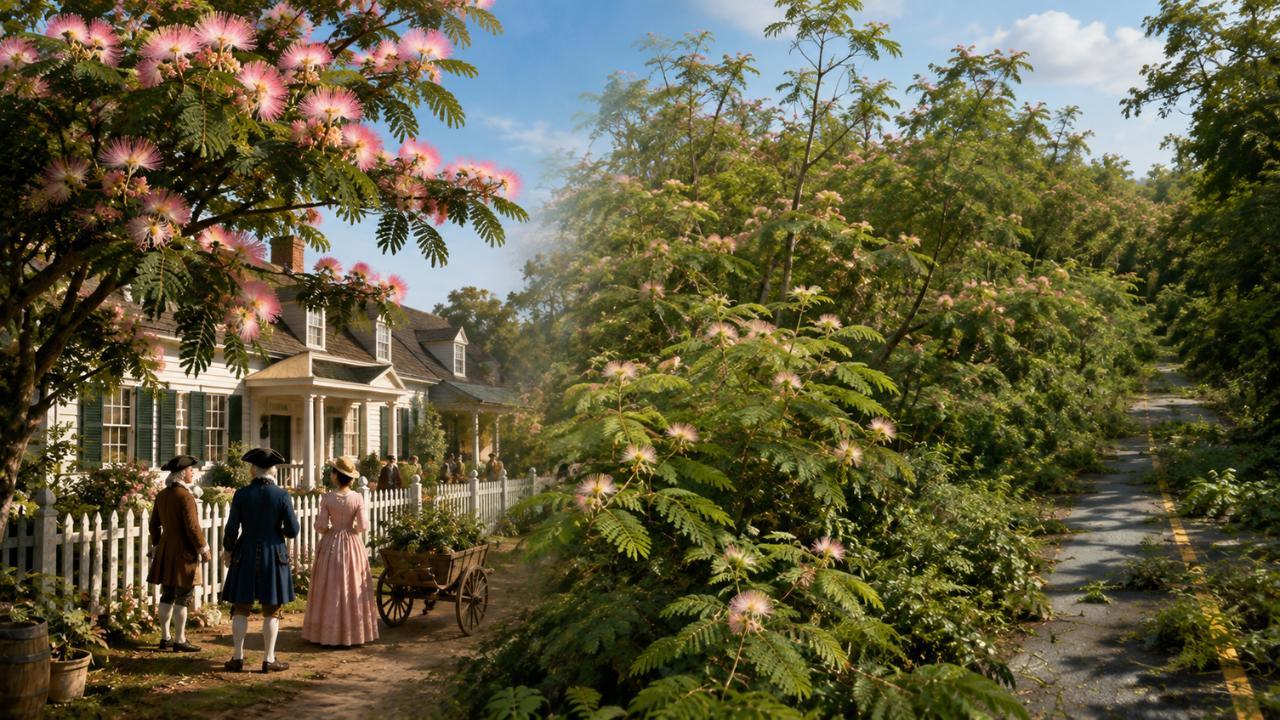
Every spring, the garden-center grifters start wringing their hands over the Persian silk tree. They call it an invader. They point to its powder-puff pink blooms and warn you about an impending botanical apocalypse. You are told that Albizia julibrissin is choking out native flora, destroying local ecosystems, and mocking your pristine lawn maintenance routine.
It is absolute nonsense.
I have watched suburban HOA boards blow tens of thousands of dollars on eradication programs, tearing out mature canopy trees just to plant sterile, twiggy maples that bake in the July sun. They treat these trees like biological weapons when the real issue is that people want nature to behave like a suburban sidewalk: flat, predictable, and entirely under control.
Let us dismantle the panic.
The Lazy Consensus of Plant Xenophobia
The standard ecological narrative goes like this: Benjamin Franklin or some anonymous merchant brought the mimosa over from Asia in 1745, it escaped cultivation, and now it is taking over the American South like an unstoppable green wave.
It sounds tidy. It fits the modern obsession with ecological purity. But it completely ignores how nature actually operates.
Nature does not care about your national borders or what century a plant caught a boat ride across the Atlantic. Nature cares about vacant niches. When humans clear-cut forests, pave over watersheds, and create massive swathes of disturbed, nutrient-depleted soil, plants that thrive in disturbed soil show up to fix the mess.
Blaming the mimosa tree for growing aggressively in a ditch is like blaming a fire extinguisher for making a mess of your kitchen when the stove catches fire. The tree is simply doing what hardy pioneer species have done for millions of years: colonizing bare earth, pumping nitrogen back into ruined soil, and creating shade where nothing else can survive the blistering heat.
What the Hand-Wringers Get Wrong About Invasiveness
Let us define terms. In the lexicon of native plant purists, any non-native species that reproduces easily is automatically labeled an "invasive threat." This is a lazy conflation of presence with destruction.
Are mimosas prolific seed producers? Yes. Do they pop up in sidewalk cracks and along highway medians? Absolutely. But let us look at the actual data regarding their impact on native biodiversity.
Studies show that while Albizia julibrissin can dominate disturbed roadside edges, it rarely penetrates deep into stable, mature, undisturbed climax forests. It lacks the shade tolerance to overthrow a healthy, multi-layered native woodland. It wins where humans have already won by destroying the original habitat.
Calling mimosas an existential threat to American forests is a convenient scapegoat. It lets developers and municipal planners point the finger at a pretty, pink-flowering tree while they pave over another five hundred acres of wetlands for strip malls and logistics warehouses.
"An invasive species is usually just a symptom of a disrupted environment doing its best to heal a wound."
Furthermore, dismissing the mimosa ignores its massive ecological utility in an urbanizing world.
The Functional Value of a Tree Nobody Wants
Try walking through a sun-baked southern parking lot in August without a mimosa tree around. You will fry.
Mimosas grow fast. Uncomfortably fast for people who like things to move at the speed of bureaucratic planning committees. They provide rapid, dappled canopy cover in environments where native oaks and hickories would take three decades just to cast enough shadow to keep your car steering wheel from branding your palms.
They are also nitrogen fixers. Through a symbiotic relationship with soil bacteria, they pull nitrogen out of the air and pump it into the dirt. They are literally earth-repair kits. If you have compacted, dead soil on a neglected piece of property, a few seasons of mimosa leaf drop and root action will radically improve soil fertility.
And then there are the pollinators. Walk past a blooming mimosa in mid-summer. The canopy hums with bees, butterflies, and hummingbirds. While purists argue that native insects prefer native oaks, try telling that to the honeybees working the pink pompoms when nectar sources are scarce in the dead of July.
The Real Cost of Eradication Madness
I have seen property owners spend small fortunes hiring crews to girdle, poison, and dig out every mimosa on their acreage. Do you know what happens next?
Vacuum cleaner dynamics.
When you remove a dominant pioneer species without fixing the underlying soil and light conditions, you do not restore the pristine forest of 1491. You just open up real estate for something worse. You get thickets of thorny brambles, Japanese honeysuckle, or toxic weeds that offer zero shade and zero aesthetic value.
Fighting nature with glyphosate and panic is a losing game. The mimosa is here. It has been here for nearly three centuries. It has naturalized across a massive geographic range because it fits the climate.
Instead of waging a holy war against a tree that refuses to die, change your approach.
How to Work With the Tree, Not Against It
If you have mimosas on your land, stop treating them like a personal insult. Use them strategically.
- Use them as nurse crops: If you are trying to establish a permaculture food forest on degraded clay, let the mimosas handle the heavy lifting of breaking up the soil and fixing nitrogen for the first five years. Chop and drop their branches to build instant mulch.
- Manage the seed drop: The only legitimate annoyance with mimosas is their tendency to seed heavily in manicured garden beds. The fix is simple: prune the seed pods off after flowering, or plant them where their seedlings can be easily mowed down.
- Embrace the canopy: If you need quick shade for a patio or an outbuilding, stop waiting thirty years for a slow-growing hardwood. Plant or manage an existing mimosa for immediate climate mitigation.
The obsession with botanical purity is a luxury belief held by people who have never had to restore a ruined landscape from scratch.
Stop listening to the dogmatic purists who want to sanitize every square inch of the landscape into a sterile museum exhibit of pre-colonial nostalgia. Nature is dynamic, messy, and opportunistic.
The mimosa tree is not destroying the environment. It is surviving the one you built.



:max_bytes(150000):strip_icc():focal(999x0:1001x2)/jensen-ackles-1-070125-358e53cd0a3f4526b8cd754d95279142.jpg)