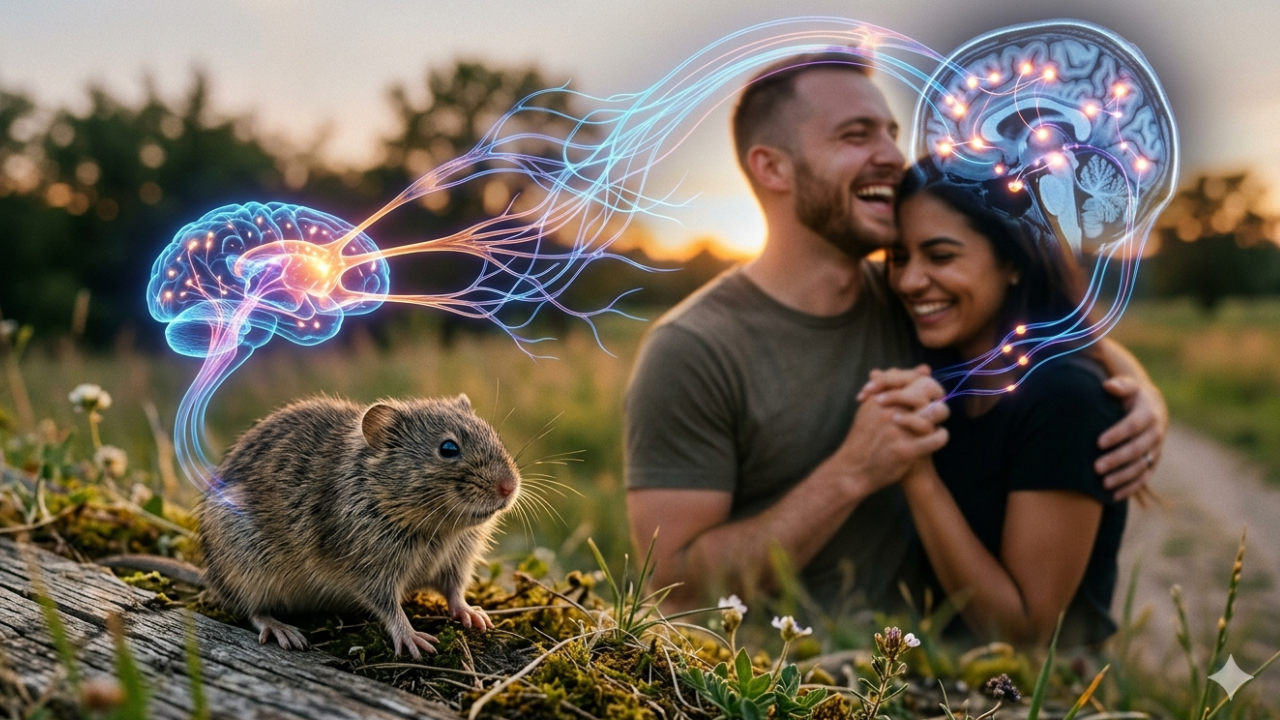
Pop science loves a simple story. For the last three decades, behavioral biology has rammed the same exhausted narrative down our throats: humans fall in love because of a tiny, monogamous rodent running around the American Midwest.
You have read the articles. They cite the prairie vole. They talk about oxytocin and vasopressin. They claim that a chemical squirt in a mouse brain explains human marriage, infidelity, and the entire architecture of romance. Discover more on a similar topic: this related article.
It is a beautiful, neat, utterly reductive lie.
Reducing human intimacy to the neurochemistry of a rodent is not just bad science; it is a profound misunderstanding of human evolutionary biology. The lazy consensus among lifestyle gurus and pop-neuroscientists insists that love is a hardwired chemical trick designed to keep pairs together for child-rearing. They treat oxytocin like a magical romance hormone. Further reporting by Refinery29 highlights related views on this issue.
The reality is far more complex, far less romantic, and infinitely more interesting. We need to stop looking at voles to explain why we cannot stay married.
The Prairie Vole Myth Exploded
Let us look at the actual science, not the watered-down version found in airport paperbacks.
In the 1970s and 80s, researchers like Lowell Getz and Sue Carter noticed that prairie voles (Microtus ochrogaster) formed lifelong pair bonds after mating. Their close relatives, meadow voles, were wildly promiscuous. The difference? Prairie voles had a higher density of receptors for oxytocin and vasopressin in the reward centers of their brains.
Inject a prairie vole with an oxytocin blocker, and they stray. Give a meadow vole an extra dose, and suddenly they settle down.
Pop culture took this data and sprinted off a cliff. The media immediately declared oxytocin the "cuddle hormone" and suggested that human fidelity was simply a matter of receptor density.
This ignores a massive, glaring biological fact: human brains do not work like vole brains.
In humans, oxytocin does not induce blind loyalty. Larry Young, one of the foremost neuroscientists studying these rodents, repeatedly warned against direct extrapolation to humans. Human romance involves the prefrontal cortex—the seat of executive function, culture, memory, and conscious choice. A vole does not decide to stay with its partner because of shared financial goals, religious compatibility, or a mutual love of cinema. It stays because its dopamine pathways are structurally tethered to a specific olfactory signature.
Imagine a scenario where human fidelity could be turned on and off with a simple nasal spray. Pharmaceutical companies would have monetized it decades ago. They tried. It failed. Because human bond formation is not a reflex.
Oxytocin Has a Dark Side
The obsession with labeling oxytocin as the "love molecule" misses the nuance of what the peptide actually does.
Research by neuroscientists like Carsten de Dreu at the University of Amsterdam revealed the dark side of the so-called cuddle chemical. Oxytocin does not promote universal love; it promotes ethnocentrism, parochial altruism, and out-group aggression.
Oxytocin sharpens the divide between "us" and "them." It increases trust toward people who look like you, think like you, and belong to your tribe. Simultaneously, it increases suspicion, derogation, and defensive aggression toward outsiders.
If love is entirely driven by oxytocin, then love is inherently exclusionary, xenophobic, and tribal. When you look at the messy reality of human history, that might track sociologically. But it completely destroys the romanticized notion that oxytocin is a benevolent force driving human connection. It is a defense mechanism disguised as affection.
Romance Is an Evolutionary Accident
Why do humans actually experience the madness of romantic love? The consensus says it is an evolutionary adaptation to ensure biparental care. Because human babies are born helpless, we need two parents to keep them alive. Therefore, evolution invented love to glue parents together.
This sounds logical, but anthropologists have repeatedly pointed out the flaws in this premise. In many ancestral human cultures, child-rearing was cooperative, distributed across grandmothers, aunts, and the wider tribe—a system known as alloparenting. A child did not rely solely on a nuclear pair bond for survival.
A more compelling, albeit less comforting, theory is that romantic love is an evolutionary byproduct, an exaptation.
Human brains grew massive over a short evolutionary window. This required a profound expansion of our neural architecture for empathy, mentalizing, and pattern recognition. Romantic love may simply be what happens when you run hyper-advanced social software on an ape brain that still possesses ancient, primitive drive systems. It is an emergent property of a complex system, not a targeted feature designed by natural selection.
We did not evolve to love. We evolved to think, manipulate, and track complex social hierarchies, and love was the chaotic side effect.
The Flawed Questions We Keep Asking
Look at the queries filling up search engines daily. People want to know: "How do I keep the spark alive?" or "Is monogamy natural for humans?"
The very premise of these questions is flawed because they assume there is a single, hardwired human nature waiting to be discovered. We look at hunter-gatherer tribes, or primates, or voles, searching for the "correct" blueprint for human relationships.
This is a form of the naturalistic fallacy—the belief that what is "natural" is inherently good or correct.
The brutal honesty is that humans are extraordinarily flexible. We are capable of lifelong monogamy, serial monogamy, polygamy, and complete celibacy. We are not prisoners of our biology in the way a rodent is.
When you ask how to "fix" a relationship by manipulating biology or chasing the high of the early dating phase, you are trying to recreate a transient chemical state. Dopamine spikes during the novelty phase of romance. That spike is mathematically guaranteed to drop. Expecting it to last is like expecting a caffeine rush to endure for three years.
The Dangerous Allure of Biological Reductionism
I have watched people blow thousands of dollars on relationship coaching, couples therapy, and even questionable hormone supplements, all trying to fix what they perceive as a biological failure. They think their relationship is broken because the obsessive, high-dopamine phase faded.
They blame themselves, or their partners, or their chemistry.
The downside of my contrarian approach is that it strips away the comfort of the biological excuse. It is comforting to think, Our oxytocin levels are just low. It removes agency. It turns relationship maintenance into a mechanical issue, like fixing an alternator on a sedan.
If you accept that love is a complex, culturally constructed, conscious choice layered over a messy evolutionary byproduct, you lose the safety net of blaming your genes. You have to take responsibility for the deliberate construction of commitment.
Actionable Order: Ditch the Chemistry, Build the Scaffold
Stop waiting for a biological feeling to dictate your long-term relationship success.
Instead of chasing the involuntary neurological high of a Midwestern rodent, focus on the distinctively human elements of connection.
- Stop testing your compatibility based on chemistry. Chemistry is a measure of novelty and dopamine. It tells you absolutely nothing about a partner's capacity for shared sacrifice, emotional regulation, or long-term alignment.
- Build structural commitments that do not rely on mood. Relying on an emotional state to maintain a relationship is a strategy destined for failure. Relationships survive on shared infrastructure—intellectual, financial, and logistical.
- Accept the drop. When the obsessive phase of love ends, your brain is not broken. You are just returning to baseline homeostasis. That is not the signal to leave; it is the starting line for actual relationship construction.
We are not voles. Stop acting like your fidelity is governed by a handful of receptors in your nucleus accumbens. You have a prefrontal cortex. Use it.