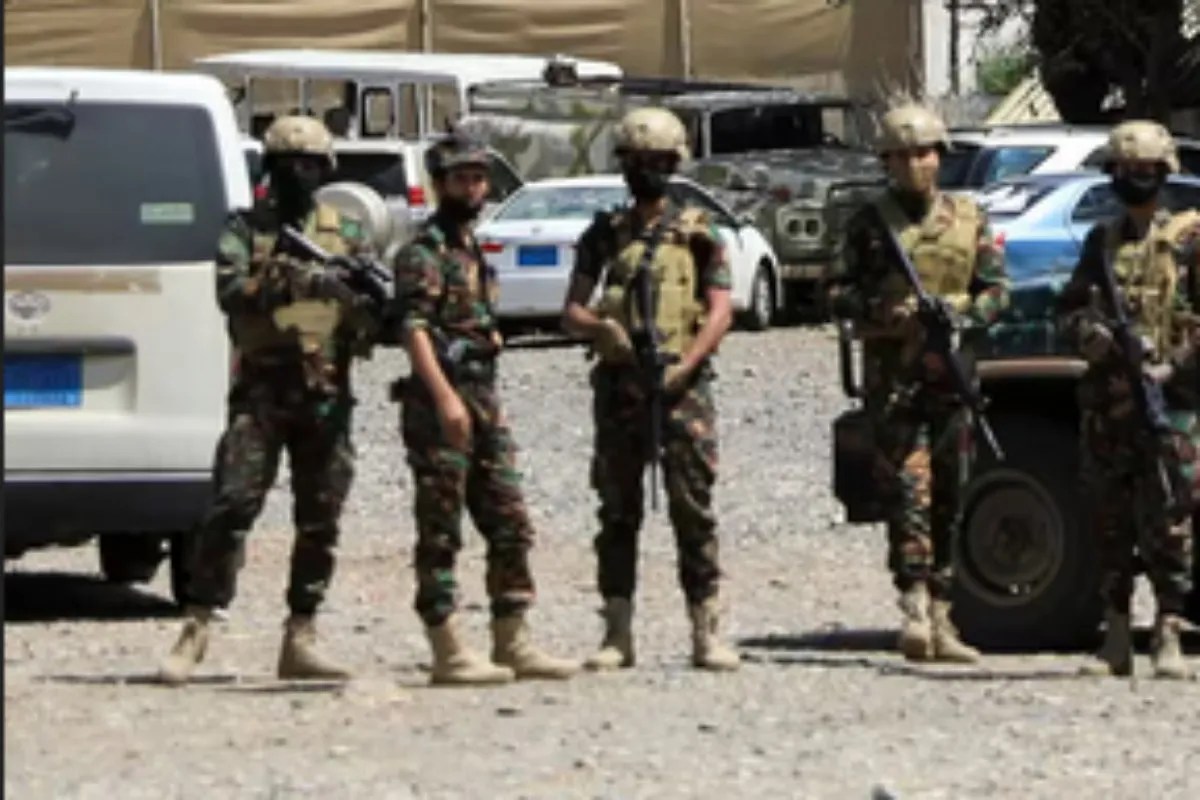
Every time a headline declares a breakthrough in Lahij, a collective sigh of relief ripples through desks that have stopped asking hard questions. The recent capture of Mount Numan by forces aligned with the internationally recognized government is being packaged as a tectonic shift. It is treated as proof that the momentum is finally swinging back.
It is nothing of the sort.
I have watched military analysts and foreign desk editors fawn over trivial topographic victories for a decade, mistaking the movement of a platoon for strategic progress. Planting a flag on a jagged limestone ridge in southern Yemen feels satisfying for a press release. It provides a clean narrative arc for an afternoon news cycle. But war does not bend to the convenience of newsroom deadlines.
The Geography of Illusion
Let us look at what actually happens when a faction captures a peak like Mount Numan in the Lahij governorate.
You take the high ground. Excellent. You control the line of sight for a few square kilometers. You force opposing units to pull back their artillery range by a fraction of a mile. For about forty-eight hours, commanders pose for photographs with assault rifles held high, broadcasting strength to a weary public desperate for any sign of an end.
Then the logistics bill arrives.
Holding an exposed mountain peak in arid, mountainous terrain requires constant resupply lines running through hostile or contested valleys. It demands water trucks, ammunition convoys, fuel, and fortified defensive positions against incoming drone and mortar fire. In asymmetric conflicts, holding high ground without deep rear-area security is not an asset. It is a stationary target.
The Houthis understand this calculus far better than the coalition-backed forces attempting to push north. They have mastered the art of tactical elastic defense. They yield ground when the air or artillery pressure becomes too concentrated, absorbing the blow, stretching enemy supply lines to breaking point, and waiting for the inevitable fragmentation of their opponents. When the opposing coalition gets bogged down trying to consolidate administrative control over a hostile population, the counter-attack arrives quietly, efficiently, and precisely where the enemy is most overextended.
The Structural Rot Beneath the Uniforms
The real story in Yemen is never about which brigade took which hill. It is about the profound institutional decay inside the forces opposing the Sanaa-based administration.
An army cannot fight effectively when its command structure resembles a patchwork quilt of rival militias, regional separatists, and foreign-backed factions with diametrically opposed end goals. The anti-Houthi front is not a unified military machine. It is a fragile coalition of convenience held together by temporary foreign funding and a shared dislike of Houthi governance.
When troops in Lahij or Taiz score a localized victory, it triggers immediate internal friction. Who gets the credit? Which local commander secures territorial control rights? Which external patron exercises final veto power over the administration of the newly retaken districts?
These are not administrative side-notes. They are the core reasons why tactical gains never translate into strategic momentum. While journalists cheer a flag on Mount Numan, the underlying political architecture remains paralyzed by mistrust and competing ambitions.
The Economics of Attrition
To understand why these localized offensives fail to dislodge the Houthi movement, you have to look at the balance sheet.
Wars are sustained by economic foundations. The Houthi administration in northern and western Yemen operates a centralized revenue extraction model. They control major commercial hubs, tax imports passing through Red Sea ports, and manage domestic currency and trade networks with ruthless efficiency. Even under years of airstrikes, blockade, and financial pressure, they have institutionalized a war economy that extracts resources directly from the population under their control.
Conversely, the government forces rely heavily on external aid, volatile foreign currency reserves, and fragmented local taxation. When a military unit captures a rural district, they inherit a devastated infrastructure, a population with zero purchasing power, and a security vacuum that drains resources rather than generating them.
You do not win a multi-front conflict by capturing barren ridges while your economic base shrinks. Every mile of mountainous territory secured in Lahij is another mile of supply line to defend, another civilian population to feed, and another drain on a treasury that cannot sustain its current operations without constant external life support.
The Danger of Comforting Fictions
There is a deep psychological comfort in believing that the tide is turning through conventional military progress. It allows observers to apply familiar models from classical state-on-state warfare to a complex, hybrid insurgency.
Stop applying nineteenth-century rules to twenty-first-century asymmetric conflicts.
When analysts frame a skirmish in Lahij as a turning point, they are projecting what they want to see onto a canvas that refuses to cooperate. This wishful thinking has a high body count. It creates false expectations among displaced populations, encourages premature offensives without adequate logistical backing, and shields political leadership from the hard, unglamorous work of genuine political settlement.
A negotiated settlement does not emerge from a mountain peak. It emerges when all sides realize that military exhaustion is mutual and total. Right now, the structural incentives for a real compromise do not exist, because too many external actors and local beneficiaries profit from the low-intensity status quo.
The Anatomy of Media Propaganda Cycles
Every few months, the cycle repeats with clockwork precision. A lull in the fighting is broken by a sudden ground push. Press releases fly across encrypted messaging apps. International wire services pick up the reports, eager to feed an audience starved of positive news out of the Arabian Peninsula.
The formula is always identical:
- Identify a rocky hill or minor administrative outpost.
- Launch a concentrated assault with heavy external air support.
- Broadcast dramatic video footage of soldiers waving flags amid dust clouds.
- Declare that the strategic balance has shifted.
Within weeks, the reality of asymmetric warfare reasserts itself. The captured outpost becomes a logistical black hole. Counter-insurgency pressure mounts from unseen networks. The frontline stabilizes a few hundred meters away from where it started. Yet the initial propaganda victory is already baked into the archives, serving as a placeholder for actual competence.
This is not reporting; it is theatrical management. It provides foreign backers with deniable optimism and local commanders with brief windows of budgetary influence. Meanwhile, the structural realities of the conflict remain completely untouched.
The Myth of External Sustainability
Another pillar of the lazy consensus is the belief that external military backing can indefinitely subsidize territorial creep.
Foreign sponsors operate on electoral cycles and shifting geopolitical calculations. Their commitment is rarely absolute or permanent. When a local force builds its entire operational posture on the expectation of endless external funding and air cover, it creates a brittle structure that shatters the moment donor priorities shift or budgetary fatigue sets in.
Real military power in a protracted civil war stems from internal legitimacy, economic self-sufficiency, and ideological cohesion—none of which can be purchased through transient foreign contracts or demonstrated by capturing a limestone ridge in Lahij. When the external taps fluctuate, the entire tactical edifice collapses back to square one.
The Civilian Toll of Perpetual Stagnation
While commanders celebrate territorial gains, the civilian population bears the brunt of these futile tactical games. Every time a front line shifts, water systems are damaged, agricultural lands become minefields, and displacement camps swell.
The humanitarian crisis in Yemen is not an unfortunate byproduct of the war; it is the environment in which the war thrives. When populations are entirely dependent on aid distribution, local power brokers weaponize access to resources. Control over a hilltop in Lahij translates into control over supply routes, checkpoint extortion rackets, and aid diversion schemes.
Pretending that capturing Mount Numan is a blow for liberation ignores the grim reality on the ground. For the average family in southern or central Yemen, the flag flying over the local ridge changes nothing about their daily survival. They still face hyperinflation, collapsed public services, and the constant threat of renewed violence.
Journalists and analysts who glorify these minor skirmishes are complicit in masking the profound paralysis of the political class. They mistake motion for progress and noise for victory.
The Unspoken Reality of Yemen
Nobody in the mainstream press wants to admit the obvious truth. The military option against the Houthi movement expired years ago.
Every offensive that captures a few kilometers of stone and dust without dismantling the adversary's financial networks, political cohesion, and ideological grip is just choreography. It looks good on evening broadcasts. It gives foreign sponsors a talking point to justify previous expenditures. But on the ground, the reality remains unchanged.
The flag on Mount Numan will flutter in the wind for as long as the current supply line holds. And when the next seasonal shift occurs, it will likely change hands again, as it has before, while the underlying tragedy of the country continues unabated.
Stop writing about hills as if they are history. They are just dirt.