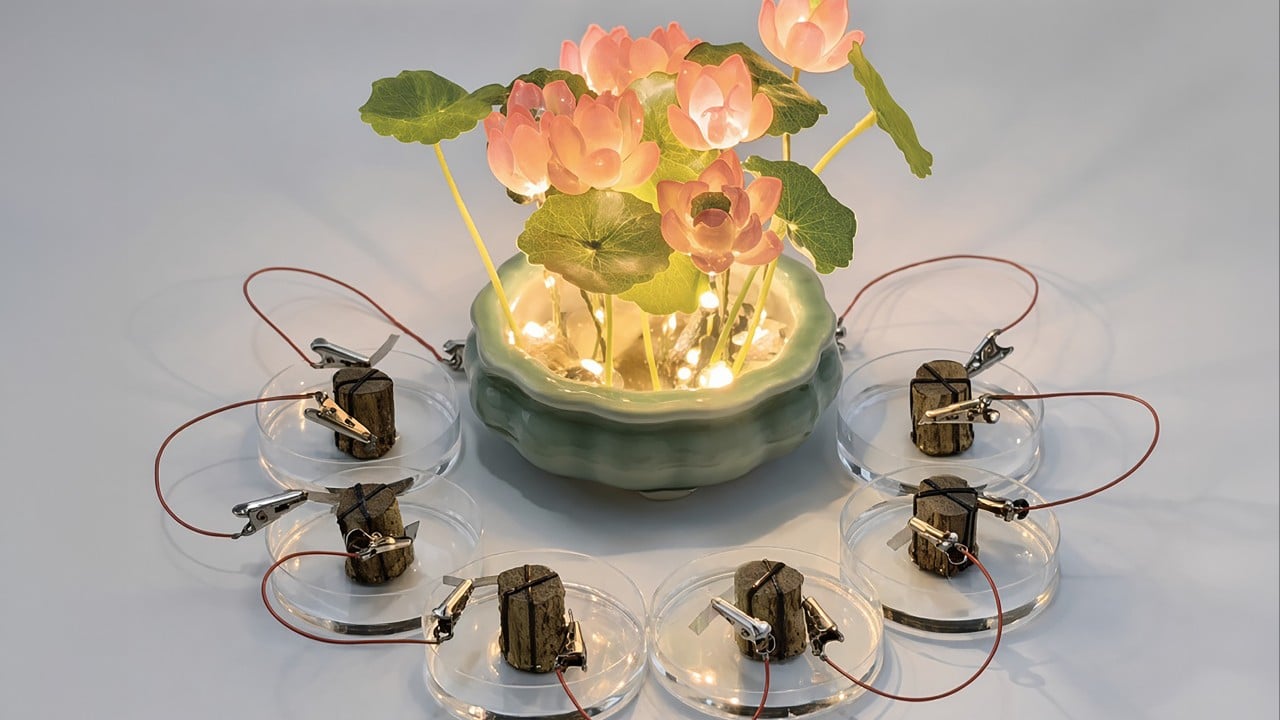
They called it endless energy. A team of researchers takes a dried lotus stem, drops it in a beaker of water, hooks up a couple of electrodes, and squeezes out a trickle of electricity as the water evaporates. Cue the breathless tech headlines. Cue the social media hype machine declaring that fossil fuels are finished because a pond plant can charge a capacitor.
It is absolute nonsense.
Let us be brutally honest about what is actually happening in these labs. Hydrovoltaic power generation—the actual scientific term for harvesting electricity from the interaction between water and solid surfaces—is real physics. It is fascinating material science. What it is not is an "endless" power source that will ever run your air conditioner, charge your electric vehicle, or replace a single megawatt of grid-scale generation.
If you have spent any time on the venture capital side of clean tech, you have seen this movie a hundred times. Academic labs publish a brilliant proof-of-concept paper in a prestigious journal. The university press office strips out all the thermodynamic caveats and writes a press release promising free power from thin air. Tech bloggers copy-paste the press release without checking the math on power density. Two years later, a naive founder raises three million dollars on a pitch deck full of lotus leaves, only to discover that powering a single industrial warehouse would require paving over half of a medium-sized country with wet aquatic plants.
The Physics Nobody Wants to Do
To understand why the "endless lotus power" narrative is a trap, you have to look at the mechanism behind it. We are dealing with the streaming potential and the electric double layer (EDL).
When water moves through the microscopic, naturally aligned vascular channels of a dried lotus stem, the walls of those channels carry a slight surface charge. They attract oppositely charged ions from the water, creating a thin, stationary layer of charge along the channel wall, while leaving a mobile layer of counter-ions in the flowing water. As capillary action pulls water up the stem and solar heat evaporates it at the top, that continuous upward flow drags the mobile ions along with it. Separating positive and negative charges creates a voltage potential. Put an electrode at the bottom and an electrode at the top, and electrons flow through an external circuit.
Notice what actually drives this engine. It is not magic. It is solar thermal energy disguised as biology.
Evaporation is an endothermic phase change. For every single gram of liquid water that turns into vapor at the top of that lotus stem, the surrounding environment has to supply roughly 2,260 joules of latent heat. If you put that lotus stem in a dark, sealed, humidity-saturated room, the evaporation stops. When the evaporation stops, the capillary flow stops. When the flow stops, your "endless" electricity drops to zero.
You are not getting free energy from a plant. You are building an indirect, remarkably inefficient solar-thermal generator that uses water as a working fluid and plant cellulose as a structural scaffold.
The Brutal Math of Power Density
Let us look at the numbers that the viral headlines conveniently leave in the footnotes.
In typical hydrovoltaic experiments using carbonized wood, lotus stems, or engineered nanoporous films, a single device—usually a few square centimeters in size—generates an open-circuit voltage of around 0.5 to 1.0 volts. That sounds respectable until you look at the current. We are talking about microamperes.
Multiply 0.8 volts by 10 microamperes and you get 8 microwatts of power.
Let us put 8 microwatts into real-world perspective:
- A standard LED lightbulb requires about 10,000,000 microwatts (10 watts). You would need over 1.2 million individual lotus stem generators wired in flawless series-parallel arrays just to read a book at night.
- A modern smartphone battery holds roughly 15 watt-hours of energy. Charging it with a single 8-microwatt lotus generator would take 1,875,000 hours. That is more than 214 years.
- A standard silicon solar panel sitting right next to that beaker of water harvests roughly 200 watts per square meter under direct sunlight. A hydrovoltaic evaporation array occupying that exact same square meter struggles to hit 1 watt under ideal laboratory airflow.
Imagine a scenario where a municipal utility decides to replace a modest 100-megawatt natural gas peaker plant with lotus stem evaporation farms. Even if engineers solved every single wiring, corrosion, and water-supply bottleneck in existence, the land footprint required to evaporate enough water to generate 100 megawatts at hydrovoltaic efficiencies would dwarf the reservoir of a major hydroelectric dam. And you would lose millions of gallons of fresh water into the atmosphere every single day just to keep the electrodes wet.
Why Natural Biomaterials Fail in the Real World
The second glaring flaw in the "lotus stem revolution" is durability. Lab experiments run for a few days using deionized water in controlled environmental chambers. The real world is filthy, salty, and alive.
When you use natural plant tissue—whether it is lotus stems, wood, or mushroom stalks—as a microfluidic channel, you are dealing with raw organic matter submerged in water. Three catastrophic failure modes hit you almost immediately:
- Biofouling: Stagnant or slow-moving water exposed to light and air is an incubator for algae, bacteria, and fungi. Within days, microbial biofilms clog the micron-scale vascular bundles. Once the pores block, capillary wicking dies.
- Salt Crystallization: Unless you are feeding your power plant expensive, energy-intensive distilled water, the water contains dissolved minerals. As water evaporates exclusively at the top surface of the stem, every mineral ion stays behind. Salt crusts form directly over the top electrode, choking off evaporation and insulating the electrical contact.
- Structural Degradation: Wet cellulose rots. Even when researchers partially carbonize the lotus stems in a furnace to turn them into conductive carbon scaffolds, the resulting material is brittle. A single freeze-thaw cycle in winter shatters the porous network into black dust.
I have watched hardware startups burn through millions in seed funding trying to commercialize bio-templated materials for energy storage and generation. The pattern is always identical. Batch-to-batch biological variation destroys manufacturing yields. One harvest of lotus stems has 30-micron pores; the next season's harvest has 45-micron pores because of a rainy spring. You cannot build an industrial supply chain on agricultural quirks when synthetic polymers and electrospun nanofibers offer uniform, tunable pore geometry down to the nanometer.
The Questions You Should Actually Be Asking
When headlines scream about endless energy from plants, people rush to ask the wrong questions. Let us dismantle the most common ones right now.
Can lotus stem generators power a home off-grid?
No. Not even close. The power density is off by five orders of magnitude. If you want off-grid power, buy monocrystalline silicon solar panels and lithium iron phosphate batteries. The price of solar panels has collapsed to pennies per watt, and they do not require a continuous supply of fresh water to keep the lights on.
Is this technology completely useless?
No—and this is where the nuance matters. Just because a technology cannot power a city does not mean it has zero commercial value. Calling hydrovoltaics useless is just as lazy as calling it endless energy.
Why do scientists keep studying evaporation electricity if the power is so low?
Because in specific, ultra-low-power niches, microwatts are all you need, and batteries are a massive liability.
Where Hydrovoltaics Actually Makes Money
If you strip away the clean-energy fantasy and look at hydrovoltaic devices through the lens of industrial instrumentation and edge computing, the picture changes completely.
There are billions of wireless sensors deployed across agriculture, civil infrastructure, and environmental monitoring. Think about soil moisture sensors buried across a ten-thousand-acre farm, or structural strain gauges mounted inside a concrete bridge pier. The sensor itself consumes almost zero power—modern ultra-low-power microcontrollers spend 99.9% of their lives in deep sleep, waking up for a few milliseconds every hour to transmit a tiny packet of data via LoRaWAN.
The bottleneck for the Internet of Things has never been the chip. It is the battery. Sending a technician out to swap dead coin-cell batteries across thousands of remote sensors costs more than the sensors themselves.
In that specific environment, an evaporation-driven generator is brilliant. You do not need kilowatts. You need a trickling 10 microwatts to trickle-charge a solid-state supercapacitor so the radio can ping a gateway once an hour. Even better: in a hydrovoltaic sensor, the power source is the sensor. Because the voltage output fluctuates directly with ambient humidity, temperature, and water availability, a farmer does not even need a separate moisture probe. The rate at which the device generates electricity is the measurement of how fast the soil is drying out.
Pioneers in this field, including Zhou Jun's group at Huazhong University of Science and Technology and Guo Wanlin's team at Nanjing University of Aeronautics and Astronautics, have demonstrated exactly this kind of self-powered sensing. They are not pitching grid replacement. They are building autonomous micro-systems that harvest ambient environmental gradients where solar panels get covered in mud or shade.
The Honest Trade-Offs of the Contrarian View
Being skeptical of academic hype does not mean betting against basic science. There is a real downside to dismissing early-stage materials research too aggressively: you can miss the moment a foundational discovery crosses an engineering threshold.
In the 1950s, Bell Labs unveiled the first practical silicon solar cell. Its efficiency was a dismal 6%, it cost a fortune to manufacture, and critics laughed at the idea that sand could ever compete with coal-fired turbines. Seventy years of relentless chemical engineering, supply chain scaling, and semiconductor physics turned that laboratory curiosity into the cheapest source of bulk electricity in human history.
Hydrovoltaics will never match the raw thermodynamic ceiling of photovoltaics because phase-change evaporation is fundamentally bottlenecked by ambient air humidity and mass transport. You cannot beat the psychrometric chart. However, synthetic hydrovoltaic membranes—engineered from functionalized graphene oxide, titanium dioxide nanowires, or conductive polymers rather than raw pond plants—are steadily pushing output from microwatts toward milliwatts.
If you are an investor, an engineer, or a tech reader, stop measuring these breakthroughs against the electrical grid. Measure them against the cost of replacing a battery in a hard-to-reach place.
The lotus stem is not going to save the planet from climate change, and it certainly is not going to give you free electricity. Respect the physics, ignore the press releases, and put your money on silicon.