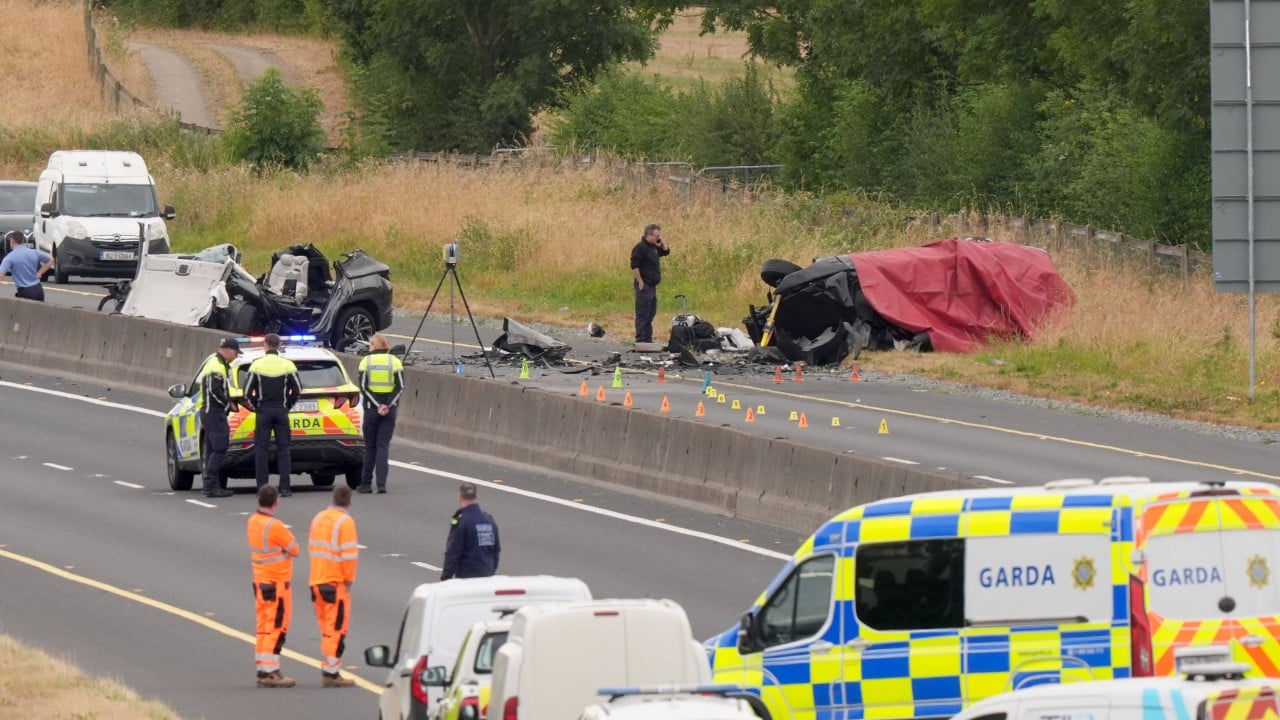
Another headline rolls across the screen. Five dead, four seriously injured in a head-on motorway collision in Ireland. The national chorus starts immediately. Thoughts and prayers. Calls for harsher penalties. Demands for more speed cameras. Pious editorials about vigilance and responsibility.
It is all completely useless noise.
Every single time a high-speed arterial road turns into a slaughterhouse, society defaults to the same intellectually lazy script. We blame the driver. We moralize about human error. We treat catastrophic kinetic impacts as moral failures rather than systemic engineering deficits. I have spent two decades analyzing transportation networks, watching planners throw billions at emotional band-aids while ignoring the mechanical realities of how humans pilot two-tonne metal boxes at 120 kilometers per hour.
Let us dispense with the polite fiction. Human beings are terrible drivers. We get tired, we get distracted, our reaction times degrade, and our spatial awareness has hard biological limits. Expecting millions of untrained citizens to maintain flawless operational discipline for hours on end is not a safety strategy. It is a suicide pact disguised as traffic management.
The Lazy Consensus of Moral Panic
The standard media narrative following a fatal crash follows a predictable, useless arc. First, report the tragic toll. Second, interview a local politician who calls for reduced speed limits. Third, quote a road safety authority urging motorists to slow down and pay attention.
This approach assumes that drivers wake up planning to gamble with their lives. It assumes that a warning sign or a slightly lower number on a metal post will override human biology.
Data from the European Transport Safety Council and various national road administrations show a persistent truth. Speed limits do not prevent head-on collisions on undivided or poorly separated high-speed corridors. A driver falling asleep, suffering a medical emergency, or executing a misjudged overtaking maneuver at 80 kilometers per hour can still cross into oncoming traffic and generate a closing speed that defies human survival mechanics.
Lowering the speed limit on a dangerous stretch of road without changing the physical infrastructure is political theater. It lets bureaucrats claim they took action while the underlying hazard remains untouched.
The Physics They Refuse to Acknowledge
Kinetic energy does not care about your feelings. It scales with the square of velocity, but it is dictated entirely by mass and trajectory. When two vehicles moving in opposite directions collide, the energy transfer is absolute and unforgiving.
Standard road design relies heavily on what engineers call driver expectancy. The idea is that if you paint enough white lines and put up enough reflective studs, people will magically stay on their own side of the asphalt. This works until it doesn't. And when it fails, people die.
Contrast this with the Scandinavian approach to high-speed corridors. In countries implementing aggressive zero-toll systems, undivided high-speed roads are treated as design flaws. If a road permits speeds above 70 kilometers per hour where opposing streams of traffic mix, it is classified as inherently unsafe.
Why? Because human error is a constant. You cannot engineer the human out of the vehicle, so you must engineer the hazard out of the road.
The Central Median Fallacy
The most glaring omission in standard reporting on motorway and national road carnage is the absence of a hard physical barrier conversation.
Ireland, like much of the developed world, still features hundreds of kilometers of high-speed national roads where opposing traffic is separated by nothing more than a painted line, a strip of grass, or low-tension wire cables that a heavy vehicle can punch through like wet cardboard.
When a crash happens on these stretches, the knee-jerk response focuses on why the car veered left or right. The real question should be why a car could cross the centerline in the first place.
Imagine a scenario where every major national route operating above 80 kilometers per hour was retrofitted with concrete rigid barriers or high-tension steel systems rated to deflect heavy impacts. Head-on collisions would drop near zero overnight. You could double enforcement budgets, quadruple fines, and run graphic television ads until the end of time, and you would not save as many lives as a few miles of Jersey barrier.
Yet, infrastructure upgrades cost money. They require concrete, heavy machinery, and political willpower. Handing out speeding tickets generates revenue and keeps the illusion of control alive.
Dismantling the Enforcement Industrial Complex
We have built an entire industry around punishing bad outcomes instead of preventing them. Automated speed cameras, unmarked patrol cars, and point-penalty systems form an enforcement ecosystem that treats road safety as a compliance game.
Driver behavior modification through fear of fines has a hard ceiling. It catches people who are paying enough attention to notice a camera box, but it does nothing for the driver experiencing a micro-sleep, a mechanical failure, or a sudden loss of control on a greasy winter morning.
The obsession with speed enforcement acts as a smokescreen for civil engineering failures. If a road consistently produces catastrophic head-on impacts, the road is poorly designed. Period. Blaming the victims posthumously or scapegoating the survivor does not absolve the state of its duty to build safe corridors.
The Hard Truth About Personal Responsibility
Let us address the counter-argument from the personal responsibility fundamentalists. The refrain is always the same: if people just drove better, we would not need expensive infrastructure overhauls.
This is libertarian fantasy applied to mass transit. We do not apply this logic to commercial aviation. We do not tell airline pilots to just pay better attention when navigating through a storm without instruments. We install radar, automated ground proximity warning systems, and redundant fail-safes because we accept that human error is inevitable at scale.
On our roads, we pretend that driving is a meritocracy of skill. It is not. It is an everyday mass activity performed by exhausted parents, distracted teenagers, aging citizens with declining vision, and stressed workers commuting in heavy traffic. Designing a system that demands perfection from every single one of them every single second is structural negligence.
What Actually Works
If we want to stop writing these exact same articles month after month, we need to abandon our emotional attachment to punitive measures and adopt aggressive infrastructural engineering.
First, mandate physical separation on all roads carrying traffic above 80 kilometers per hour. If opposing lanes are not separated by a concrete or heavy steel barrier, the speed limit on that route must be legally capped at a level where a head-on impact becomes survivable.
Second, reallocate road safety budgets away from marketing campaigns and passive speed traps directly into capital infrastructure projects. Every euro spent on a billboard telling people to slow down is a euro stolen from a median barrier that could have deflected a stray truck.
Third, stop treating crashes as anomalies. They are mathematically predictable outcomes of mixing high speeds, high masses, and zero physical separation.
The next time five people die on a high-speed road, do not ask how fast they were going. Ask why the state left an open invitation for two tonnes of steel to meet another at closing speeds of 200 kilometers per hour with nothing between them except empty air.
Fix the road. Everything else is just noise.