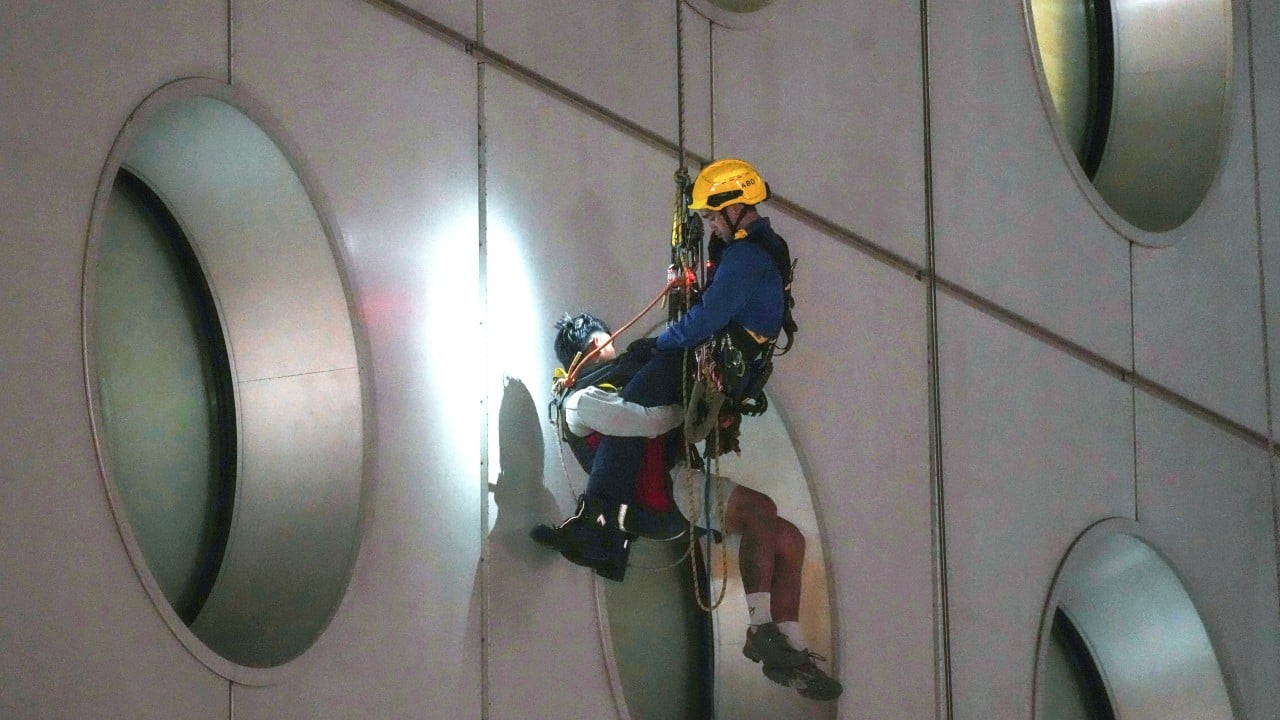
The headline reads like a movie script. A Hong Kong firefighter dangling from a helicopter hoist looks a stranded hiker in the eye and asks a deadpan, casual question to break the tension: "Have you done this before?"
Internet readers love it. Local news outlets eat it up. Comment sections fill with heart emojis and praise for the rescuer’s cool-headed charm under pressure.
Here is the uncomfortable truth that nobody inside the aviation rescue community wants to say out loud while the public is busy applauding: casual banter during a live hoist operation is not a sign of mastery. It is a symptom of cognitive drift, a threat to Crew Resource Management, and a habit that masks severe operational risk.
If you think mid-air small talk is what keeps a panicked victim calm, you have fallen for a Hollywood myth. Real survival in vertical rescue depends on ruthless vocal economy, standardized brevity codes, and strict sensory discipline. When rescuers start trading quips on the wire, someone is taking their eye off the mechanical failure modes that actually kill people.
The Lie of the "Chill Hero" Narrative
Media coverage of technical rescues—especially helicopter hoist operations over rugged terrain like Hong Kong’s Lion Rock or Sai Kung country parks—relies on a predictable formula. Journalists strip away the terrifying physics of rotor wash, dynamic load oscillation, and engine failure profiles, replacing them with a human-interest anecdote. A quip becomes the centerpiece of the story.
This framing creates a dangerous feedback loop. The public begins to equate casualness with competence. Worse, junior operators start subconsciously mimicking that demeanor, believing that projecting effortless cool is part of the job description.
In high-consequence environments, "chill" is a liability.
Consider the reality of a helicopter hoist evolution. A twin-engine aircraft—such as the Airbus H175 operated by Hong Kong’s Government Flying Service (GFS)—is hovering out of ground effect, often inches from jagged granite cliffs or dense canopy. The pilot has zero visual reference to the victim. The winch operator is leaning out of an open cabin door, managing a steel cable under hundreds of pounds of tension while translating spatial geometry into precise voice commands for the pilot: "Forward two, down one, hold hover."
Every syllable spoken over the intercom or shouted into the rotor wash consumes bandwidth. When a rescuer on the ground or on the wire initiates unnecessary conversation, they introduce acoustic clutter into an environment already operating near the threshold of human auditory processing.
Cognitive Load Is Not Infinite
Human working memory is brutally limited. Under acute stress—hanging 150 feet below a hovering airframe in gusty crosswinds—the prefrontal cortex experiences significant narrowing. Psychologists call this attentional tunneling. Aviation safety investigators call it the precursor to an accident chain.
When a rescue specialist asks a victim, "Have you done this before?", two things happen simultaneously:
- The rescuer shifts from procedural execution to social performance. Even a micro-second spent formulating a witty remark diverts cognitive cycles away from checking the victim’s harness buckle, monitoring cable twist, or watching for snag hazards on the rock face.
- The victim receives an ambiguous social cue instead of a clear motor command. A person experiencing acute sympathetic nervous system arousal—tunnel vision, tachycardia, auditory exclusion—does not need an icebreaker. They need an unambiguous physical directive they can execute without thinking.
I have sat in post-incident debriefs where crews laughed off near-misses because the extraction looked smooth on camera. Later, when you pull the cockpit voice recorder or review the helmet-cam footage frame by frame, you see the exact second the chatter started—and the exact second a secondary safety strap went unchecked or a tag line fouled on a scrub bush. Nobody died, so the story became a funny anecdote at the station bar. That is the definition of normalization of deviance, a term coined by sociologist Diane Vaughan after studying the Challenger disaster. Just because a shortcut or distraction did not cause a catastrophe today does not mean the margin of safety wasn't eroded.
What Actually Calms a Panicked Victim
Defenders of the "friendly chat" approach argue that humor breaks the freeze response. They claim that if a terrified hiker hears a relaxed voice, their cortisol drops and they cooperate better.
This misunderstands basic neurobiology under acute threat.
When a civilian is stranded on a cliff edge with a 110-decibel turbine screaming overhead and 70-knot rotor downwash blasting grit into their face, their brain is not processing nuanced conversational humor. They are in survival mode. Sarcasm, dry wit, or open-ended questions require the victim's brain to decode intent, evaluate social context, and formulate a verbal reply.
If the victim does not speak the rescuer's exact dialect, or if the rotor noise clips half the sentence, an open-ended question creates confusion. Confusion breeds hesitation. Hesitation during a dynamic lift—when the aircraft is drifting or fuel reserves are ticking down—is poison.
Compare a casual question to proper command-and-control vocalization:
- The Hollywood Way: "Have you done this before? Don't worry, just enjoy the ride, the view is great from up here."
- The Professional Way: "Look at me. Keep your hands crossed on your chest. Do not grab the cable. Lift your knees when we move."
Notice the difference. The second approach uses low-frequency, authoritative cadence, affirmative phrasing (telling the brain what to do rather than abstractly asking about past experiences), and zero wasted words. A calm, decisive order reduces anxiety far faster than a joke because it signals to the victim's nervous system that someone else is completely in control of the environment.
The Silent Killers of Hoist Operations
To understand why vocal discipline matters so much, look at what can go wrong in the thirty seconds between hooking up a victim and clearing the terrain obstacle.
1. Dynamic Rollover and Cable Snagging
If a hoist cable or tag line catches on a rock outcrop while the helicopter transitions from a hover to forward flight, the aircraft can be pulled past its critical roll angle in less than two seconds. The winch operator must execute an immediate cable shear—cutting the wire and dropping the load—to save the aircraft and crew. During that window, the rescuer on the wire must be 100% locked into the terrain geometry, not making conversation.
2. Static Electricity Discharge
Helicopter rotors slicing through dry or dust-laden air generate massive electrostatic charges—often exceeding 100,000 volts. If the grounding wand or hoist hook touches the ground or the victim before discharging properly, the resulting shock can cause involuntary muscle contraction, knocking a rescuer off a ledge or causing a victim to panic and unclip.
3. Harness Slippage and Inverted Suspension
Civilian rescue strops and extraction harnesses rely on body weight and proper chest-strap tension to keep the occupant upright. If a panicked hiker raises their arms overhead—the exact instinct people have when startled or trying to wave—they can slip right through a standard rescue strop. A rescuer whose attention is split by banter is slower to spot the subtle upward creep of the harness under the victim's armpits.
4. Loss of Visual Reference (Brownout/Whiteout/Cloud Ingress)
In places like Hong Kong, mountain weather shifts in minutes. Orographic clouds roll over ridges without warning, enveloping a hovering helicopter in zero-visibility fog. When the pilot loses visual contact with the terrain, the entire aircraft relies on the winch operator’s verbal altitude and drift calls. Any extraneous noise or distraction in the cabin degrades the clarity of those calls.
Why Media and Agencies Keep Pushing the Wrong Story
If experienced aviation crews know that strict discipline saves lives, why do press releases and viral news stories keep highlighting lighthearted mid-air moments?
Public relations and recruitment.
Fire departments and flying services operate under intense public scrutiny and budget pressure. A story about hydraulic pressure tolerances, hoist duty cycles, and sterile cockpit protocols does not generate clicks. A story about a charming rescuer cracking a joke mid-air turns civil servants into folk heroes overnight.
There is also a subtle cultural factor in high-tempo urban rescue units. In dense, hyper-busy jurisdictions like Hong Kong—where fire and rescue crews respond to hundreds of mountain rescue calls every year—familiarity breeds complacency. When you have performed fifty routine evacuations of dehydrated hikers in running shoes, the fiftieth lift starts feeling like a routine elevator ride.
That is precisely when the mountain bites back.
Imagine a scenario where a crew conducts three straightforward rescues in a single afternoon. By the fourth call, the adrenaline has worn off, the routine feels effortless, and the banter flows freely during hook-up. On that fourth lift, a sudden downdraft drops the tail rotor two meters closer to a boulder, the victim panics at the sudden drop, grabs the rescuer's neck, and knocks the rescuer’s helmet communication lead loose. Suddenly, the "routine" chat turns into a silent, frantic wrestling match 200 feet above the rocks with no comms to the cockpit.
The Sterile Cockpit Rule Exists for a Reason
Commercial aviation solved this problem decades ago. Following a series of fatal crashes in the 1970s caused by flight crews chatting about non-essential topics during critical phases of flight, the Federal Aviation Administration introduced the Sterile Cockpit Rule (14 CFR § 121.542).
The rule is simple: below 10,000 feet, during taxi, takeoff, landing, and all critical maneuvers, flight crews are strictly prohibited from engaging in non-essential conversation. No jokes. No personal stories. No casual check-ins. Every word spoken must directly pertain to the safe operation of the aircraft.
Helicopter hoist operations are exponentially more hazardous than a commercial airliner descending on an instrument landing system. A commercial jet has two pilots, automated flight controls, miles of cleared runway, and thousands of feet of airspace buffer. A rescue helicopter hovering beside a cliff has rotor tips spinning twenty feet from solid rock, fluctuating wind shear, and human lives dangling on a six-millimeter steel wire.
Yet we applaud when rescue crews violate the exact principle that commercial aviation treats as sacred.
What Real Mastery Looks Like on the Wire
To be clear, stripping away casual banter does not mean turning rescuers into robotic, unempathetic bullies. Cold aggression fails just as badly as sloppy humor. If you scream at a terrified civilian, they lock up.
True professional mastery in technical rescue looks and sounds very different from what makes viral headlines:
- Pre-Arrival Silence and Assessment: Before the hook even touches the ground, the rescuer reads the victim’s posture, breathing rate, and grip tension. Are they frozen? Hyperventilating? Reaching wildly? The assessment happens silently through observation, not through Q&A.
- Physical Anchoring Before Speech: The rescuer establishes physical contact and clips the victim into a safety tether before offering reassurance. Hardware first, psychology second.
- Economy of Language: Communication is reduced to three-to-five-word anchors delivered in a flat, steady, low-register voice. "You are clipped in." "I have you." "Hands on your straps." Repetition replaces improvisation.
- Eye-Level Calibration: Instead of shouting over rotor wash from four feet away, the rescuer positions themselves directly in front of the victim’s field of view, blocking out the terrifying drop behind them and forcing visual fixation on the rescuer's chest or shoulders.
Admittedly, this approach has a downside when the cameras are rolling: it looks boring. There are no viral quotes. There is no witty repartee for the evening news anchor to chuckle over before tossing to the weather forecast. It looks like quiet, methodical, almost clinical mechanical execution.
And that is the whole point.
Stop Confusing Luck With Skill
Let’s look at the actual search intent behind readers clicking on stories about mid-air rescue conversations. People want to know how rescuers stay calm when staring straight down a lethal drop, and what it feels like to be plucked off a mountainside by a helicopter.
The honest answer is that genuine composure in extreme danger does not sound like a stand-up routine. It sounds like silence punctuated by sharp, unambiguous commands.
When a firefighter or aircrewman makes a joke during a live hoist and everything goes smoothly, they did not succeed because of the joke. They succeeded in spite of the distraction—backed by millions of dollars of redundant engineering, rigorous maintenance schedules, and a pilot fighting the collective stick to hold the aircraft steady.
Celebrating the quip while ignoring the risk teaches the wrong lesson to every rookie rescuer watching from the sidelines and every hiker who treats technical terrain like a theme park ride.
Next time you read a glowing profile about a rescuer’s mid-air small talk, ask yourself a simple question: if the engine coughed or the cable snagged at that exact second, would you want the person holding your life to be thinking about their next line—or watching the hook?
Keep the jokes for the debrief room. On the wire, shut up and run the checklist.