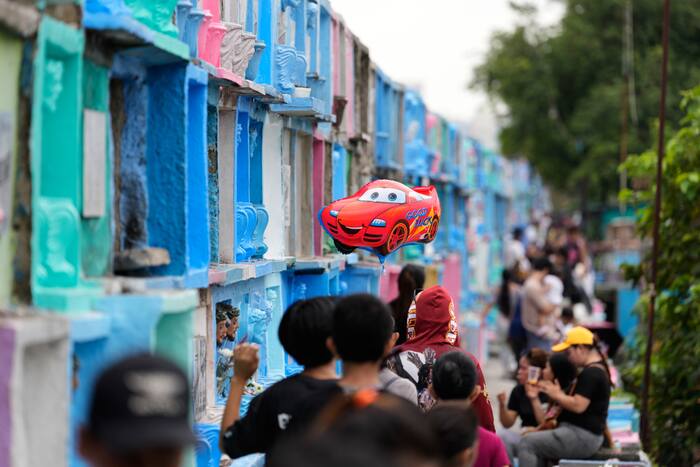
Every November 1st, the travel writers and lifestyle editors roll out the exact same tear-jerking script. They tell you that Filipinos treat death like a fiesta. They swoon over the picnics in Manila North Cemetery, the blooming white chrysanthemums, the glowing candles, and the heartwarming sight of multi-generational families playing tong-its atop marble tombs. They frame it as a beautiful, defiant celebration of eternal closeness.
They are selling you a postcard. They are completely missing the reality on the ground.
If you have actually spent a decade covering Southeast Asian cultural economics, urban planning, and sociology, you know that the sanitized "family reunion at the graveyard" narrative is lazy journalism. It mistakes logistical necessity, deep-seated social obligation, and a massive commercial engine for pure, unadulterated spiritual devotion.
Undas—the collective Filipino observance of All Saints' Day and All Souls' Day—is not a quaint, timeless folk tradition where loved ones simply stay close. It is a high-pressure social audit, a multi-billion-peso retail spectacle, and a coping mechanism for an urban infrastructure that gives working-class families nowhere else to gather.
The Lie of the "Joyful Reunion"
Standard media coverage treats the cemetery picnic as an organic expression of Filipino resilience. Look closer at the mechanics of Undas.
Ask anyone who has actually navigated the North Luzon Expressway on October 31st or fought for elbow room in crowded municipal cemeteries from Cebu to Davao. Nobody is having a relaxing spiritual retreat. The air is thick with melting paraffin wax, diesel exhaust, and humid sweat.
The romanticized narrative ignores the heavy burden of pakikisama—the uniquely Filipino cultural imperative to maintain smooth interpersonal relationships and conform to group expectations. In practice, showing up at the cemetery on November 1st is often less about communing with the dead and more about proving your loyalty to the living.
Miss a year, and the family group chat turns cold. Fail to bring enough food for the extended cousins, and you are whispered about until Christmas. Anthropologist F. Landa Jocano spent decades mapping these exact social structures, noting how ritual obligations in the Philippines function as strict social glue rather than purely internal spiritual exercises. When lifestyle articles reduce this complex web of obligation to "keeping loved ones close," they erase the exhausting social pressure baked into the holiday.
Follow the Money Beneath the Tombstones
If you want to understand what Undas has actually become, stop listening to cultural commentators and look at the receipts.
Over the past twenty years, the observance has been aggressively hijacked by retail and real estate conglomerates. What was once a solemn Catholic obligation rooted in praying for souls in purgatory—a theological distinction almost entirely lost on modern participants—has morphed into a massive Q4 economic stimulus.
Consider the numbers. Every late October, highway toll operators, bus lines, flower growers in Benguet, candle manufacturers, and fast-food chains hit peak seasonal volume. Memorial parks developed by the country's largest property giants are no longer somber burial grounds; they are master-planned leisure estates marketed like high-end subdivisions, complete with manicured lawns, chapel rentals, and strict rules on tent sizes.
The "closeness" touted by mainstream articles is heavily gatekept by socioeconomic status:
- The Elite Experience: Air-conditioned mausoleums in private memorial parks featuring private restrooms, catering setups, and generator-backed Wi-Fi.
- The Working-Class Reality: Crammed public cemeteries where families sleep on cardboard boxes next to stacked concrete niches (apartment-style tombs) because they cannot afford perpetual lease renewals.
- The Displaced: Families whose relatives' bones are exhumed and dumped into common ossuaries after a five-year municipal lease expires, leaving them with nowhere to lay a flower.
Pretending that all Filipinos experience Undas as a charming, unified cultural picnic is an insult to the millions of families navigating severe spatial inequality even in death.
Why People Ask the Wrong Questions About Undas
Search engines are flooded every October with sanitized, tourist-friendly queries. Let us dismantle the most common misconceptions hiding behind them.
"Why do Filipinos celebrate death instead of mourning it?"
They do not celebrate death. That is a Western projection invented by foreign correspondents who get confused when they see people laughing near a grave.
Filipinos fear death and grieve deeply, just like everyone else. What outsiders misinterpret as "celebrating death" is actually radical communal distraction. In a society with minimal institutional mental health support and exorbitant therapy costs, collective noise, food, and humor are the primary tools used to blunt the sharp edges of grief. You laugh and gamble at the grave so you do not have to sit in silence with the reality of permanent loss.
"Is All Saints' Day the most important family holiday in the Philippines?"
No. Christmas holds that title without contest. Undas is the mandatory warm-up act.
More importantly, calling it a "family holiday" obscures why people actually congregate in cemeteries. In hyper-dense cities like Metro Manila, public parks are scarce, malls are expensive, and multi-generational households live in cramped quarters. For millions of low-income families, the cemetery on November 1st is one of the few legally sanctioned, free-to-enter public spaces where an entire clan can pitch a tarp, occupy square footage, and exist together without being shooed away by private security guards.
"What is the proper etiquette for visiting a Filipino cemetery?"
Forget the polite blog posts telling you to "bring white flowers and wear respectful colors." If you want to survive the actual ground reality, the real rules are purely tactical:
- Arrive at 4:00 AM or stay home. Anything after 7:00 AM on November 1st puts you in gridlock that will test your sanity.
- Pack for a music festival, not a church service. Bring portable fans, power banks, industrial-strength mosquito repellent, and cash in small denominations for informal parking attendants and cleaners.
- Leave the performative solemnity at the gate. If you show up crying uncontrollably while everyone else is eating pancit and catching up on gossip, you will make the entire gathering uncomfortable.
The Theological Amnesia Nobody Wants to Admit
Here is a detail the feel-good articles always gloss over: almost nobody at the cemetery is actually observing All Saints' Day correctly.
In Catholic doctrine, November 1st (All Saints' Day) is dedicated to the canonized and uncanonized saints in heaven—the souls who have already made it. November 2nd (All Souls' Day) is the day designated for praying for the departed relatives who may still be in purgatory.
Yet in the Philippines, the cultural gravity pulls almost entirely toward November 1st. Why? Because November 1st is the official non-working holiday. The liturgical calendar lost the war to the labor code decades ago.
The result is a fascinating theological mashup. Families gather on the day meant for saints, pray rosaries meant for souls in purgatory, set out plates of food—known as atang in the north—rooted in pre-colonial animist ancestor worship, and blast modern pop music from Bluetooth speakers. It is a brilliant, messy survival mechanism of syncretism. Calling it a simple, pious act of keeping loved ones close strips away the raw, contradictory history that makes it actually interesting.
The Uncomfortable Downside of Changing the Narrative
Admitting that Undas is driven by social pressure, commercialism, and urban spatial deficits comes with a sharp sting. If you strip away the romanticized myth, you risk sounding cynical about one of the few traditions that genuinely brings scattered Filipino families under one sky—or one tarp—once a year.
There is real value in forced togetherness. In an era where millions of Overseas Filipino Workers (OFWs) spend years separated from their children and parents, any cultural mechanism that compels people to stop working, travel home, and sit beside their elders carries undeniable social utility. Even if the motivation is half-guilt and half-obligation, the outcome is still human connection.
How to Reclaim the Ritual Without the Noise
If you want to actually honor the dead without falling victim to the performative circus of modern Undas, stop following the crowd into the November 1st bottleneck.
- Shift your visit to October 28th or November 3rd. You will have complete silence, zero traffic, clean air, and actual space to sit with your memories rather than managing crowd logistics.
- Audit your spending. Skip the overpriced, plastic-wrapped floral arrangements that rot in the sun within six hours and create tons of municipal waste. Redirect that money to a cause the deceased actually cared about, or use it to buy a decent meal for the living elders in your family while they can still taste it.
- Drop the performance. If you are only going to the cemetery to post a moody candle photo on Instagram or avoid getting judged by your aunt, stay home. Light a candle at your dining table, say a genuine prayer, and call your surviving parents.
The dead do not care how expensive your floral wreath is, how many cousins showed up to eat lechon on their grave, or how heartwarming a lifestyle writer thinks your grief looks from a distance. Stop performing closeness for the living, and start showing up for your family before they need a headstone.