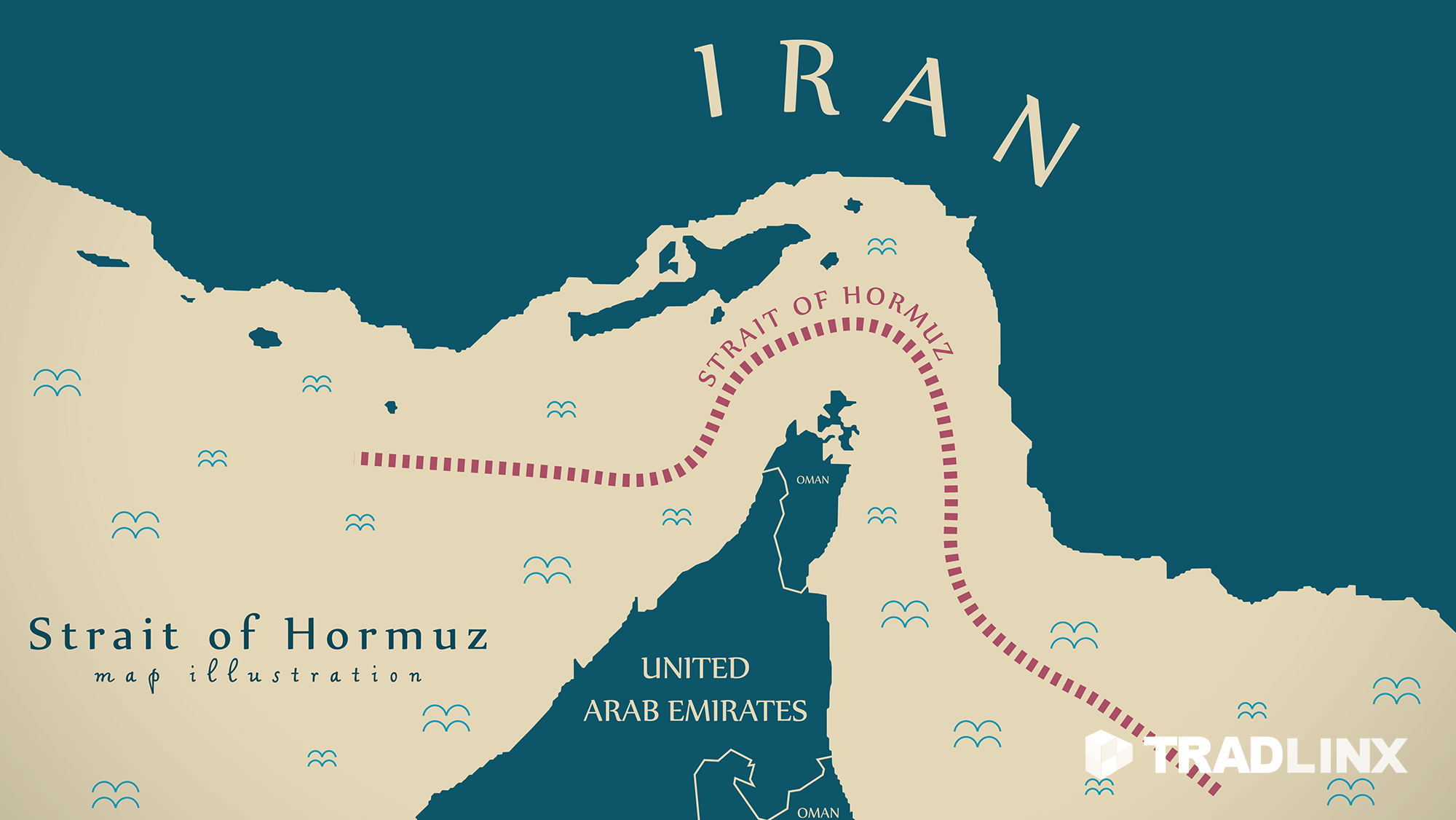
The threat of a total naval blockade in the Strait of Hormuz has moved from a theoretical war game to a central pillar of American foreign policy, yet the tactical reality on the water remains a nightmare for global energy markets. While the Trump administration signals a return to "maximum pressure" with a maritime twist, Tehran’s response—warning of "deadly whirlpools"—is not mere rhetorical flair. It is a description of a specific, asymmetrical naval doctrine designed to turn the world's most vital energy artery into a graveyard for high-value assets. If a blockade begins, the immediate result will not be a tidy surrender by the Islamic Republic, but a catastrophic spike in crude prices and a logistical knot that the U.S. Navy may find impossible to untie without a full-scale regional war.
The Strait of Hormuz is a narrow chokepoint, barely 21 miles wide at its tightest, through which roughly 20 percent of the world’s petroleum consumption flows. For a superpower, a blockade seems like the ultimate leverage. By cutting off Iran's ability to export its remaining "ghost fleet" oil, the U.S. aims to bankrupt the regime. However, the geography favors the defender. Iran’s Islamic Revolutionary Guard Corps Navy (IRGCN) does not try to match the U.S. Fifth Fleet ship-for-ship. Instead, they have spent decades perfecting the art of the swarm.
The Asymmetric Math of a Gulf Conflict
Modern naval warfare is often dictated by the cost of the intercept versus the cost of the threat. When a billion-dollar destroyer uses a million-dollar missile to take out a ten-thousand-dollar drone, the math eventually breaks the bigger power. In the Strait of Hormuz, Iran utilizes hundreds of fast-attack craft, sea mines, and shore-based anti-ship missiles hidden in the rugged limestone cliffs of the Musandam Peninsula.
A U.S.-led blockade requires ships to remain in relatively static positions to intercept tankers. This turns those ships into targets. Iranian military leaders use the term "deadly whirlpools" to describe the chaotic, multi-directional nature of an engagement in these waters. If the U.S. closes the door on Iranian exports, Tehran has made it clear they will close the door for everyone. This is not a bluff. It is a survival mechanism.
The tactical problem is the "swarm." Imagine fifty small, high-speed boats, some remote-controlled and packed with explosives, charging a single carrier strike group from multiple angles. Even the most advanced Aegis combat systems can be overwhelmed by sheer volume. In the tight confines of the Gulf, reaction times are measured in seconds, not minutes. This is why the Pentagon’s own past war games, such as the infamous Millennium Challenge 2002, often resulted in massive "Blue Team" losses when facing a Red Team that used unconventional, swarming tactics in restricted waters.
The Economic Suicide Pact
Investors often talk about "geopolitical risk" as a vague metric, but a blockade in Hormuz is a concrete math problem. Shipping insurance rates would vanish or become so expensive that no commercial captain would enter the Gulf. This effectively shuts down the ports of Saudi Arabia, the UAE, Kuwait, and Iraq.
- Global Supply Shock: A prolonged closure could remove 18 to 20 million barrels of oil per day from the market.
- Price Volatility: Analysts estimate crude could jump to $150 or $200 a barrel overnight.
- Infrastructure Fragility: Iran’s "whirlpool" strategy includes targeting desalination plants along the Arab coast. This turns a fuel crisis into a water crisis for America's regional allies.
The irony of a blockade intended to punish Iran is that it might hurt the global economy more than the target. China, the primary buyer of Iranian oil, would likely view a blockade as a direct act of economic warfare against Beijing. This elevates a regional spat into a Great Power confrontation. China has already invested heavily in Iranian infrastructure and has zero interest in seeing its energy security dictated by a U.S. naval cordon.
The Ghost Fleet and the Enforcement Gap
Enforcing a blockade is not as simple as parking a ship in the middle of the ocean. Iran has become a master of the "gray zone." They use a "ghost fleet" of aging tankers that fly flags of convenience, turn off their transponders, and engage in ship-to-ship transfers in the middle of the night.
To actually stop the flow of Iranian oil, the U.S. Navy would have to board and seize vessels. This is a high-stakes gamble. Each seizure provides a justification for Iran to seize a Western-linked tanker in retaliation, a game of tit-for-tat they have played successfully for years. The "whirlpool" isn't just physical; it's a cycle of escalation where each move intended to settle the situation only draws the participants deeper into a conflict with no clear exit strategy.
Furthermore, the U.S. presence in the region is stretched. With commitments in the Red Sea defending against Houthi rebels and a permanent eye on the Pacific, maintaining a constant, high-alert blockade in the Strait of Hormuz places an immense strain on personnel and hardware. Maintenance cycles for destroyers are already backlogged. A year-long blockade would require a rotation of ships that the current U.S. shipbuilding industry is not equipped to support.
Why Technical Superiority Fails in Narrow Channels
In the open ocean, the U.S. Navy is untouchable. In the Strait, that superiority is neutralized by physics and geography. The shallow waters of the Gulf make submarine operations difficult for the U.S., while providing excellent cover for Iran’s small, quiet Ghadir-class midget submarines. These tiny vessels can sit on the sandy bottom and wait for a carrier’s acoustic signature to pass overhead.
Iran's missile batteries are another factor often underestimated. The Noor and Qader anti-ship missiles are mobile. They are moved on trucks, hidden in tunnels, and fired from land-based positions that are incredibly hard to neutralize without a ground invasion. A naval blockade, by definition, stays on the water. It cannot stop the missiles launched from the mountains. This means any attempt to "blockade" Iran's coast would require the U.S. to also strike targets deep inland to protect its fleet, effectively starting a land war.
The "miscalculation" Iran warns about is the assumption that the U.S. can control the level of escalation. Washington may think it is just turning a dial on economic pressure. Tehran, however, views any blockade as a total threat to its existence. When a regime feels it has nothing left to lose, it stops following the rules of "proportional response."
The Failure of Allied Consensus
A blockade is most effective when the world supports it. Currently, there is no international mandate for a total maritime shutdown of the Strait. European allies, still reeling from the energy shocks of the past few years, are unlikely to provide more than a symbolic presence. Without a UN mandate or a broad coalition, a U.S. blockade looks like a unilateral act of aggression, making it harder to sustain long-term.
Regional players like Qatar and Oman, who share the Strait's waters with Iran, have spent years maintaining a delicate neutrality. They are terrified of being caught in the crossfire. If the U.S. uses their bases to launch blockade operations, they become targets for Iranian retaliation. This could lead to the closure of the Al Udeid Air Base or other critical hubs, further complicating the American logistical position.
The Strategy of the Deadly Whirlpool
Iran's goal is to make the cost of the blockade so high that the U.S. is forced to blink. They don't need to win a battle; they just need to ensure that no one else wins either. By threatening "deadly whirlpools," they are signaling that they will turn the Strait into a zone of absolute denial. This involves:
- Saturation Mine Laying: Dropping thousands of sophisticated, bottom-dwelling mines that are nearly impossible to clear under fire.
- UAV Swarms: Using kamikaze drones to target the bridge and sensor arrays of Western warships, "blinding" them before a missile strike.
- Proxy Activation: Ordering groups in Iraq, Yemen, and Lebanon to strike U.S. assets simultaneously, forcing the Navy to defend on multiple fronts.
This isn't a scenario where the U.S. can simply sail through and expect the opposition to crumble. It is a grind. It is a slow-motion collision where the global economy is the first casualty.
A blockade might seem like a "clean" way to exert power—no boots on the ground, just ships on the water. But in the Strait of Hormuz, the water is the battlefield, and the geography is a weapon that Iran has spent forty years learning how to use. The U.S. military is built for the "big fight" in the open sea. It is far less prepared for the "dirty fight" in a crowded, narrow channel where the enemy is everywhere and nowhere at once.
If the order is given to close the Strait to Iranian oil, the U.S. must be prepared for the reality that it might be closing the Strait to the world. The whirlpool doesn't just trap the enemy; it pulls in everything within reach. The financial fallout alone could trigger a global recession that would make the 2008 crisis look like a minor correction. When the "maximum pressure" of a blockade meets the "maximum resistance" of a cornered regional power, the result is rarely a peaceful transition. It is usually an explosion.
Every ship that enters those waters during a blockade becomes a pawn in a game of high-stakes chicken. The U.S. has the bigger hammer, but Iran has the home-field advantage and a willingness to burn the whole stadium down.
The "whirlpool" is real, and once the fleet enters it, there is no easy way to sail out.
The Tactical Bottleneck
The sheer density of traffic in the Strait means that any military engagement will involve massive collateral damage. Hundreds of neutral vessels, from fishing boats to giant cargo ships, are always in the area. A blockade force would have to sort through thousands of radar pips to identify a single "illegal" tanker. This creates a target-rich environment for Iranian "hit and run" tactics. They can hide their combat craft among the civilian traffic, using innocent sailors as human shields.
If the U.S. Navy fires on a boat that turns out to be a civilian dhow, the propaganda victory for Tehran is immense. If they wait to identify the target, they risk being hit by an explosive-laden suicide craft. This is the "deadly" part of the whirlpool—a tactical environment where there are no good choices, only degrees of failure.
A blockade is an act of war, not a diplomatic maneuver. Treating it as anything less ignores the historical reality of naval conflict. The moment the first Iranian tanker is boarded by U.S. Navy SEALs, the "maximum pressure" campaign stops being an economic policy and becomes a kinetic war.
The U.S. may have the technology to see everything, but in the Strait of Hormuz, seeing the threat doesn't always mean you can stop it. The "whirlpool" is waiting, and the cost of entry is higher than any administration has yet dared to calculate.
Stop looking at the map and start looking at the math. The math of the Strait of Hormuz says that a blockade is a recipe for a global catastrophe that no one is truly prepared to manage.
Move the fleet, and you move the world toward a cliff.