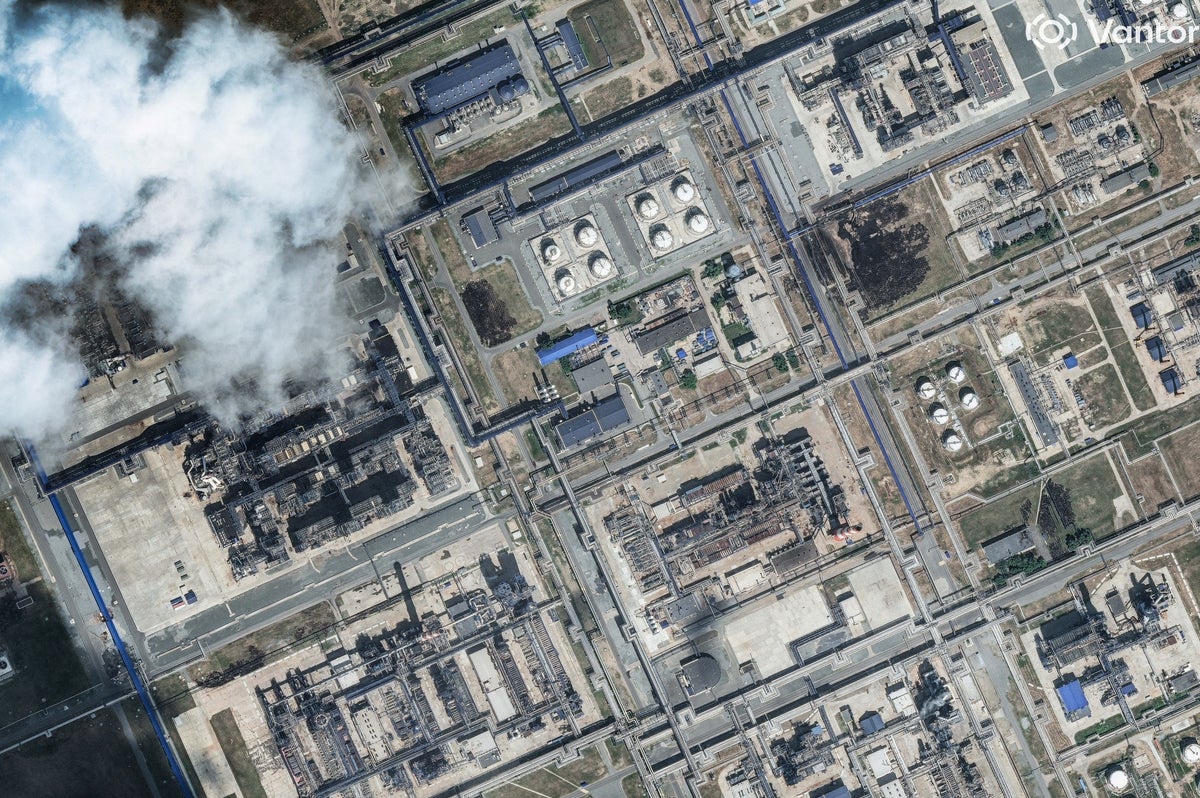
When the first primitive, long-range quadcopters and converted light aircraft began buzzing across the international border toward Russian industrial hubs, military theorists dismissed them as little more than psychological theater. They carried small payloads. Their guidance systems were prone to civilian-grade jamming. Western capitals quietly fretted that these asymmetric hits would cross unspoken escalation thresholds without altering the fundamental math of the frontline.
Those assumptions dissolved under the weight of sustained engineering adaptation. Today, Ukraine operates a sophisticated campaign of deep strikes targeting the beating heart of the Russian war economy. By focusing long-range unmanned systems on primary distillation towers, catalytic crackers, and fuel distribution nodes, Kyiv has systematically dismantled the notion of geographic immunity.
To understand the trajectory of these operations, one must look past the daily scoreboard of smoking oil depots and examine the precise mechanical vulnerabilities being exploited.
The Anatomy of an Industrial Target
Modern petroleum refining is not a uniform mass of steel that burns evenly when touched by fire. It is an intricate, highly specialized sequence of chemical engineering towers where precise temperatures and pressures separate raw crude into usable fractions.
When a long-range drone strikes a general storage tank, the immediate visual is dramatic. Black smoke billows for miles, and local emergency services scramble. Yet, from a systemic standpoint, a storage tank is merely a bucket. It can be bypassed, drained, or repaired with relative speed.
The true targets of this campaign are primary distillation units, commonly known in the industry as CDU units. These massive columns are irreplaceable overnight. A custom-built fractionating tower requires specialized metallurgy, precise engineering blueprints, and months of heavy fabrication work. Most advanced Western components used in these systems are blocked by strict export controls.
When a strike penetrates a facility like the Nizhnekamsk complex in Tatarstan or reaches deep into Siberian processing hubs, it targets the proprietary brains and custom valves of the Russian energy apparatus. A single successful impact on a vacuum distillation unit can idle an entire refinery's output for months, forcing operators into a grueling game of cannibalizing parts from damaged plants to keep others online.
Shifting the Economic Burden
The secondary shockwave of these attacks registers directly on the balance sheets of the Russian federal budget. For decades, the foundational strength of the state rested on exporting refined petroleum products rather than raw crude alone. Refined gasoline and diesel command significantly higher margins, capturing the economic value-add domestically before export.
As domestic refining capacity faces chronic friction, the structural export profile shifts. Raw crude flows outward in greater volumes, while internal processing lags behind demand. This dynamic introduces severe domestic strain:
- Regional Fuel Deficits: Local distribution networks experience acute pinch points, forcing temporary retail restrictions and emergency government interventions.
- Logistical Bottlenecks: Rail and pipeline networks must compensate for localized shortages, shifting transport priorities away from heavy military logistics.
- Compensatory Subsidies: Refineries require extensive capital injections and tax breaks from Moscow to fund rapid rebuilding efforts, draining funds from other state sectors.
By forcing Moscow to choose between supplying fuel to domestic agricultural and civilian markets or maintaining export revenue streams, the campaign weaponizes economic friction against the state's central treasury.
The Evolution of Long-Range Guidance
Early iterations of these raids relied heavily on basic satellite navigation coordinates that left them exposed to dense layers of electronic warfare and localized jamming rings. The airspace surrounding major Russian industrial installations is defended by rings of electronic suppression units designed to spoof GPS receivers and disorient incoming aerial vehicles.
To counter this, engineering teams adapted machine vision guidance systems and autonomous inertial navigation backups. These platforms no longer rely exclusively on external signals during their terminal phase. Instead, onboard processing units compare real-time optical data of the target landscape against pre-loaded topographical maps, allowing them to complete their final descent even when electronic jamming blankets the surrounding grid.
This technological leap explains the expanding geographic scope of the operations. Distance is no longer an absolute shield. Facilities thousands of kilometers away from the border now find themselves vulnerable to autonomous navigation packages that operate independently of external control links.
Counter-Measures and the Limits of Air Defense
Protecting thousands of square miles of critical infrastructure presents an impossible mathematical problem for any military air defense network. Anti-missile systems like the S-400 are engineered to track high-speed ballistic projectiles and tactical aircraft at high altitudes, making them ill-suited for intercepting low-flying, slow-moving autonomous drones tracing river valleys and tree lines.
Industrial operators have attempted to improvise physical barriers, erecting crude steel mesh nets and gabion walls around vulnerable processing units. While these improvised defenses can occasionally deflect fragments from a low-yield detonation, they offer little protection against precision-guided payloads designed to detonate at the precise structural stress point of a distillation column.
Physical dispersal of fuel reserves offers only marginal relief. Refineries cannot be easily moved underground; their vast scale and heavy operational footprints tether them permanently to geographic extraction and pipeline paths. Every month the campaign sustains its operational tempo, the cumulative repair deficit compounds, turning localized industrial damage into a chronic structural drain on national energy output.