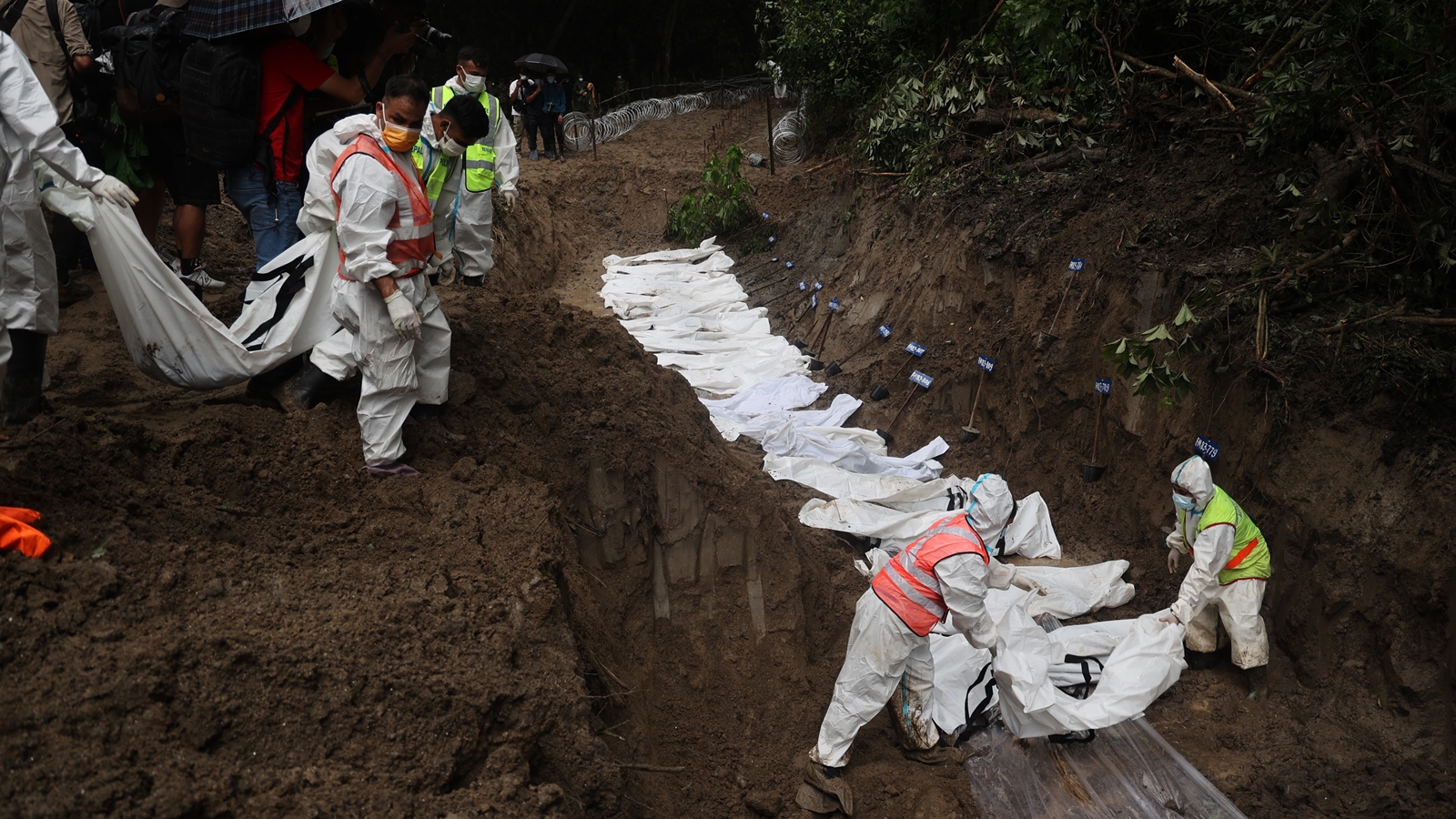
The loss of 90 lives in a coal mine gas explosion is not an isolated tragedy but the terminal output of a systemic failure in gas drainage and ventilation architecture. When methane concentrations in an underground environment cross the explosive threshold—typically between 5% and 15%—the margin for error vanishes. In high-gas mines, such as those found in the Heilongjiang province, the disaster is rarely the result of a single spark. It is the result of a "Swiss Cheese" model of failure where geological instability, inadequate monitoring sensor density, and a prioritization of extraction speed over degassing cycles align to create a lethal combustion chamber.
The Physics of Methane Accumulation and Ignition
To understand the scale of a 90-fatality event, one must analyze the stoichiometric reality of methane combustion. Underground coal mines are subject to constant gas emission from the coal seam itself. This is governed by the gas content of the coal ($m^3/t$) and the rate of coal production. The fundamental equation of mine safety relies on maintaining methane levels below 1% through constant dilution.
The failure at Hegang can be deconstructed into three critical breakdown points:
1. The Ventilation-Gas Balance Breakdown
Mine ventilation systems are designed to deliver a specific volume of air (measured in $m^3/s$) to dilute methane. However, as mines go deeper, the gas pressure within the coal seams increases. If the rate of coal extraction outpaces the capacity of the ventilation fans to provide fresh air, "pockets" of gas accumulate in the "gob"—the goaf or the collapsed area behind the mining face. A sudden drop in barometric pressure or a collapse in the gob can push these concentrated gases into the active working areas, instantly bypassing the 1% safety threshold.
2. The Ignition Source Matrix
While methane provides the fuel, the ignition source is the catalyst. In a rigorous industrial environment, these sources are categorized into three risk tiers:
- Mechanical Friction: Sparks generated by shearer loaders hitting hard rock (pyrite inclusions) within the coal seam.
- Electrical Faults: Arcing from non-explosion-proof equipment or damaged cabling.
- Human Error: Improper blasting techniques where explosives are used without sufficient water-stemming or gas testing.
3. Dust-Gas Synergy
A gas explosion killing 90 people suggests a secondary phenomenon: coal dust participation. A pure methane explosion is often localized. However, the shockwave from a small methane ignition kicks up coal dust settled on the floors and walls. This dust then ignites, creating a chain reaction that travels through miles of tunnels. This suggests that the "rock dusting" protocols—where inert limestone dust is spread to neutralize coal dust—were either insufficient or bypassed.
The Economic Pressure Function on Safety Margins
In the strategic management of state-owned or private mining enterprises, a tension exists between output quotas and degasification lead times. High-gas mines require "pre-drainage," a process where holes are drilled into the coal seam months or years in advance of mining to vacuum out the methane.
The Cost of Degasification
Effective pre-drainage reduces the gas content of a seam by 30% to 50%. This process is capital intensive and yields no immediate revenue. When energy demand spikes or production targets are aggressive, the "degasification cycle" is often shortened. The result is a higher residual gas content in the coal at the moment of extraction. This creates a bottleneck: the shearer must move slower to keep gas levels safe, or it must move at full speed and risk a "gas outburst."
The Sensor Reliability Gap
Advanced mining operations utilize a distributed network of methane sensors that automatically cut power to the mining face if levels exceed 1.5%. A disaster of this magnitude indicates a failure in this automated safety loop. This typically occurs through:
- Sensor Masking: Manually covering sensors to prevent production stoppages.
- Dead Zones: Placing sensors in locations where they do not capture the actual gas concentrations at the roof of the tunnel, where methane (being lighter than air) naturally accumulates.
- Lag Time: Communication delays between the sensor and the surface control room.
Structural Defects in Regulatory Oversight
The geographic concentration of these accidents in specific Chinese provinces points to a regional variation in the enforcement of "Special Equipment" standards. While national laws are stringent, the local implementation often suffers from information asymmetry. Mine inspectors cannot be present 24/7, and mine managers possess better data on the actual state of the mine than the regulators do.
The Disconnect in Risk Reporting
In many fatal incidents, post-accident investigations reveal that "minor" gas alarms were frequent in the days leading up to the blast. These are often treated as operational nuisances rather than precursors to a catastrophic event. This represents a failure in the "Precursor Analysis" framework. Instead of a linear increase in risk, methane levels in a poorly ventilated mine exhibit non-linear spikes. A mine that is "safe" at 10:00 AM can become an explosive hazard by 10:15 AM if a localized roof fall occurs.
The Technical Debt of Aging Infrastructure
Many mines in the Heilongjiang region are legacy assets. Retrofitting these with modern "V-Type" ventilation layouts or high-capacity gas drainage stations requires significant structural rework. When the cost of the safety upgrade exceeds the projected net present value (NPV) of the remaining coal in that sector, there is a perverse incentive to "run to fail"—to extract the remaining coal with minimal further investment in safety infrastructure.
Quantifying the Human and Operational Impact
The death toll of 90 is not merely a tragedy; it is an indicator of the population density at the working face. Modern, automated mines utilize "longwall" mining with minimal personnel in the high-risk zone. A high fatality count suggests a labor-intensive operation where many miners were concentrated in the return air-way or near the extraction point.
Emergency Response Limitations
Underground, the first 60 seconds post-explosion determine the survival rate. The primary cause of death in these scenarios is rarely the blast itself, but the "Afterdamp"—a lethal mixture of carbon monoxide, carbon dioxide, and nitrogen. The failure to survive indicates:
- Inadequate Self-Rescuers: Miners likely lacked functioning oxygen-generating breathing apparatus or were not trained to deploy them in zero-visibility, high-heat environments.
- Refuge Chamber Failure: Modern mines are required to have hardened refuge chambers with independent air supplies. If these are bypassed or unreachable, the mortality rate for those not killed by the initial shockwave reaches 100%.
Strategic Imperatives for Mine Safety Restoration
Moving forward, the focus must shift from reactive penalties to proactive engineering controls. The following pillars are the only viable path to zero-fatality mining in high-gas environments.
Implementation of Real-Time Tomography
Standard point-sensors must be replaced by continuous laser-based gas monitoring that creates a heat map of gas concentrations throughout the mine. This removes the "dead zone" risk and provides a visual representation of gas migration patterns.
Mandatory Pre-Drainage Thresholds
Regulatory bodies must enforce a "No Drainage, No Mining" policy. If the gas content of a seam exceeds a specific threshold (e.g., $8m^3/t$), mining permits must be automatically suspended until pre-drainage targets are verified by independent third-party sensors.
Decoupling Safety from Production
The safety department within a mining enterprise should report directly to a regional regulator, not the mine manager. This eliminates the conflict of interest where a safety officer’s bonus is tied to the mine's production output.
The Hegang disaster is a stark reminder that in the battle between geological reality and industrial ambition, physics is indifferent to production quotas. The only defense is a redundant, automated, and strictly enforced ventilation architecture that treats methane not as a manageable risk, but as a permanent, lethal adversary.