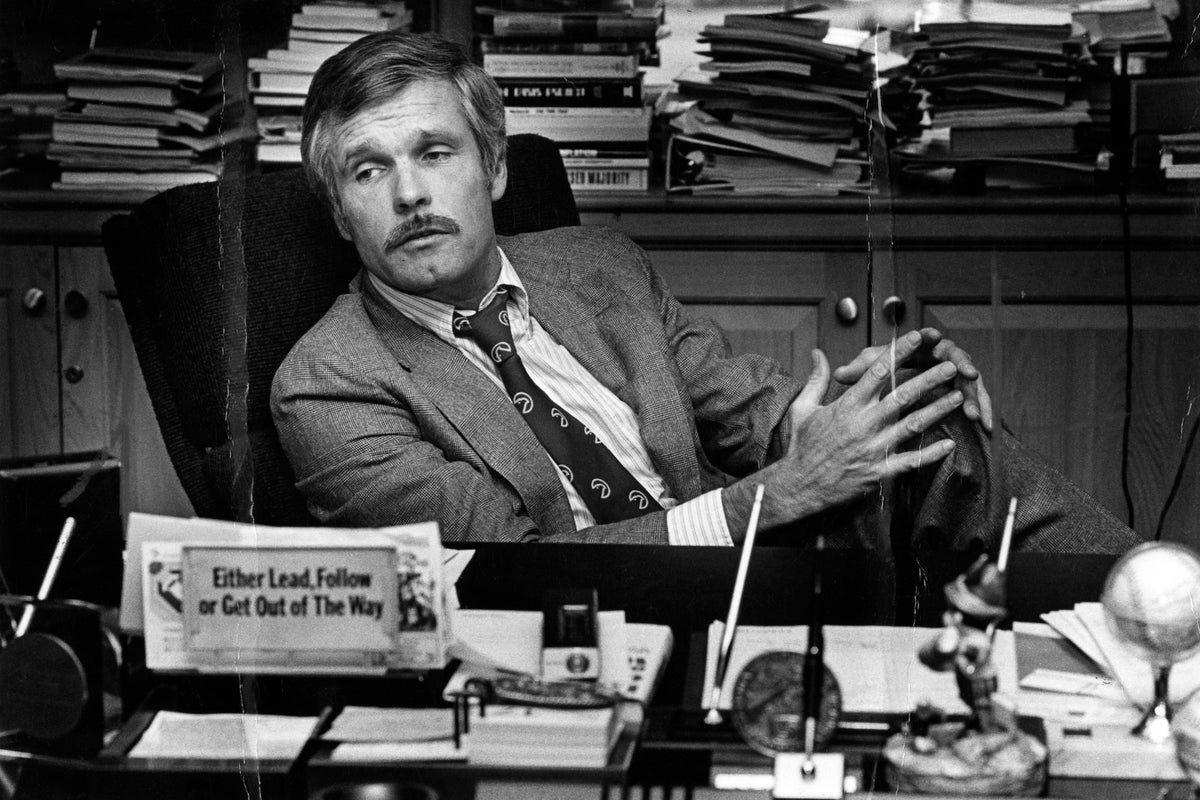
The transition of television news from a cyclical, scheduled product to a continuous, borderless utility was not an evolution of media—it was a fundamental re-engineering of the information supply chain. When Ted Turner launched CNN in 1980, he solved a distribution problem that the Big Three networks (ABC, CBS, NBC) were structurally incapable of addressing due to their reliance on the scarcity of broadcast spectrum. By shifting the economic model from a three-times-daily batch processing system to a 24-hour real-time flow, Turner initiated a feedback loop between global events and public perception that permanently compressed the decision-making windows of sovereign governments and corporate boards.
Understanding this shift requires an analysis of the specific technical and economic levers that enabled the collapse of the "news cycle" as a concept.
The Economic Efficiency of Continuous Latency
Traditional broadcast news operated on a model of high-cost, high-curation scarcity. Networks invested heavily in 22-minute blocks of information, distilled from hours of footage. This created a massive "opportunity cost" for any story that broke outside the scheduled window. Turner’s innovation was the realization that the marginal cost of broadcasting an additional hour of news via satellite and cable was significantly lower than the cost of producing premium scripted entertainment to fill that same time.
Three primary pillars defined this economic shift:
- Inventory Expansion: By moving to a 24-hour clock, CNN increased its available ad inventory by 800% compared to traditional evening news programs. Even with lower initial ratings, the sheer volume of sellable time created a cash-flow engine that could fund global bureaus.
- The Satellite Arbitrage: In the late 1970s, satellite transponder space was underutilized. Turner leveraged RCA’s Satcom I to bypass the physical limitations of terrestrial transmission towers, allowing a single signal to reach every cable headend in North America simultaneously.
- Variable Cost Scalability: In a batch-processing model, every news program requires a new set of anchors and writers. In a continuous-flow model, the "breaking news" event becomes the content itself, reducing the need for expensive high-concept production and shifting the value to the raw feed.
The CNN Effect and Political Information Velocity
The geopolitical impact of continuous news, often termed the "CNN Effect," is frequently misunderstood as mere public pressure. It is more accurately described as a compression of the OODA Loop (Observe, Orient, Decide, Act) for state actors.
Before the advent of global continuous news, diplomatic information moved through secure, private channels. The time required for a message to move from an embassy to a foreign ministry provided a natural buffer for deliberation. The introduction of live, on-the-ground reporting from conflict zones removed this buffer. When images of the 1989 Tiananmen Square protests or the 1991 Gulf War were broadcast in real-time, policymakers were forced to "Orient" and "Decide" before they had finished "Observing."
This creates a specific technical failure in governance: Reactive Policy Oscillation. Because the public reacts to raw, uncontextualized data feeds, governments are often forced to issue statements before their internal intelligence has verified the facts. This leads to a cycle where policy is driven by the immediate visual impact of a news event rather than long-term strategic interest.
Architectural Vulnerabilities of the 24-Hour Model
While the continuous news model was a breakthrough in distribution, it introduced structural flaws that would eventually lead to the fragmentation of the modern media environment. The primary bottleneck is the Information-to-Noise Ratio.
When there is no significant news breaking, a 24-hour network still has 1,440 minutes of airtime to fill. This requirement necessitates the "manufacture of urgency." The second-order effects of this requirement include:
- Punditry as a Cost-Saving Measure: Deep investigative reporting is expensive and slow. Filling airtime with two opposing experts debating a topic is cheap and fast. This shifted the news from a factual reporting mechanism to a conflict-driven entertainment product.
- The Speculation Multiplier: In the absence of hard facts during a developing story, networks fill time with "what if" scenarios. This conditions the audience to value speculative speed over verified accuracy.
- The Loss of Proportionality: Every event, regardless of its actual statistical significance, is given the "Breaking News" treatment to maintain viewer retention. This distorts the public’s perception of risk, prioritizing rare but visual events (e.g., plane crashes) over systemic but slow-moving issues (e.g., demographic shifts).
The Transition from Globalism to Tribalism
Turner’s original vision was a "global village" where shared information would foster international understanding. This hypothesis failed to account for the Market Segmentation of Truth.
As cable expanded, the increase in competition meant that networks could no longer survive on a broad, neutral audience. They had to differentiate. The easiest way to differentiate a commodity product—which news becomes when everyone has the same satellite feeds—is through brand identity and ideological alignment.
The move from "what happened" to "what this means for people like us" was a rational response to the saturation of the news market. By the late 1990s, the infrastructure Turner built to connect the world was being repurposed to segment it. The high fixed costs of launching a satellite-based network originally acted as a barrier to entry, but as digital distribution costs plummeted toward zero in the 21st century, the "continuous" aspect of news moved from TV to the smartphone.
Information Logistics: The Shift to Asynchronous Feeds
The current disruption of news is the final stage of the process Turner began. If Turner broke the 22-minute news block, the internet broke the 24-hour linear feed. We have moved from Synchronous Consumption (everyone watching the same thing at the same time) to Asynchronous Fragmentation.
The news is no longer a "channel"; it is a stream of discrete data packets optimized for algorithmic amplification. The "Global Vision" has been replaced by "Personalized Realities." This creates a specific challenge for institutional trust. When the news was a scarce resource, the provider acted as a curator. When news is an infinite resource, the provider acts as a mirror.
The technical debt of the 24-hour news cycle is now coming due. The infrastructure designed for speed and global reach is being used to disseminate hyper-targeted misinformation at a scale Turner likely never anticipated. The "global" aspect of his vision has been achieved, but the "unifying" aspect has been defeated by the economics of attention.
Strategic Imperatives for Information Integrity
For organizations and individuals operating in this environment, the following protocols are necessary to mitigate the risks of high-velocity, low-context information:
- Impose Artificial Latency: Reject the pressure of the "breaking news" cycle. Decision-making should occur only after a 24-to-48-hour verification window, regardless of the perceived urgency of the initial report.
- Source Diversification via Proximity: Value reports from entities that possess physical presence and technical expertise in a region over centralized "commentary hubs." Raw data feeds are superior to curated summaries if you have the internal capability to analyze them.
- De-emphasize Visual Narrative: Static images and short video clips are high-impact but low-information. Prioritize long-form white papers, statistical datasets, and historical context to counteract the "CNN Effect" of emotional reactivity.
The 24-hour news model succeeded in making the world smaller and faster, but it also made the information environment more volatile. The competitive advantage now lies not in having access to the news first, but in having the structural discipline to process it last. This is the only way to avoid the reactive traps inherent in a continuous-flow information economy.