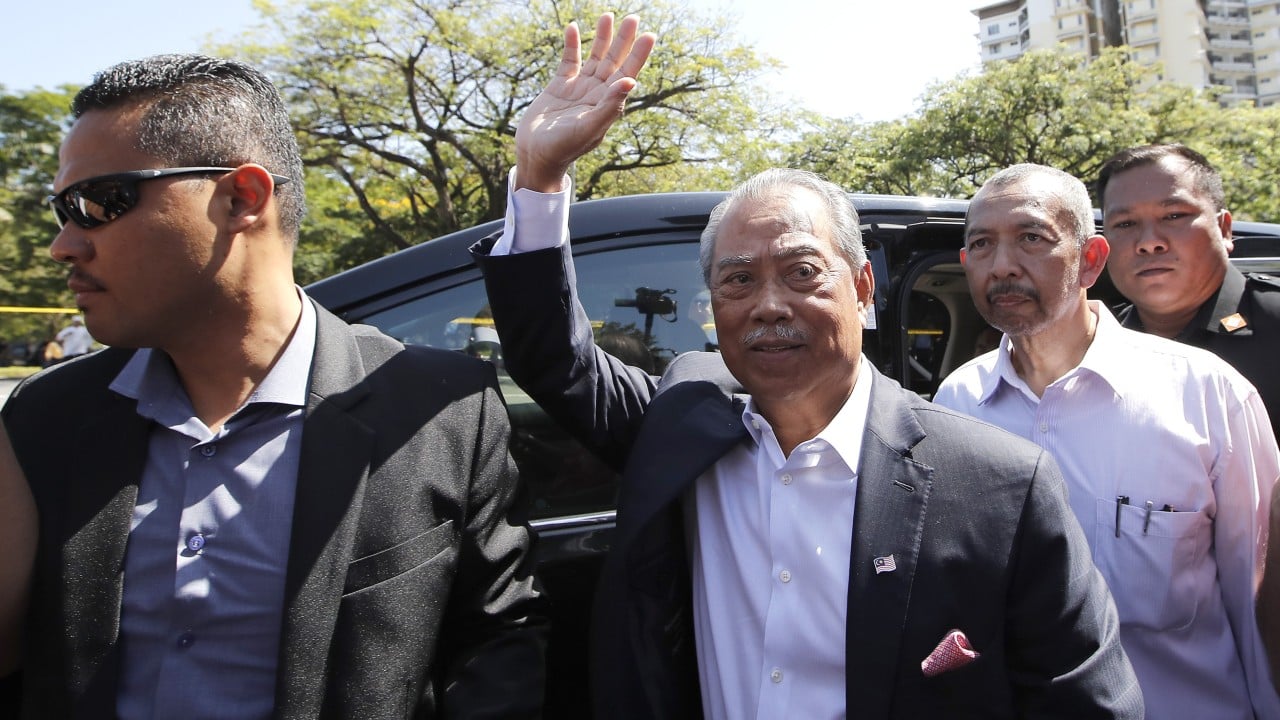
The collapse of high-profile state prosecutions against political figures rarely signals a functional normalization of the judicial branch. Instead, it exposes the friction points between executive anti-corruption mandates and the procedural rigidity of statutory criminal law. The decision by Malaysian prosecutors to drop four core charges—comprising one count of abuse of power involving a RM200 million (approximately US$49 million) transaction tied to Bukhary Equity and three counts of money laundering—against former Prime Minister Muhyiddin Yassin provides a clear diagnostic case study. This outcome highlights the structural vulnerabilities inherent in political-financial indictments when evidentiary thresholds collide with legislative definitions.
To understand why these charges dissolved, one must evaluate the statutory architecture governing political financing and abuse of office in Malaysia. The prosecution's case rested on two primary legal vectors: the Malaysian Anti-Corruption Commission (MACC) Act 2009 for abuse of power, and the Anti-Money Laundering, Anti-Terrorism Financing and Proceeds of Unlawful Activities Act 2001 (AMLA) for the subsequent management of party funds.
The friction within this mechanism lies in the definition of gratification versus institutional party funding. Under Section 23 of the MACC Act, an offense requires proof that a public official used their office or position for gratification, whether for themselves, a relative, or an associate. When corporate donations or contributions are channeled into institutional political accounts—such as those of the Bersatu party—the evidentiary burden shifts significantly. The state must prove a direct, transactional quid pro quo rather than standard political patronage or institutional fundraising mechanisms utilized broadly across the political spectrum.
The legal strategy deployed by the defense capitalized on this precise vulnerability. In criminal prosecutions of this magnitude, the failure of the indictment to disclose explicit particulars of the offense creates a fatal defect. When drafting charges related to the abuse of executive authority during a specific temporal window (such as Muhyiddin’s tenure as prime minister between 2020 and 2021), the state carries the absolute obligation to establish the exact nexus between the administrative decision and the alleged material benefit.
Without a tight causal chain linking a specific government procurement award or policy exemption to a specific corporate inflow, the charges rely on circumstantial inferences. In appellate review, courts routinely reject indictments that read like political manifestos rather than precise criminal charges. The structural failure of the prosecution was not necessarily an absence of political intent, but an overextension of statutory tools to capture complex, historically ingrained party-financing habits under narrow anti-corruption statutes.
This dynamic creates a profound institutional hazard for any administration pursuing anti-corruption campaigns. When high-stakes indictments are filed prematurely to signal political cleanups or satisfy immediate reform narratives, they encounter the friction of institutional courts. If the charges lack the granular forensic documentation required to withstand rigorous cross-examination, the resulting acquittals produce an unintended inverse effect: they legitimize the accused, provide political capital to the opposition, and expose the prosecuting agency to accusations of selective enforcement or legal incompetence.
The broader systemic cost involves the erosion of public trust in the state's anti-corruption apparatus. When a case involving tens of millions of dollars collapses due to prosecutorial withdrawal or lack of cogent legal reasoning, the public perception shifts from believing in institutional accountability to viewing the judicial process as an extension of political theater.
Future state strategies targeting executive-level financial misconduct must pivot from high-visibility, broad-net indictments to narrow, forensic-heavy asset-tracing models. The enforcement agencies must build cases where the paper trail of beneficial ownership and direct executive directive leaves no judicial ambiguity. Until the investigative threshold matches the defensive capabilities of elite legal representation, political corruption trials will continue to trade short-term political signaling for long-term judicial instability.