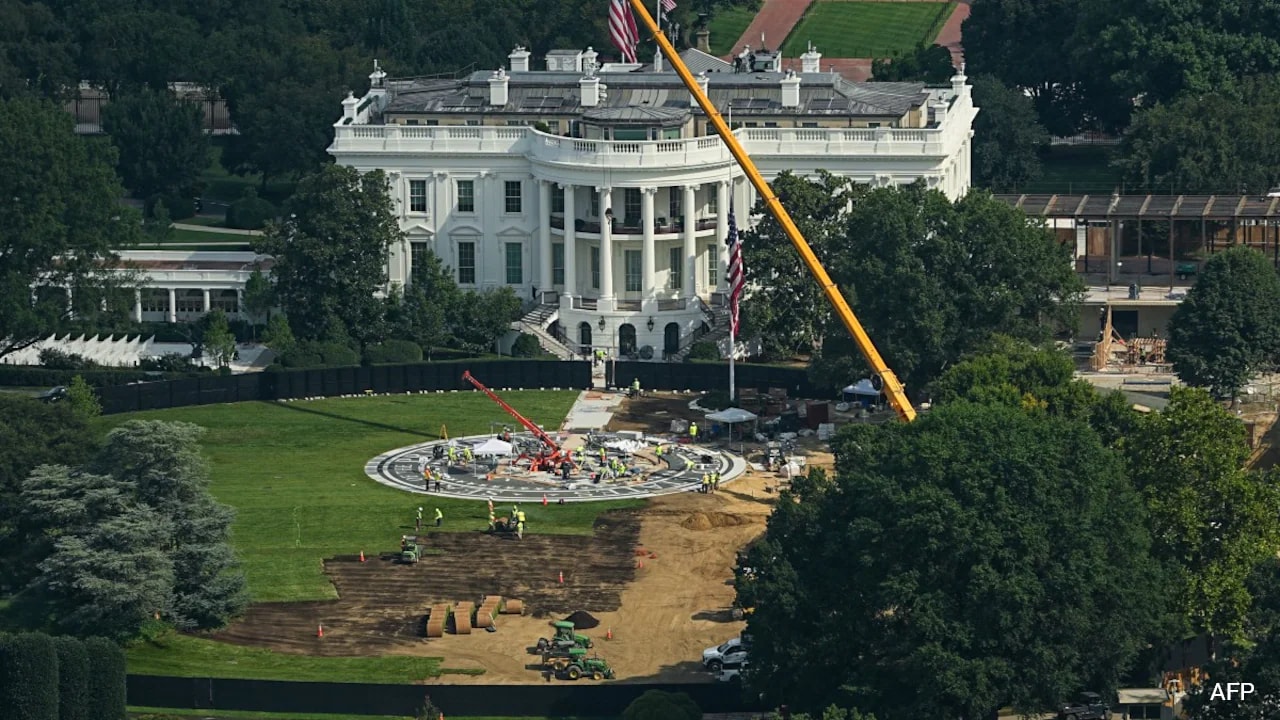
The heavy machinery outside 1600 Pennsylvania Avenue isn't stopping anytime soon. In a 5-4 decision, the Supreme Court cleared the way for the Trump administration to push forward with its contentious $400 million White House ballroom project. If you've been following the frantic legal ping-pong over the demolished East Wing, this ruling is a massive turning point.
Let's look at what actually happened. The high court's unsigned opinion lifted lower court orders that had temporarily frozen above-ground construction. Justices ruled that the National Trust for Historic Preservation—the main group trying to halt the project—lacked the legal standing to sue. By shutting down the lawsuit on procedural grounds, the court sidestepped a direct ruling on whether the executive branch has the constitutional authority to fundamentally reshape federal property without congressional sign-off.
The Race Against the Clock
Construction crews haven't been waiting around for judicial paperwork. Solicitor General D. John Sauer revealed in court filings that a 250-person crew has been hammering away twenty hours a day, seven days a week. The structure is roughly 65 percent complete. We are talking about a massive concrete and steel superstructure stretching five stories deep with a footprint approaching 50,000 square feet.
The administration argued successfully that stopping work now would cause "irreparable harm", especially given that parts of the project intersect with critical security infrastructure and underground facilities. With private donations covering roughly $335 million of the $400 million price tag, the administration claims the project is too far along to turn back. White House officials expect the shell of the building to be substantially finished by November, with a targeted completion date slated for August 2028.
Separation of Powers and Dissenting Voices
Not everyone on the bench was thrilled with the outcome. Chief Justice John Roberts penned a sharp dissent, joined by three of his colleagues, arguing that the majority's decision ignores fundamental constitutional boundaries.
"Today's decision is no victory for the separation of powers," Roberts wrote, noting that Congress holds the power of the purse and ultimate authority over federal property in the District of Columbia. The D.C. Circuit Court of Appeals previously agreed, ruling that the executive branch cannot simply ignore Congress to build massive architectural additions on federal park grounds.
Yet, practical realities often trump judicial theory. When a 70-foot-high steel frame is already dominating the landscape, courts become deeply reluctant to order a teardown. The legal strategy to outrun the courts appears to have worked.
The White House ballroom will likely stand as a physical monument to shifting political power long after current term limits expire. Whether you view the project as a long-overdue upgrade for presidential hosting or an executive overreach past constitutional guardrails, the legal roadblocks have cleared. The concrete is pouring, the timeline is locked, and Washington's newest landmark is well on its way to reality.