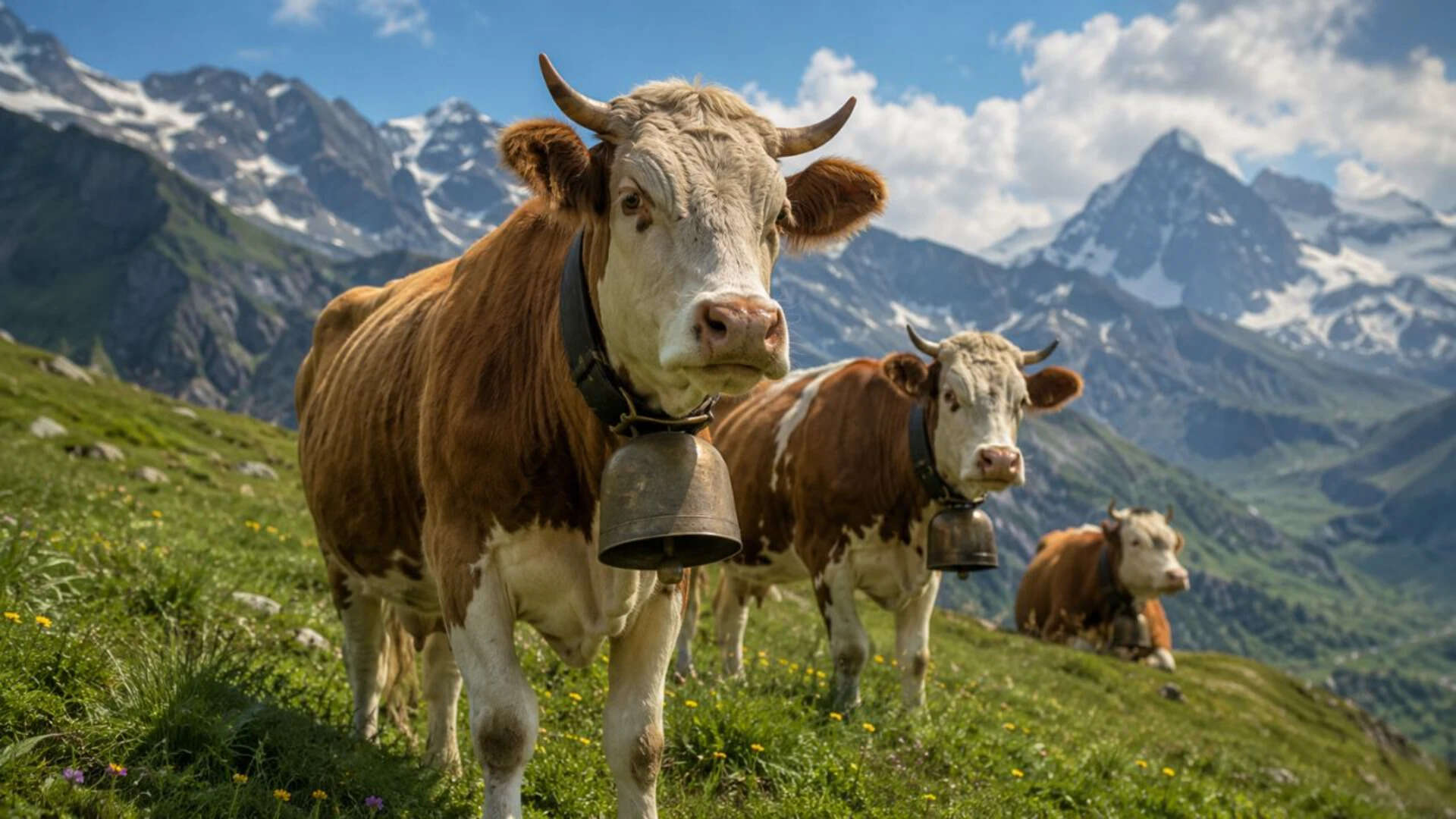
You have seen the postcards. A pristine green pasture, snow-capped peaks in the background, and a spotted cow staring lazily at the camera with a massive, heavy metal bell slung around its neck. It looks incredibly peaceful. It sounds romantic.
But if you have ever hiked the Swiss Alps, you know the reality is anything but quiet. It is a constant, metallic clangor that echoes off the rock faces.
Why do they do it? The short answer is simple. Swiss cows wear giant bells to keep from getting lost in treacherous mountain terrain. But the long answer is far more complicated, involving centuries of survival, a clash between modern technology and heritage, and a bitter animal welfare debate that has divided Switzerland.
The Real Reason Behind the Clanging in the Alps
To understand the bells, you have to understand alpine farming. Every spring, Swiss farmers send their herds up into the high mountains to graze on sweet alpine grass. This practice, called Alpwirtschaft, has been going on for thousands of years.
The pastures are not flat, fenced-in fields. They are massive, steep, and often covered in dense forest or shrouded in sudden, thick mountain fog. If a cow wanders off or falls into a ravine, a farmer has almost zero chance of finding her by sight alone.
That is where the sound comes in. Each bell has a distinct pitch. Experienced farmers can actually identify their individual cows just by the unique ring of their bell. If the clanging stops, or if a bell starts ringing frantically, the farmer knows immediately that a cow is stuck, injured, or panicked. It is a low-tech tracking system that doesn't need battery power or cell service.
Glocken versus Treicheln and Why the Difference Matters
Not all cow bells are created equal. In Switzerland, there is a massive difference between a Glocken and a Treicheln. Mistaking one for the other is a quick way to show you are a tourist.
First, you have the Treicheln. These are made of pressed sheet metal. They are relatively light, shaped like a flattened bulb, and produce a deeper, clanking, hollow sound. Cows wear these during the summer grazing season because they are easier on their necks.
Then you have the Glocken. These are heavy, cast bronze bells. They make a bright, ringing, metallic sound. They are often decorated with intricate patterns, coats of arms, or leather straps embroidered with alpine flowers.
A cow only wears a giant, heavy Glocken for special occasions, most notably the Alpabzug. This is the annual autumn festival when the herds are decorated with flowers and paraded down from the mountains to the valley floor for the winter. These ceremonial bells can weigh over twenty pounds. No farmer makes a cow wear that kind of weight all summer long. It is purely for the parade, a way to show off the wealth and success of the farm.
The ETH Zurich Study That Sparked a National Debate
While tourists love the sound, not everyone is a fan. In 2014, researchers at the prestigious ETH Zurich university decided to look into how these bells actually affect the animals. What they found shocked the country.
The study monitored cows wearing bells weighing about twelve pounds. The researchers discovered that the noise levels generated by these bells reached up to 113 decibels. To put that in perspective, that is louder than a lawnmower and about the same volume as a chainsaw or a live rock concert.
Cows have highly sensitive hearing, much more sensitive than ours. The study showed that the constant noise and weight changed the cows' behavior. They chewed their food less, spent less time resting, and reacted differently to sounds around them. Animal rights groups immediately called for a ban on heavy bells, arguing that forcing a cow to wear a constant, deafening noise machine is cruel.
Farmers pushed back hard. To many in the Swiss countryside, the sound of cow bells is the very definition of their national identity. They argued that the study was artificial, using heavier bells than most cows wear daily, and that the bells are vital for animal safety. The debate is still highly charged, touching on the delicate balance between animal welfare and sacred cultural tradition.
Can GPS Ever Replace the Swiss Cow Bell
A common question from outsiders is simple. Why not just use GPS trackers? It is the twenty-first century, after all.
The truth is, some farmers are experimenting with GPS collars. But high-tech solutions have massive real-world limitations in the Swiss Alps.
Deep mountain valleys have notorious cellular dead zones. If a cow wanders into a deep gorge, a GPS tracker might lose its signal entirely. Battery life is another major issue. A cow bell never runs out of power, never gets its screen cracked by a rock, and doesn't care if it gets soaked in a torrential downpour.
There is also the economic side. Buying and maintaining high-end GPS tracking systems for a herd of fifty cows is incredibly expensive compared to a set of durable, traditional bells that can last for generations.
For now, the bells are staying. They are a practical tool, a cultural icon, and a tourism magnet.
How to Respectfully Share the Alps with Swiss Cows
If you plan to hike in Switzerland, you will share the trails with these bell-wearing animals. Here is how to do it safely and respectfully.
- Give them space. A mother cow is fiercely protective of her calf. If you walk directly through a herd, you risk getting charged. Stick to the marked trails, and if cows are blocking the path, hike in a wide arc around them.
- Never try to touch the bells. They aren't souvenirs or toys, and approaching a cow to grab her bell is a great way to get kicked.
- Keep your dog on a leash. Cows view dogs as predators. If a cow charges you because of your dog, let go of the leash immediately so the dog can run away, which usually diffuses the situation.
Appreciate the soundscape for what it is. It is not just background noise for your social media videos. It is the centuries-old acoustic map of the Swiss mountains, keeping herds safe and farmers connected to their land. Enjoy the rhythm of the Alps, keep your distance, and let the cows do their job.


