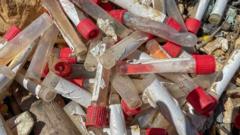
The discovery of clinical waste on the shorelines of the Isle of Sheppey is not merely an aesthetic or environmental grievance; it is a critical failure in the closed-loop logistics of medical utility disposal. When syringes, pharmaceuticals, and specimen containers enter a public marine environment, they represent a breach in the Chain of Custody (CoC) that governs biohazardous materials. This incident exposes the specific vulnerabilities in the regional waste hierarchy, where the breakdown occurs at the intersection of illegal fly-tipping, inadequate municipal oversight, and the physical mechanics of tidal distribution.
Understanding the threat requires moving beyond the "disgust" reported by local observers and analyzing the Pathogenic Risk Vector. Clinical waste is categorized by its potential to transmit blood-borne pathogens (BBPs) or chemical contaminants. The presence of this material in a high-traffic public zone like Minster or Leysdown beaches transforms a localized disposal violation into a public health liability. Meanwhile, you can find other stories here: The Royal PR Machine is Out of Sync With History.
The Triad of Source Attribution
To identify the origin of the waste, one must categorize the potential contributors based on their operational signatures. The material found on Sheppey beaches does not typically originate from a single household; its volume and composition suggest institutional or industrial-scale mismanagement.
- Institutional Leakage (Tier 1): This involves hospitals, clinics, or private medical facilities. These entities are mandated to follow strict "Orange Bag" or "Yellow Bag" protocols. A breach here suggests a failure of the third-party waste contractor responsible for incineration or sterilization. If the contractor seeks to avoid the high costs of high-temperature incineration, they may resort to illegal dumping to preserve margins.
- Domestic Medical Dependency (Tier 2): A rising demographic of home-based care leads to an increase in "sharps" and clinical waste within the domestic waste stream. While individual volume is low, the aggregate risk is high if local councils do not provide accessible, high-frequency collection points for home-care patients.
- The Marine Transfer Mechanism: In the specific geography of the Thames Estuary and the Medway, waste is often not dumped directly on the beach. It is frequently introduced into the river systems or offshore, where the Estuarine Residual Circulation—a process where denser saltwater pushes inland under fresher river water—traps debris. Prevailing winds and spring tides then deposit this concentrated mass onto the Sheppey coastline, which acts as a natural catchment area.
The Cost Function of Illegal Disposal
The decision to dump clinical waste illegally is a calculated economic choice driven by the rising costs of specialized processing. Clinical waste cannot be sent to standard landfills; it requires Heat Disinfection Units (HDU) or Energy from Waste (EfW) facilities equipped with specialized scrubbers to handle toxic off-gassing. To explore the complete picture, we recommend the excellent analysis by The Guardian.
The "Cost of Compliance" includes:
- Specialized Packaging: Puncture-resistant sharps containers and UN-approved bio-bins.
- Licensed Logistics: Drivers and vehicles ADR-certified for hazardous goods.
- Gate Fees: The price charged by incineration plants, which has tracked upward due to energy costs and carbon taxation.
When the Cost of Compliance exceeds the Risk-Adjusted Penalty (the fine multiplied by the probability of being caught), bad actors opt for "midnight moves." In the UK, the probability of prosecution for fly-tipping remains statistically low, creating an economic incentive for environmental externalities. The Isle of Sheppey, with its secluded access points and proximity to major shipping lanes, becomes a low-risk "sink" for these avoided costs.
Public Health Implications and Needle-Stick Protocols
The primary hazard in the Sheppey incident is the Percutaneous Injury Risk. Syringes washed up on a beach are rarely sterile. While many viruses like HIV lose viability quickly outside the host, others, such as Hepatitis B (HBV), are remarkably resilient and can survive in a dried state or within the protected environment of a capped syringe for weeks, even in saline conditions.
The mechanism of injury is twofold:
- Direct Inoculation: The physical puncture of the skin by a contaminated needle.
- Chemical Exposure: The leaching of pharmaceutical residues into the sand and intertidal pools, affecting local biodiversity and potentially entering the human food chain through shellfish.
Standard municipal responses often focus on manual clearing, but this addresses the symptom rather than the systemic risk. A rigorous health response requires a Spatial Risk Mapping of the affected beaches, identifying "hotspots" where the tide naturally aggregates small-format plastics and needles.
Failure of the Regulatory Shield
The Environment Agency (EA) and local authorities operate under a framework intended to prevent these occurrences, yet the Sheppey breach highlights three specific structural bottlenecks:
1. The Monitoring Gap
The EA relies heavily on self-reporting and "Duty of Care" audits. This system assumes that every link in the chain—from the nurse disposing of a needle to the driver unloading at the incinerator—is acting in good faith. There is a lack of real-time, GPS-verified tracking for individual clinical waste units. Without Unit-Level Traceability, once a bag of waste leaves a facility, it effectively enters a "black box" until it is officially logged at a disposal site.
2. Jurisdictional Friction
The shoreline is a complex legal zone. Responsibility is often split between the Crown Estate, the local council, and the Environment Agency. This fragmentation leads to a "diffusion of responsibility," where the speed of cleanup and the intensity of the subsequent investigation are hampered by budgetary disputes over who "owns" the waste once it touches the sand.
3. The Resource Constraint
Environmental enforcement teams have seen consistent budgetary contractions. The ability to conduct forensic "waste-to-source" investigations—where serial numbers on batches of medicine or specific institutional markings are used to trace the waste back to its origin—is rarely utilized unless the incident reaches a massive scale. The Sheppey deposits, while "disgusting" and dangerous, are often treated as isolated littering incidents rather than evidence of a larger criminal enterprise.
Strategic Mitigation and Forensic Recovery
To prevent the Isle of Sheppey from becoming a permanent terminal for the region’s clinical mismanagement, the response must shift from reactive cleaning to proactive disruption.
Step 1: Forensic Batch Analysis. Authorities must stop treating the waste as "trash" and start treating it as "evidence." Recovered items should be audited for manufacturer batch codes. In a globalized supply chain, these codes can narrow down the distribution to specific NHS Trusts or private pharmacies within a specific timeframe.
Step 2: Implementing Digital Twin Tracking. The waste management industry must adopt blockchain or encrypted ledger systems where every container of clinical waste is scanned at five points: generation, collection, transit, arrival, and destruction. Any "orphan" containers that do not reach the final stage should trigger an automatic investigation within 24 hours.
Step 3: Estuarine Modeling for Predictive Interdiction. By utilizing hydrodynamic models of the Thames and Medway, authorities can predict where floating waste will land based on weather patterns. Rather than waiting for needles to appear on tourist beaches, skimming vessels can be deployed to intercept debris at "choke points" before they enter the intertidal zone.
Step 4: Increasing the "Risk" in the Risk-Adjusted Penalty. The fines for clinical waste dumping should be decoupled from standard fly-tipping penalties. Because clinical waste introduces bio-pathogens into the public sphere, it should be prosecuted under public endangerment or "reckless endangerment" statutes, which carry significantly higher custodial sentences and financial ruins for the companies involved.
The presence of medical waste on the Isle of Sheppey is a diagnostic indicator of a sick logistics chain. Until the economic incentives for illegal dumping are neutralized through aggressive forensic tracing and unit-level transparency, the coastline will continue to serve as the involuntary landfill for the region's hidden medical costs. The solution is not more litter pickers; it is a total overhaul of the biohazardous Chain of Custody.