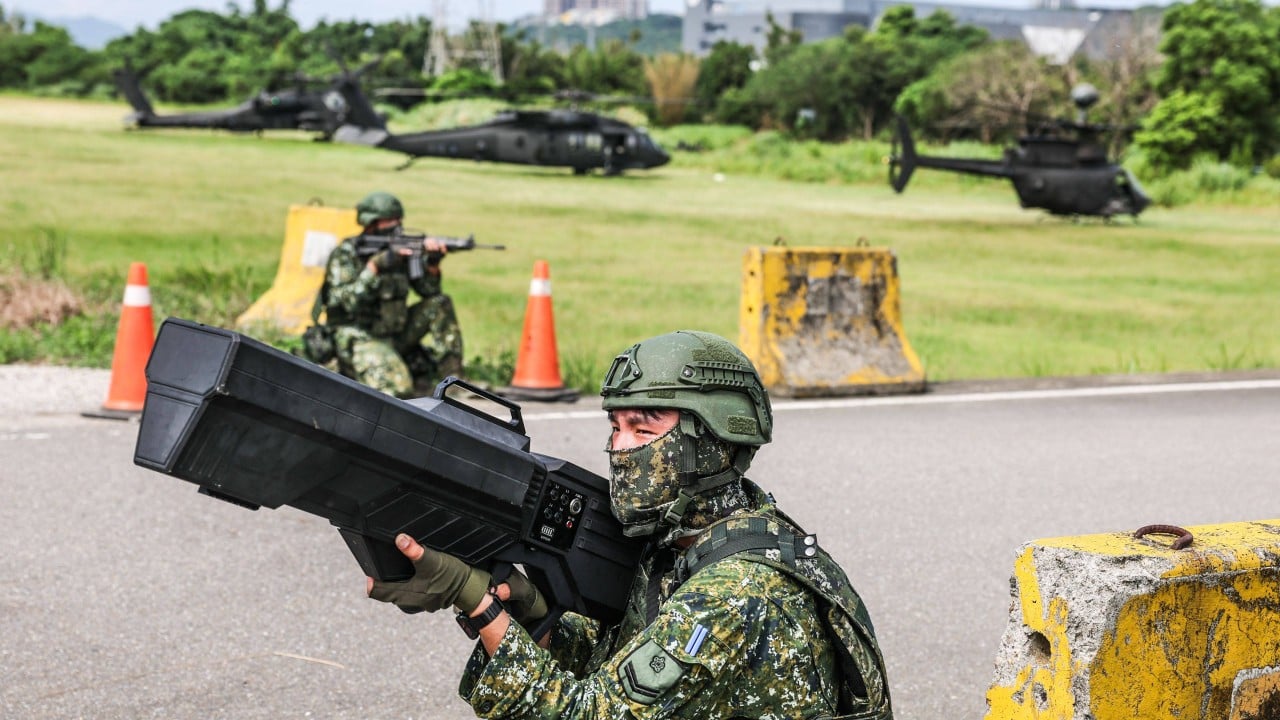
When a government audit exposes severe gaps in national defense, military planners take notice. A recent evaluation from Taiwan's National Audit Office reveals an uncomfortable truth. Taipei's counter-drone shields are falling dangerously behind Beijing's rapid technological leaps.
Most people assume modern defense systems can easily neutralize small unmanned aircraft. That assumption is flat-out wrong. Beijing's military and defense contractors are rewriting the playbook on drone warfare. Meanwhile, Taiwan's domestically developed countermeasures are struggling with basic frequency detection and severe procurement delays. Recently making news lately: Why Ukraine Just Blew Up Russia Space Factory Behind Its Starlink Competitor.
If you look past the political headlines, the core issue is an asymmetrical technology gap. Let's break down why traditional defense models are failing and what the audit actually uncovered.
The Blind Spots in Electronic Warfare
Taiwan's defense strategy has historically relied on electronic warfare, signal disruption, and radio-frequency jamming. It makes sense on paper. Jam the signal, drop the drone. Additional details into this topic are covered by Wired.
Except Beijing has evolved past standard radio frequencies.
The audit highlights that Taiwan's current systems target standard commercial bands like 2.4 gigahertz and 5.8 gigahertz. Chinese developers are pivoting aggressively toward the 5.1 gigahertz band, leaving local detection grids completely blind to these new operational frequencies.
Worse yet, the National Chung-Shan Institute of Science and Technology (NCSIST) developed counter-drone systems that simply cannot suppress threats operating on these alternative frequencies. When your equipment searches the wrong spectrum, incoming threats fly right past unnoticed.
Fiber-Optic and AI Guidance Changes Everything
Jamming radio waves only works if a drone depends on a wireless link to its operator. Modern engineering has bypassed that vulnerability entirely.
China is advancing two major classes of unmanned systems that render traditional electronic countermeasures useless:
- Fiber-optic tethered drones: These physical data cables transmit high-definition video and control commands directly to the platform. You cannot jam a wire.
- AI-guided autonomous platforms: These drones utilize onboard computer vision to lock onto targets independently. Once launched, they require zero human intervention or radio communication during the terminal attack phase.
Taiwan's current counter-unmanned aerial system (C-UAS) architecture lacks the kinetic interception tools required to stop these threats. Relying solely on invisible electronic invisible fences against physical cables or autonomous logic is a losing bet.
Navigation Gaps and Procurement Bottlenecks
Technology gaps are only half the battle. Bureaucratic red tape and manufacturing hurdles are choking local defense readiness.
The audit points out that domestic detection networks fail to track specific bandwidths associated with China's Beidou-3 satellite navigation system. Ignoring regional navigation signals in your immediate geographic vicinity is a massive oversight.
Compounding these technical shortcomings are persistent internal delays. Construction setbacks, component sourcing issues, and tangled project tenders have derailed production schedules. Systems ordered by the Air Force have routinely missed testing milestones and deployment targets. When bureaucratic execution moves slower than commercial technology cycles, national security pays the price.
Shifting Toward a Multi-Layered Defense
Fixing these vulnerabilities requires an immediate shift in doctrine. Throwing more radio-frequency jammers at the problem will not work.
Military analysts argue that Taiwan must transition to a genuinely multi-layered defense architecture. That means pairing electronic countermeasures with hard-kill options:
- Automated kinetic turrets for close-range base defense
- Directed-energy weapons to reduce intercept costs against massed swarms
- Mobile fire units equipped with optical tracking to counter non-RF threats
Building software that can rapidly adapt to shifting Chinese frequency allocations is non-negotiable. Taipei has the microelectronics manufacturing power, but turning that industrial capacity into agile frontline hardware demands urgent structural reform.
The audit serves as a harsh wake-up call. Closing the gap requires acknowledging these failures publicly and modernizing defense procurement before time runs out.