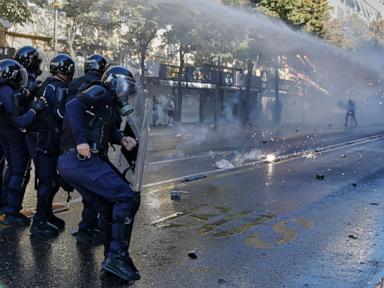
The air across Albania's capital smells permanently of charred rubber, sulfur, and industrial-grade tear gas. For weeks, the asphalt outside the Prime Minister’s Office in Tirana has served as a nightly battleground where civilian frustration meets institutional stubbornness. What began as localized outrage over property rights and questionable public contracts has transformed into a sustained political rebellion. Thousands of citizens, led by an uncompromising younger generation that rejects traditional party lines, refuse to disperse.
Prime Minister Edi Rama remains entrenched inside his offices, calling for dialogue while police lines push back crowds with water cannons and batons. The streets tell a different story. When demonstrators hurl chunks of broken concrete and fireworks at riot shields, they are not just reacting to the immediate economic squeeze or allegations of high-level corruption. They are acting out a profound exhaustion with a political class that has treated the state as private property for over a decade.
The Mechanics of Institutional Decay
To understand why thousands are willing to face chemical irritants night after night, look past the immediate clashes and examine the structural rot. Albania’s economic reality for the average worker is stark. While luxury towers rise along the Adriatic coast and central Tirana, financed by capital inflows and murky development deals, local wages stagnate beneath the weight of relentless inflation.
Public anger crystallized around intersecting scandals involving high-ranking officials and disputed public tenders. When citizens see state institutions consistently protect political insiders rather than investigate systemic graft, faith in the democratic process evaporates. The judiciary, heavily pressured and slow to deliver meaningful accountability, has failed to act as a reliable safety valve for public grievance. Consequently, the street became the only courtroom left open.
The authorities routinely frame the unrest as the work of political extremists or radicalized agitators trying to destabilize the country. This argument fundamentally misunderstands the demographic composition of the crowds. These are not merely loyalists of traditional opposition parties obeying partisan commands. They are university students, working professionals, and urban residents who have watched their futures hollowed out by cronyism. When the government sets out empty chairs or concrete blocks bearing the word "dialogue," protesters answer by smashing them. They view official invitations to talk not as genuine outreach, but as an exhausted regime's attempt to buy time and defuse momentum.
The Cost of Defiance
The state’s response has been heavy-handed, relying on mass detentions and heavy police deployments to reclaim public squares. Hundreds have been detained, and charges mount against activists who refuse to stand down. International observers, including diaspora organizations and human rights monitors, have criticized the disproportionate use of force against demonstrators. Yet, every cloud of tear gas seems to harden resolve rather than scatter it.
A hypothetical scenario illustrates the psychological shift: if a government systematically ignores small peaceful assemblies for months, treating civic petitions as bureaucratic nuisances, citizens eventually conclude that only structural disruption commands attention. This is precisely what happened in Tirana. The movement mutated from orderly daytime marches into persistent evening confrontations because quiet dissent yielded zero institutional results.
The opposition parties, themselves historically tainted by past governance failures, have largely tried to latch onto a movement that originally sought to bypass them entirely. Activists are acutely aware of this dynamic. They keep an arm's length from career politicians who want to weaponize street anger for their own electoral rehabilitation. This independence gives the current wave of unrest its unpredictable, volatile edge. There is no single chairman who can call off the demonstrations in exchange for backroom concessions.
The Point of No Return
As mobilization plans target upcoming national holidays, the standoff shows no sign of cooling down. The government faces an intractable dilemma. Conceding to the core demands—including major cabinet resignations and a complete overhaul of public procurement—would signal weakness and invite further challenges to the ruling party's grip on power. Maintaining the current strategy of attrition risks turning the capital into a permanent zone of civil friction, eroding the country's international standing and scaring off vital foreign investment.
History suggests that when a ruling elite relies entirely on police cordons to maintain social peace, the state ceases to govern and merely occupies its own territory. Tirana is locked in this exact paralysis. The smoke clears each morning only to return each evening, carrying the undeniable scent of an administration running out of time.