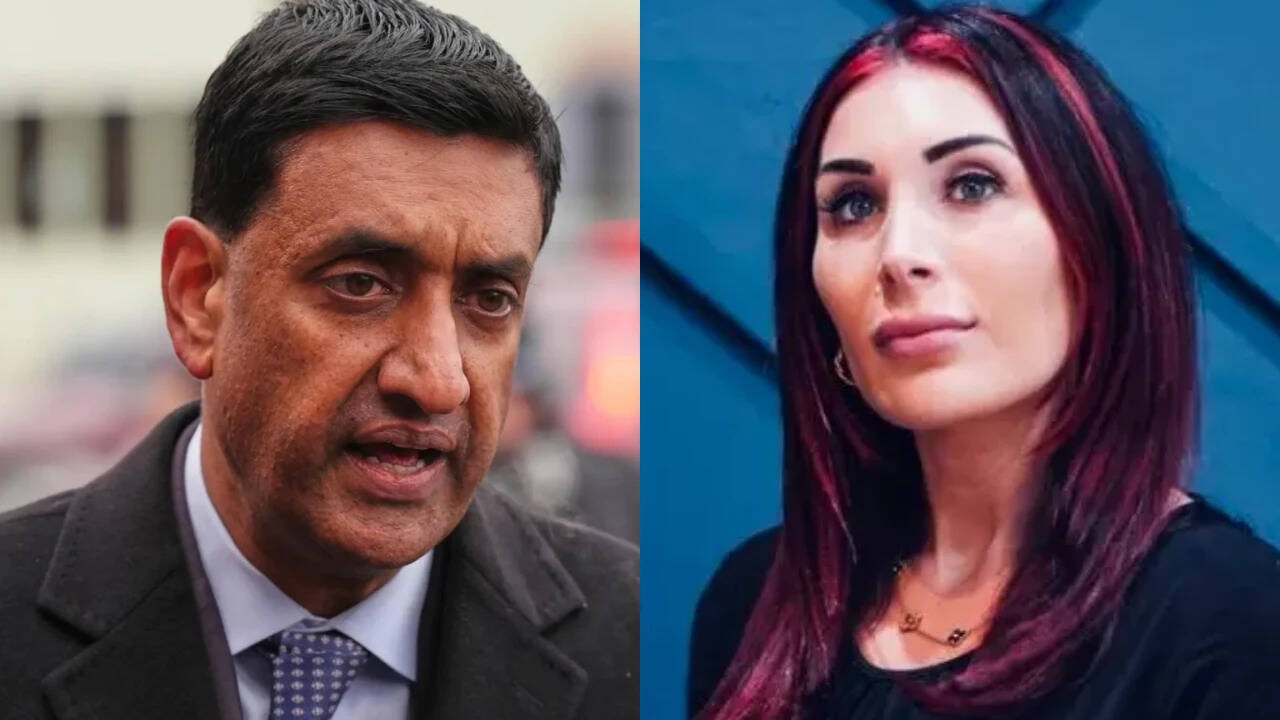
The recent verbal collision between Democratic Representative Ro Khanna and far-right activist Laura Loomer regarding a potential conflict with Iran is more than just another viral flashpoint in a fractured political climate. It represents a fundamental shift in how American identity, religious heritage, and foreign policy are being weaponized for digital engagement. When Loomer questioned Khanna’s stance on Iran by weaponizing his recent "spiritual renewal" trip to India, she wasn't just debating war—she was attempting to redefine what it means to be a "loyal" American politician in an age of hyper-partisan suspicion.
The conflict centers on a perceived contradiction between Khanna’s advocacy for diplomacy with Iran and his public embrace of Hindu spirituality during his 2023 visit to India. Loomer’s logic, if one can call it that, suggests that a person reconnecting with Eastern spiritual traditions should somehow be more hawkish toward Islamic regimes. This isn't just a failure of geopolitical understanding; it is a calculated effort to force non-white American leaders into a narrow box where their faith and their policy must serve a specific, Western-centric agenda.
The Weaponization of the Sacred
Khanna’s trip to India was widely covered as a personal and diplomatic endeavor. He met with government officials, discussed technology transfers, and visited temples. For an Indian-American representative of Silicon Valley, this is standard constituent outreach and personal heritage work. However, in the hands of a professional provocateur like Loomer, this "renewal" becomes a cudgel.
By framing Khanna’s spiritual journey as a liability, Loomer tapped into a growing trend of "identity auditing." This is the practice of scanning a public figure’s cultural or religious background to find perceived inconsistencies with their political voting record. In this case, the audit suggests that if Khanna respects Hindu values, he must inherently oppose a nation like Iran. It ignores the reality that foreign policy is rarely a reflection of private prayer. It is a cold calculation of national interest, regional stability, and the prevention of human suffering.
Silicon Valley Values Meet Global Realities
As the representative for California’s 17th Congressional District, Khanna sits at the intersection of global technology and American labor. His district is the engine room of the world’s digital economy. When he speaks on Iran, he isn't just speaking as a member of the House Armed Services Committee; he is speaking for a region that understands the fragility of global supply chains.
A war with Iran is not a localized event. It is a systemic shock. It would disrupt the flow of oil through the Strait of Hormuz, send energy prices into a vertical climb, and likely trigger retaliatory cyberattacks that could cripple the very infrastructure Khanna’s constituents build and maintain. Loomer’s critique ignores these material stakes in favor of a spiritual purity test. She wants a crusade. Khanna is looking at a spreadsheet of consequences.
The disconnect is profound. On one side, you have a representative trying to manage the complex gears of a 21st-century superpower. On the other, you have a media personality who treats global conflict like a scripted drama where characters must remain "in-character" based on their religious label.
The India Factor in American Politics
The subtext of the Loomer-Khanna spat is the rising influence of the Indian-American diaspora and the way both the left and right are struggling to categorize it. For decades, the "model minority" myth kept this demographic in a quiet, professional corner. That era is over.
We now see Indian-Americans at the highest levels of both parties, from Kamala Harris to Nikki Haley and Vivek Ramaswamy. This visibility has invited a new kind of scrutiny. Loomer’s attack on Khanna is a preview of a future where American politicians of South Asian descent will be forced to answer for the actions of foreign governments or the tenets of their ancestral faiths in ways their white counterparts never are.
Nobody asks a Methodist congressman if his "spiritual renewal" at a retreat in the Ozarks means he should favor a specific policy toward the United Kingdom. But for Khanna, a trip to India is treated as a geopolitical alignment shift. It is a double standard that assumes "Western" is the default and everything else is a potential conflict of interest.
Iran and the Cost of Rhetorical Escalation
To understand why this argument matters, we have to look at the actual state of Iran-U.S. relations. We are currently in a period of extreme volatility. Between proxy conflicts in the Middle East and the slow-motion collapse of nuclear oversight, the margin for error is razor-thin.
In this environment, rhetoric acts as a catalyst. When activists like Loomer frame opposition to war as a spiritual failure or a lack of moral clarity, they push the public conversation toward an all-or-nothing mindset. It removes the nuance required for effective diplomacy. If every attempt to avoid a catastrophic war is labeled as "weakness" or "inconsistency," then the only "strong" path left is escalation.
Khanna’s position—that a war with Iran would be a disaster for American interests—is a mainstream view held by many in the military and intelligence communities. It is grounded in the lessons of the last twenty years of Middle Eastern intervention. Yet, because he has an "other" heritage, that position is treated as suspect.
The Digital Echo Chamber as a War Room
Loomer operates in an economy of outrage. Her goal isn't to change Khanna’s mind or even to influence the House Armed Services Committee. Her goal is to generate content that validates a specific worldview for her followers.
This is the "engagement trap." By responding, Khanna elevates the conversation, giving Loomer the platform she craves. By staying silent, he allows a distorted narrative about his faith and his loyalty to fester. It is a no-win scenario that has become the standard operating procedure for modern political discourse.
The platforms themselves share the blame. Algorithms do not distinguish between a thoughtful debate on foreign policy and a bad-faith attack on someone’s religion. They only see "intensity." The more heated the exchange, the more it is promoted, leading to a public that is highly "informed" about the latest insult but completely ignorant of the actual complexities of the Iranian nuclear program or the nuances of Indian-American relations.
Beyond the Viral Moment
The real story here isn't that two people disagreed on X (formerly Twitter). The story is the erosion of the boundary between private faith and public service. If we accept the premise that a politician’s "spiritual renewal" must dictate their stance on specific foreign wars, we are moving toward a form of sectarian politics that this country was specifically designed to avoid.
Khanna’s "renewal" in India was likely an attempt to find grounding in an increasingly chaotic world. To have that moment of personal reflection turned into a political litmus test is a grim reflection of our current state. It suggests that for some, there is no such thing as a private life or a personal belief—everything is fodder for the perpetual campaign.
The irony is that Khanna’s district—Silicon Valley—created the tools that Loomer uses to attack him. The platforms that were supposed to connect the world have instead provided a megaphone for those who wish to divide it along the oldest lines imaginable: us versus them, believer versus infidel, patriot versus traitor.
The Strategy of Deflection
When confronted with complex policy questions, the easiest path is often a personal attack. It is much harder to argue the merits of the Joint Comprehensive Plan of Action (JCPOA) or the intricacies of the regional balance of power between Riyadh and Tehran than it is to tweet about someone's "spiritual renewal."
Loomer’s tactic is a classic "red herring." It shifts the focus from the horrific costs of a potential war to the perceived character flaws of the person trying to prevent it. It’s a distraction that works because it appeals to our basest instincts—our desire to see a "gotcha" moment.
But for those who will actually have to deal with the fallout of a war—the soldiers, the families in the region, and the global economy—these "gotcha" moments are worse than useless. They are dangerous. They create a political environment where the only "safe" position is the most aggressive one.
Mapping the New Political Battlefield
We are entering an era where the primary qualification for political commentary is the ability to generate heat, not light. The Khanna-Loomer exchange is a perfect case study in this new reality. It features a high-ranking lawmaker trying to maintain a consistent policy position and a professional insurgent trying to blow up that consistency using the explosives of identity politics.
This map isn't just about tweets; it’s about how an idea moves from the fringes of the internet into the national consciousness. It starts with a bad-faith question about "spiritual renewal," gets picked up by partisan news outlets, and eventually forces a sitting congressman to defend his right to visit a temple without it being a statement on Iranian centrifuges.
The False Choice of Modern Loyalty
Ultimately, the demand that Khanna’s Indian heritage or Hindu faith should align him with a specific war-making agenda is a demand for a flattened identity. It says that you cannot be a complex human being with a multifaceted background. You must be a caricature.
If Khanna wants to avoid a war with Iran, he should be judged on the merits of that position. Is it realistic? Does it protect American lives? Does it promote long-term stability? These are the questions an investigative journalist should be asking. To ask instead about his "spiritual renewal" is to admit that you have no interest in the answers to the real questions.
The "hard-hitting" reality of this situation is that we are losing the ability to have a serious conversation about the most serious topics. When the threat of war is treated as a backdrop for a religious purity test, the winners are not the American people or the cause of peace. The winners are the influencers who profit from the noise.
Foreign policy is a game of inches played in the dark. It requires patience, a deep understanding of history, and the ability to see the world through the eyes of your adversary. It is the opposite of a viral tweet. By reducing the Iran debate to a question of Ro Khanna's "renewal," we aren't just insulting a congressman—we are forfeiting our right to a functional democracy.
The next time a public figure's faith is used to justify or condemn a missile strike, look closely at who is doing the talking. Usually, it's someone who has never been in a war room, never studied a map of a contested border, and never had to live with the consequences of their own rhetoric. They aren't looking for the truth; they are looking for the "like" button.
Stop treating these exchanges as debates. They are performances. And in this particular performance, the script is written by people who would rather see the world burn than see their engagement numbers drop. If we want to fix the "Iran war" discourse, we have to start by ignoring the people who think a trip to a temple is a declaration of war.
The burden of proof shouldn't be on Ro Khanna to explain his spiritual life. It should be on those who use faith as a weapon to explain why they are so eager for a conflict that would cost thousands of lives and trillions of dollars, all for the sake of a more coherent social media feed.